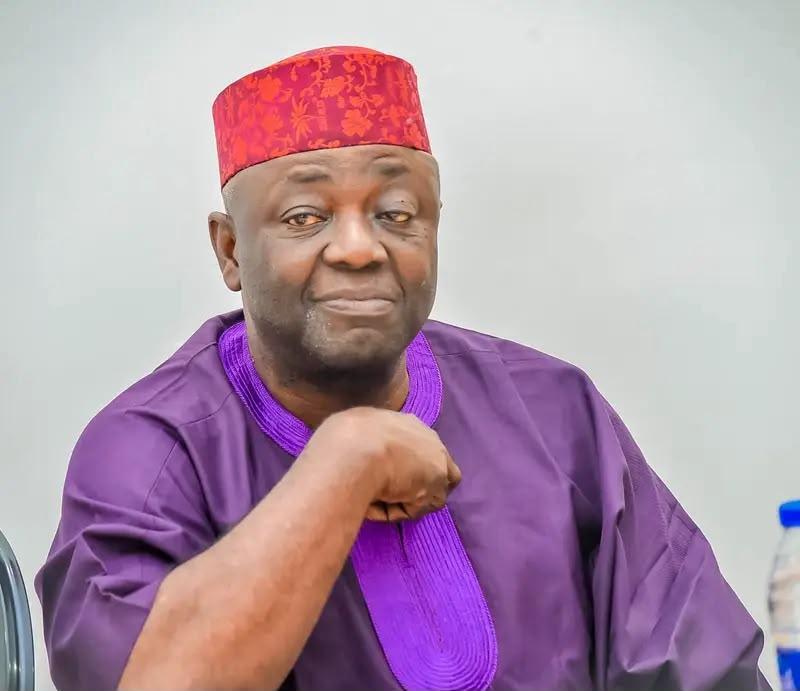
Cross River budgetary allocation to health has risen from less than 5% to over 10% – Ayuk
The Commissioner for Health in Cross River State, Henry Egbe Ayuk, in this interview, reflects on his philosophy of leadership and governance, offering insights into the challenges and opportunities facing Cross River State and the Ministry.
The Commissioner for Health in Cross River State, Henry Egbe Ayuk, in this interview, reflects on his philosophy of leadership and governance, offering insights into the challenges and opportunities facing Cross River State and the Ministry. He discusses issues ranging from infrastructure, housing for healthcare workers and sustainability to politics, medical doctors, nursing students’ development and the future of the People’s Paradise City, while outlining his vision for building more resilient and medically-equipped healthcare institutions, inclusive and nationally competitive. BLESSING ADIMABUA brings the excerpts:
What can you say is the overall achievement of the Ministry of Health in Cross River State in the last three years?
Well, to have a better understanding of what the governor has done expressively is to have an idea of how the system works and how the health sector worked when he came and what it is now so that you will be able to have some understanding of what he has done. Let me start with the physical allocation for the health sector, because without funding you cannot do anything. We came in and met a grossly under-staffed Health sector. Then, the physical allocation, the financial performance even from public allocation for healthcare was far below five percent and less than five percent of the total budgetary allocation was allocated which was far below national target of 15 percent. Today, as I speak to you the allocation has risen to over 10 percent but we are not there yet at 15 percent which is the target nationally.
However, at least, we have moved for more than five decades and you can see it; we are operating at least, 10 percent. Then, the general budget performance of the health sector was less than one to two percent when we came in, but today, it has escalated to 38 percent. If we are able to meet 40 to 50 percent that is sufficient for a state that has nothing because we are still battling for our oil wells. You can see that the allocation suffers even from the Federal, so that is exactly what it is.
Secondly, in terms of human resources, we came in and met an embargo on employment because for over 10 years nobody was being employed into the health system, but His Excellency, the Executive Governor of Cross River State, Bassey Edet Otu has injected into the health system over 2000 different health professionals including Doctors, Nurses, Pharmacists and so on. It didn’t just end there because there is one thing to employ and one thing to retain them. As at the time we came in the disparity level compare it to their counterparts at the Federal level was too much but the governor has gone ahead to adopt the nationally-accepted consolidated salary structure for doctors and he is implementing it 100 percent.
Moreso, as I speak with you today, it is more profitable to stay in the state civil service than at the teaching hospital if we are comparing people at the state level, so that is exactly what he has done.
He didn’t do that for only doctors, he increased it by 15 percent, the allowances and basic salaries of all other Health workers in the state and that is the situation with healthcare workers.
Now, moving beyond that, we have been able to set up a framework, a legal framework for sustainable service delivery and we have started implementing it positively by passing it into law and by setting specific health programmes. The governor has passed it into law by setting specific health programmes so that by the time he leaves office nobody will come and say this is what was done in the previous regime. These are legal tools and policies that are backed up by law and not just statements. So, one of it was that when we came in, there was nothing like Health Management Board, but today we have it by law. We have almost implemented it because there is a law on Hospital Management Board which is currently in existence. We have a law on drug management called Drug Management Agency and that is the only agency that is in tandem with national objectives of healthcare policy. Our state is the only one with that policy and what does that policy do? It is telling you that drugs will be uniformly procured by a central body that regulates the source and use of drugs.
So, the agency will be dealing directly with the national manufacturers that are credited with that purpose. We use them for that purpose to ensure that drugs that are procured are regulated.
Furthermore, in line with that, we have the Anti Quackery Taskforce right now, so that the service delivery in terms of laboratory, in terms of drug usage and in terms of general healthcare services are defined, so that if you are running a clinic or private medical clinic, we are assured that you are licensed to do that job and doing things according to the service of national guideline and international standards and so a lot of people are today being dragged by the government to court for doing one thing or the other against quality healthcare services and so, that is exactly where we are.
We have on board the extension of retirement age of healthcare workers in the state so that instead of the mandatory 60 years or 35 years of service for retirement, it has been extended to 65 years and if you are still interested in working not on contract basis but full time though it is not mandatory because you must be examined and interviewed by the state Civil Service Commission to ensure that you are still strong and your health status is still okay and that is what is happening.
In fact, when we came on board, the health infrastructure of this state was in bad shape and a lot of healthcare centres and hospitals were vandalised by #ENDSARS protesters and apart from that they were decayed. There was nothing remaining, and again the Governor, His Excellency, Bassey Edet Otu has started a gradual process of rebuilding, reconstructing of healthcare system. First, with the primary healthcare because as of today, we have more than 100 Healthcare Centres across the state that has been revitalised and what I mean by that is that we have functional healthcare workers that are in those places.
We have existing infrastructure, we have increased the scope of healthcare service delivery and right now, we have miniature hospitals with full complement of facilities like theatres, labour wards, labour rooms and in addition to every ward in this state. We have 190 wards in the state and each has at least, one midwife, somebody who specialised, trained in skills in ensuring that women deliver safely by minimising mortality and mobility rate and that is what we have been doing.
In these facilities, there is a staff quarter to ensure 24-hour undiluted service delivery.