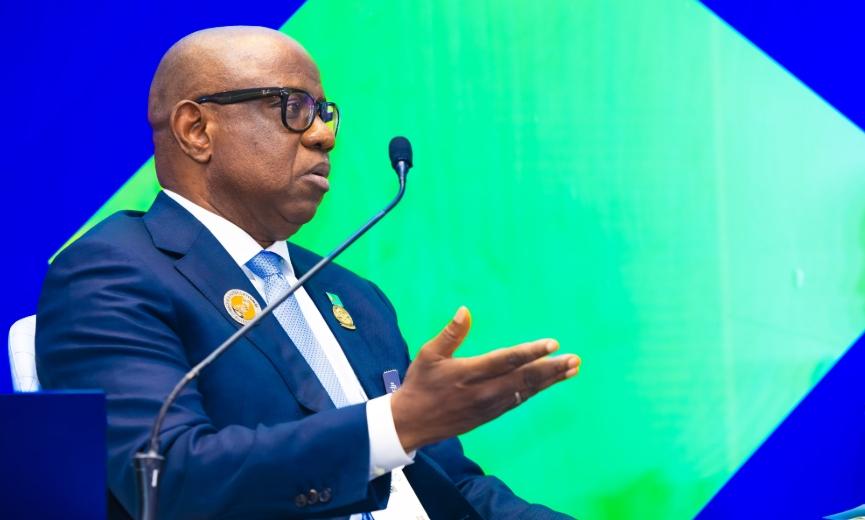
The Nigerian National Petroleum Company Limited (NNPCL) says Nigeria’s crude oil production has increased significantly from historic lows recorded in 2022, citing improved pipeline security and efforts to curb oil theft.
- +Nigeria’s oil output rises to 1.7mbpd as pipeline security improves – NNPC
The Group Chief Executive Officer of NNPC Ltd, Bashir Ojulari, disclosed this on Wednesday at a parliamentary roundtable on pipeline security held at the National Assembly in Abuja.
The Group Chief Executive Officer of NNPC Ltd, Bashir Ojulari, disclosed this on Wednesday at a parliamentary roundtable on pipeline security held at the National Assembly in Abuja.
Mr Ojulari said national crude production increased from about 960,000 barrels per day in 2022 to an average of 1.71 million barrels per day, with a peak of 1.84 million barrels per day in 2025.
He attributed the growth to the implementation of an integrated energy security framework designed to protect oil infrastructure in the Niger Delta.
According to him, the model combines policy coordination, intelligence gathering, security operations, regulatory oversight, industry collaboration and community-based surveillance.
He said the approach has helped address persistent challenges such as oil theft and pipeline vandalism, which had previously constrained production.
“The progress recorded is the result of deliberate and coordinated efforts, not by chance,” he said, noting that improved security has also boosted investor confidence in Nigeria’s oil and gas sector.
In a statement published on its website on Wednesday, the NNPC explained that the roundtable brought together key government officials and industry stakeholders to assess the state of pipeline security and its impact on oil production.
Over the past decade, crude oil production in Nigeria has faced critical challenges including unprecedented oil theft, pipeline vandalism, dilapidated infrastructure, and high production costs.
This often resulted in output falling below 1.5 million barrels per day. Analysts say these issues stem from instability in the Niger Delta, regulatory uncertainty, and limited investment, which often lead companies to declare force majeure.
The NNPC has, on several occasions, stated that oil theft is among the biggest obstacles to the country producing up to 2 million barrels daily. In 2022, the NNPCL said it lost 470,000 bpd of crude oil, valued at about $700 million per month, due to oil theft.
Meanwhile, IOCs operating in Nigeria, such as Shell, have faced immense challenges due to community disputes over environmental damage caused by oil spills. Oil production in the Niger Delta was halted at some point due to a surge in pipeline vandalism.
Oil operators have also lamented that high security costs to protect facilities are contributing to a spike in overall production costs across the sector.
Last week, the Nigerian Upstream Petroleum Regulatory Commission (NUPRC) said Nigeria’s total oil and condensate reserves stood at 37.01 billion barrels as of 1 January 2026, while gas reserves rose to 215.19 trillion cubic feet (TCF).
The commission said oil and condensate reserves recorded a marginal decline of 0.74 per cent compared to the previous year, attributing the drop to 2025 production and updates based on field performance and subsurface technical evaluations.
In contrast, gas reserves increased by 2.21 per cent, largely driven by discoveries and improved reservoir studies.
In his remarks, Senate President Godswill Akpabio, represented by Jimoh Ibrahim, called for stronger collaboration among stakeholders to sustain production growth and address lingering challenges.
Similarly, Speaker of the House of Representatives Tajudeen Abbas, represented by House Leader Julius Ihonvbere, urged participants to review progress made so far and ensure fairness and inclusiveness in policy implementation.
The event was convened by the joint Senate and House of Representatives committees on petroleum resources and was attended by top security officials, including the National Security Adviser, the Minister of Defence, and heads of security agencies.
Presentations were also made by the Chief of Defence Staff, the Inspector General of Police, the Director-General of the State Security Services, the Commandant General of the Nigeria Security and Civil Defence Corps, and private security operators.
NNPC said it would continue to strengthen partnerships and sustain security interventions to support production growth and long-term stability in the sector.