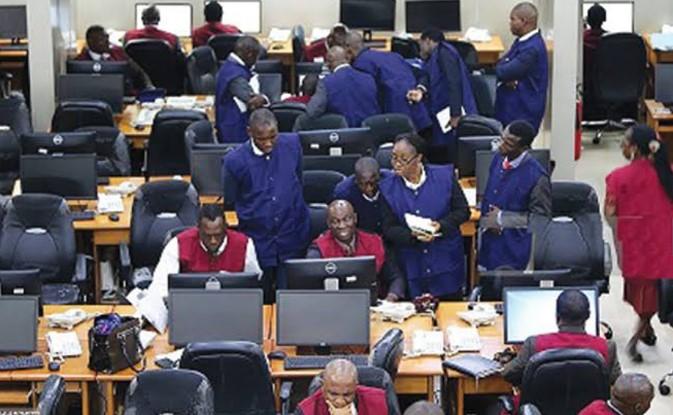
Financial experts have urged the Nigerian Exchange Limited (NGX) and market regulators to raise the minimum free float requirement for listed companies to 50% in a bid to deepen liquidity and improve market efficiency.
- +Experts push for 50% free float rule to boost NGX liquidity
The recommendation was a key focus of discussions on the latest edition of the Market Watch podcast hosted by Frank Fagbo and Oge Obierika, where analysts examined current trends in the Nigerian equities market.
The recommendation was a key focus of discussions on the latest edition of the Market Watch podcast hosted by Frank Fagbo and Oge Obierika, where analysts examined current trends in the Nigerian equities market.
The Nigerian Exchange Limited (NGX) generally requires listed companies to maintain a minimum free float of 20% of their issued share capital held by the public, or a free float market value of N20 billion (Main Board) or N40 billion (Premium Board). For the Growth Board, requirements are lower, typically 10-15%.
According to market analysts Idika Aja and Muktar Mohammed, while increasing the number of trading hours is good, raising the volume of shares available for trading would significantly enhance market depth and boost investor participation.
Idika Aja noted that although NGX’s plan to extend trading hours from 9:30 a.m.–2:30 p.m. to 9:00 a.m.–4:00 p.m. aligns with global standards, it may not significantly improve liquidity on its own.
Muktar Mohammed dismissed concerns that the market is in bubble territory, stating that the current rally is driven by improved fundamentals rather than speculative excesses.
He added that recent price increases reflect a correction from years of undervaluation, rather than unsustainable growth.
The discussion comes as NGX prepares to implement extended trading hours aimed at improving market participation.
The exchange recently announced plans to extend trading hours to 4:00 p.m. from April 27, 2026.
The move also shifts the market opening time earlier to 9:00 a.m. from 9:30 a.m.
The initiative will align Nigeria’s capital market operations with global best practices.
It is expected to provide investors with a longer window to execute trades.
Despite this, analysts believe structural issues such as limited free float continue to constrain liquidity.
The analysts also addressed concerns about whether the Nigerian stock market is currently overvalued.
Aja explained that a true market bubble occurs when stock prices significantly exceed their intrinsic value.
Using valuation metrics such as Price-to-Earnings (PE) and Price-to-Earnings Growth (PEG) ratios, he argued that many Nigerian stocks remain undervalued.
He cited examples of companies with strong growth rates, noting that some stocks still trade below their fair value when future earnings are considered.
The oil and gas sector, particularly upstream companies, was highlighted as showing strong fundamentals and sustained growth potential.
Both analysts projected that the market may enter a phase of correction, with investors taking profits and reallocating funds to fixed-income instruments before re-entering equities.
Recent reforms by NGX are part of broader efforts to strengthen Nigeria’s capital market.
The extension of trading hours is expected to improve accessibility and participation.