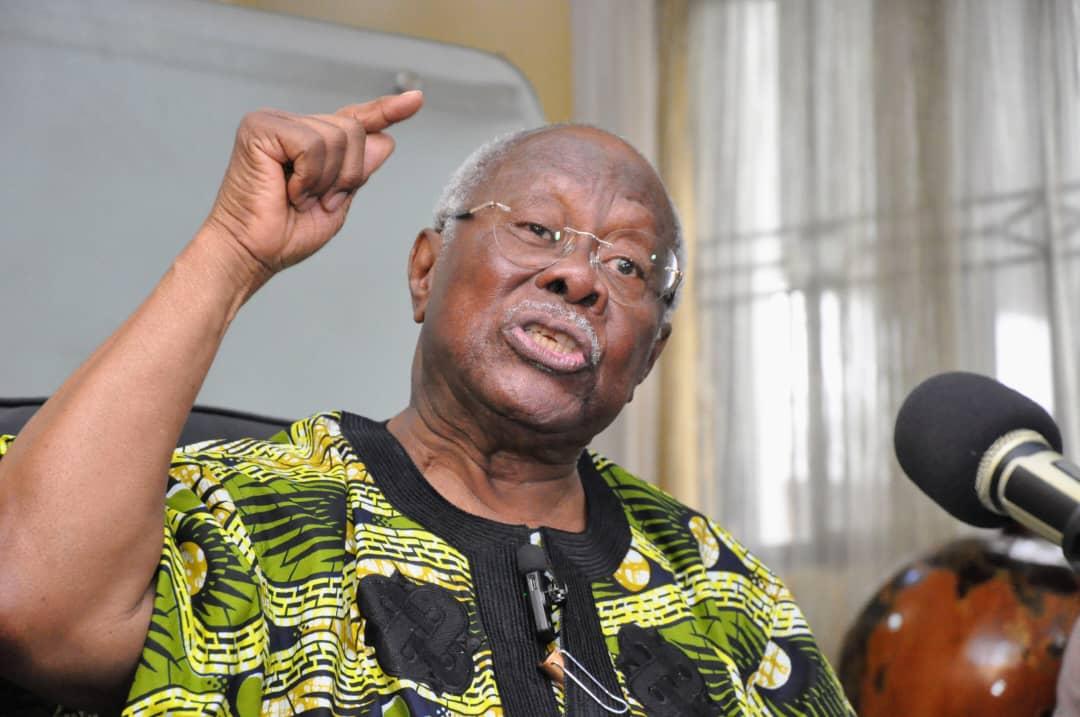
Bode George warns Tinubu on Nigeria’s ‘strained’ democracy, rising political tensions
A chieftain of the People’s Democratic Party (PDP), Olabode George, has raised the alarm over what he described as mounting pressure on Nigeria’s democratic system, warning that the country’s stability and unity are under visible strain.
A chieftain of the People’s Democratic Party (PDP), Olabode George, has raised the alarm over what he described as mounting pressure on Nigeria’s democratic system, warning that the country’s stability and unity are under visible strain.
In an open letter addressed to President Bola Ahmed Tinubu, George cautioned against what he called the erosion of democratic balance and the suppression of opposition voices, describing the trend as “troubling and dangerous.”
“This is not a routine correspondence; it is a deeply held conviction from my heart,” George wrote. “Nigeria’s stability, unity, and democratic future are now under visible strain.”
The elder statesman said developments within the political space suggest a drift toward unchecked dominance, warning that weakening dissent could destabilise the country.
“Democracy cannot survive where opposition is weakened, ridiculed, or systematically neutralised. A country governed without credible dissent is not stable—it is volatile,” he stated.
George further warned that attempts to consolidate power without restraint could backfire, noting that history is replete with leaders who equated control with strength and ignored critical voices until it was too late.
“The assumption that power can be consolidated without consequence is a grave miscalculation,” he said.
He argued that political patronage and financial influence cannot replace justice and fairness, stressing that trust remains the cornerstone of sustainable leadership.
“What sustains leadership is trust, and trust is built on fairness, equity, transparency and justice. Today, that trust is under pressure,” he added.
The PDP stalwart linked Nigeria’s current economic challenges with rising political tensions, warning that the combination could prove combustible if not carefully managed.
“A nation under economic strain cannot afford political provocation. This is how instability begins—not suddenly, but gradually,” he said.
George urged the president to reassess the current trajectory of governance, calling for strengthened democratic institutions and greater openness to dissenting views.
“You stand at a decisive crossroad. You can choose to correct course, or allow the current trajectory to continue one that risks deepening division,” he warned.
He also cautioned against reliance on advisers who downplay concerns or encourage aggressive political consolidation, describing such counsel as dangerous to both leadership and national stability.
“Those who tell you that all is well are not safeguarding your leadership; they are endangering it,” George stated.
On the judiciary, he stressed the importance of preserving institutional integrity, particularly as the country approaches critical decisions from the Supreme Court of Nigeria.
“Every action taken by leadership must reinforce, not weaken the integrity of our institutions,” he said.
George further warned that Nigeria risks losing its standing as a leading African nation if internal tensions persist unchecked.
“Nations do not collapse overnight; they unravel through a series of ignored warnings,” he added.
He concluded with a call for electoral transparency, urging the Independent National Electoral Commission to remain impartial in all processes.
“There must be no manipulation whatsoever. The will of the Nigerian people must be respected and allowed to prevail freely, transparently, and without interference,” he said.
The open letter adds to growing concerns among political stakeholders over governance, economic hardship, and the state of democratic institutions ahead of future electoral cycles.