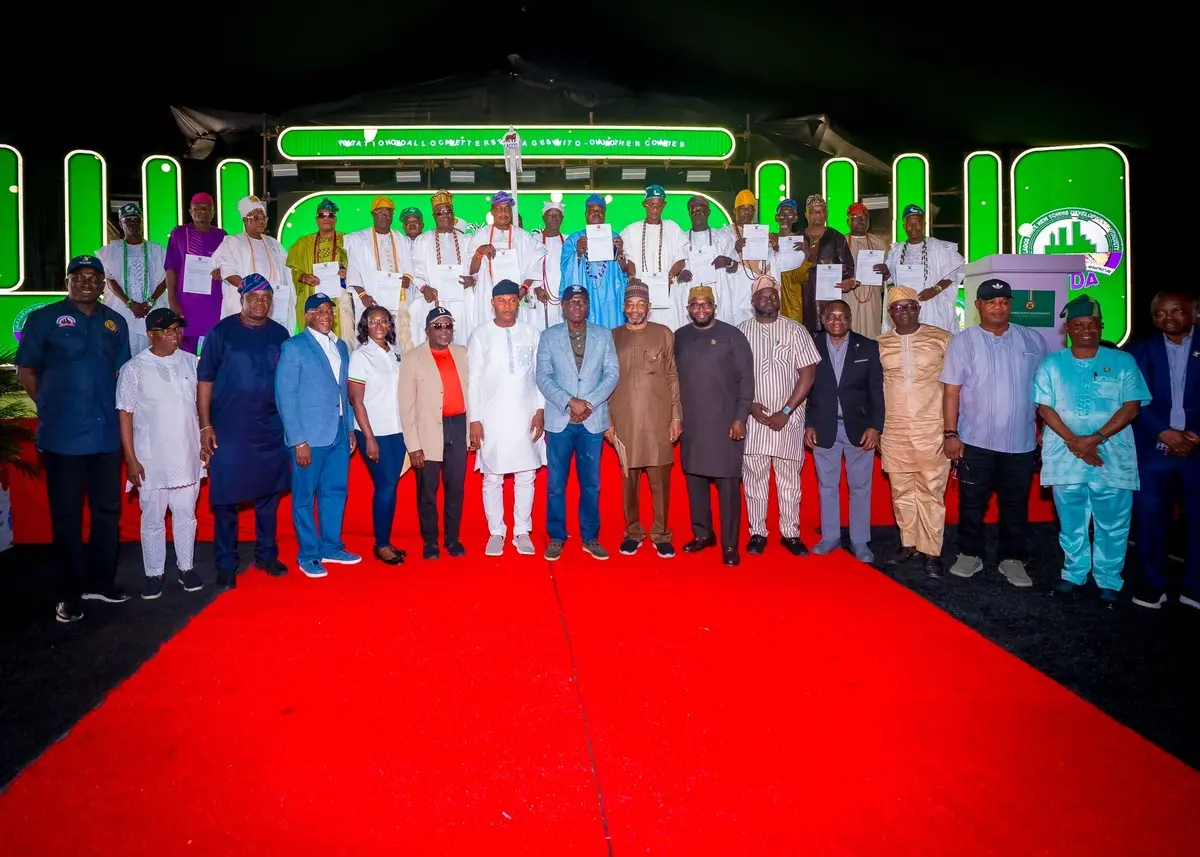
The Lagos State Government has formalised community land allocations across Sangotedo and Ibeju-Lekki as part of plans to develop a 16,300-hectare master-planned urban community.
- +Lagos redraws Lekki land map, 98 villages get allocation letters
According to a statement issued by the Governor’s Special Adviser on Media and Publicity, Gboyega Akosile, Governor Babajide Sanwo-Olu presented land allocation letters to leaders of 98 beneficiary villages during a ceremony at the Ito Omu Link Bridge in Sangotedo on Wednesday.
According to a statement issued by the Governor’s Special Adviser on Media and Publicity, Gboyega Akosile, Governor Babajide Sanwo-Olu presented land allocation letters to leaders of 98 beneficiary villages during a ceremony at the Ito Omu Link Bridge in Sangotedo on Wednesday.
The allocation letters formally recognise the beneficiary communities within the proposed development area and mark the commencement of the state’s implementation of the master-planned project, which is expected to support housing delivery, infrastructure development and long-term urban growth.
Sanwo-Olu said the state government is committed to ensuring that the growth of Ito Omu and neighbouring communities is driven by deliberate planning rather than unplanned urban expansion.
According to the statement, the allocation letters followed the state’s acquisition of 16,300 hectares of land through the Lagos State New Towns Development Authority (NTDA) to develop and maintain a master-planned urban community that will support housing needs and other developmental activities.
Sanwo-Olu added that the project aligns with the state’s THEMES+ Agenda and is designed to deliver stronger land tenure, improved infrastructure, new economic opportunities and better living conditions while preserving the heritage and identity of the host communities.
Sanwo-Olu said the presentation of the allocation letters marks the beginning of project implementation, with the state planning to improve road access, drainage systems and social infrastructure across the beneficiary communities.
He said the proposed Ito Omu Waterfront Jetty will improve connectivity and ease movement within the area.
Speaking on behalf of the beneficiary communities, the Onibeju of Ibeju-Lekki, Oba Razak Olasunkanmi, urged the government to ensure the master plan incorporates both residential and commercial districts to strengthen connectivity among the communities.
The traditional ruler also called for the establishment of a technical college in the area to equip young people with vocational skills.
Urban Planner and Co-Founder/Director of Goania Project Ltd, Tpl. Niyi Aderohunmu, who spoke to Nairametrics, described the issuance of the land allocation letters as one of the first practical steps towards implementing a master-planned new town rather than a routine administrative exercise.
According to him, the letters formally recognise the interests of host communities within the development framework by converting customary land claims into documented allocations.
He said the process also serves as a benefit-sharing mechanism by defining what host communities receive following government land acquisition, helping to reduce the risk of future land disputes, litigation and project delays.
He added that resolving community land interests before construction begins gives planners a stronger basis for designing roads, drainage systems, schools, healthcare facilities, utility corridors and other public infrastructure while discouraging informal settlements that conflict with the approved master plan.
Aderohunmu added that clearly defined land interests and stronger community integration also improve investor confidence by reducing uncertainty over land ownership and governance while making the project more attractive for long-term infrastructure financing.
Nairametrics previously reported that urban planning and environmental experts attributed recurring flooding across parts of Lagos not only to heavy rainfall but also to decades of unplanned urban expansion, weak development control and the loss of wetlands, particularly along the rapidly developing Lekki corridor.
The state’s master-planned development is expected to provide a coordinated framework for residential, commercial and industrial growth while integrating transport infrastructure, host communities and land-use planning to support the Lekki-Ibeju corridor’s long-term development.