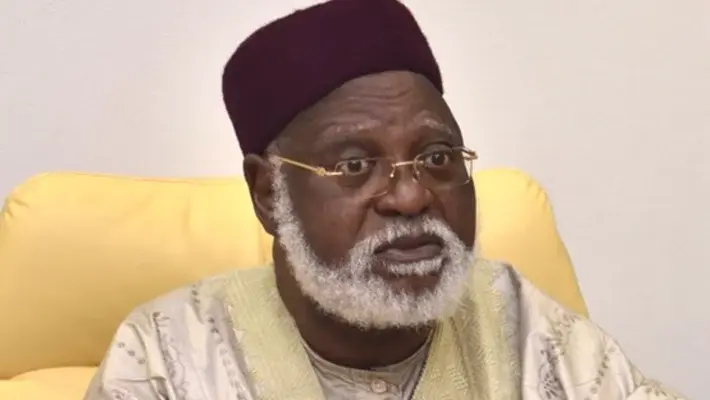
Tofa told me same politicians collected money from him, Abiola for mobilisation — Abdulsalami.
- +“Some of those they thought were for Abiola were actually with the government.”
Former Head of State, Gen. Abdulsalami Abubakar (retd.), has revealed that some politicians who publicly championed the cause of Chief MKO Abiola during the June 12 crisis were secretly working with the government, while others collected money from both Abiola’s camp and his opponent, the late Bashir Tofa, during the 1993 presidential election.
Former Head of State, Gen.
The disclosures are contained in Chapter 16 of Abdulsalami’s 264-page autobiography titled ‘Call of Duty,’ obtained by our correspondent at its public presentation at the Aso Rock Villa, Abuja.
In the chapter which contains Abdulsalami’s assessment of Nigeria’s political class, the former Head of State described Nigerian politicians, irrespective of party affiliation, as “a tribe on their own” who publicly inflame ethnic and religious divisions while privately meeting to wine and dine together.
His revelations involved those of Tofa, the candidate of the National Republican Convention who contested against Abiola in the June 12, 1993, presidential election, which Abubakar said the late politician shared with him personally.
He wrote, “The late Alhaji Bashir Tofa told me a story to illustrate this. He said some politicians had visited him requesting for some money for the mobilisation of supporters.
“They assured him that they would deliver the votes in their respective wards to him. He gave them what they demanded. Tofa later visited the state chairman of Abiola’s party, the SDP, and was dumbfounded to see the same set of people there.
“He eventually lost Kano and even his own ward to Abiola. Such is the way of politicians.”
Abdulsalami also recounted a personal experience from the 1980s, when he was Chief Instructor at the Nigerian Defence Academy and witnessed first-hand the duplicity of politicians embroiled in the crisis that tore apart the Peoples Redemption Party.
He wrote that when the PRP split into factions loyal to Mallam Aminu Kano and Alhaji Abubakar Rimi, respectively, a crisis that led to the impeachment of Governor Balarabe Musa of Kaduna State in 1981, he visited a friend’s guest house only to find politicians from both warring camps chatting, laughing and dining together.
“I was shocked. These were politicians who, in public, were pretending not to have any point of connection, and the masses were fighting each other because of them. Here, they were hobnobbing, away from public view,” he wrote.
He stated the encounter hardened his view of Nigeria’s political class.
According to him, later that same day, he watched a politician from the Aminu Kano faction pour invectives on Rimi on national television, only to recognise him as one of the men he had seen hours earlier at the gathering.
Abdulsalami wrote, “A politician who was very active in the First Republic told me that regardless of the parties, most politicians of the North belonged to back then, they all used to visit the Premier, Sir Ahmadu Bello.
“Occasionally, they would meet, eat and drink and the Premier would give them some token while charging them to work for the welfare of their people.
“But this camaraderie did not stop them from going on radio, television or the newspapers to hurl insults and abuses at one another.”
Abdulsalami, who said he applied the lessons directly to the June 12 impasse, revealed that the duplicity was not incidental but systematic.
He wrote, “I saw a similar drama during the June 12 crisis. Ordinary Nigerians did not know what was going on behind the scenes.
“Some of those they thought were for Abiola were actually with the government.”
On the annulment of the June 12 elections, Abdulsalami said he was serving as Chief of Policy and Plans at Army Headquarters when General Ibrahim Babangida halted the transition programme.
He disclosed that while he was personally close to Babangida from their childhood days, he held no position in the transition structure and was not a member of the Armed Forces Ruling Council.
“I was not even a member of the transition programme, Council (AFRC), the highest ruling body in the Armed Forces.
“I was close to General Babangida from our childhood days because I was in the know of everything going on in his government,” he stated.
He said he could have privately asked Babangida why the election was annulled but was “not obligated to explain anything” to him as he was not a key actor in the political drama.
According to him, “I believe Nigerians must no longer allow politicians to fool them and cause division along ethnic and religious lines.
“Nigerians must know that even when politicians disagree among themselves in the open, they still meet somewhere to wine and dine.
“The truth, irrespective of the divisiveness which the politicians promote today, is that they are together.”
“From my experience of the Nigerian political environment, my conclusion has always been that it is the people, the masses, who really do not understand that they are only pawns in the hands of politicians,” he added.