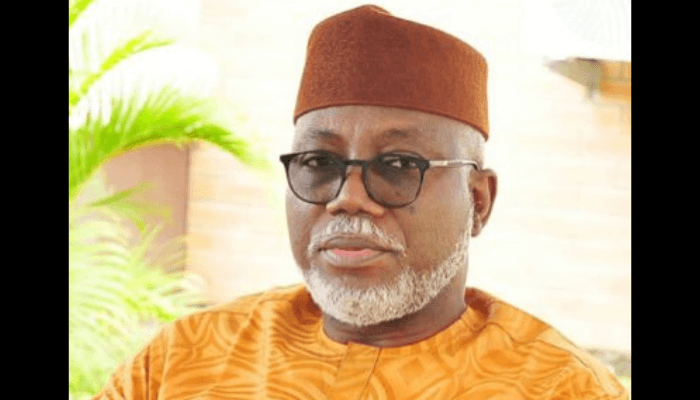
Use federal allocations to deliver more tangible developmental projects in Ondo, Mimiko challenges Aiyedatiwa
Ondo State Governor, Lucky Aiyedatiwa has been called upon to use the increased federal allocations accruing to states since the removal of fuel subsidy to deliver more tangible developmental projects for the people of the state.
Ondo State Governor, Lucky Aiyedatiwa has been called upon to use the increased federal allocations accruing to states since the removal of fuel subsidy to deliver more tangible developmental projects for the people of the state.
Abbas Mimiko, the governorship candidate of the Zenith Labour Party (ZLP) in the November 16, 2024 Ondo State election, who made the call on Sunday while speaking with journalists said Ondo must translate the rising federal revenue into visible progress in healthcare, education and social services.
According to him, the current administration had the benefit of significantly improved revenues, but the state was yet to replicate the developmental strides recorded under the Olusegun Mimiko administration.
Mimiko; “States that were receiving less than N10 billion monthly are now getting close to N40 billion in some cases. With that kind of revenue increase, citizens should be seeing measurable improvement in their lives. Ondo has not yet matched the trajectory we witnessed under the Mimiko years, especially in health, education and social intervention programmes.”
He, however, commended Aiyedatiwa’s push for the proposed seaport and bitumen development initiatives, describing them as bold long-term projects that should be given time to mature. “It is too early to completely judge this administration, but certainly things could have been done much better,” he noted.
Besides, Mimiko threw his weight behind President Bola Ahmed Tinubu’s economic reforms, insisting that the President should not be blamed for the current hardship in the country because he inherited a near-collapsed economy. He likened Tinubu’s emergence to the final leg of a relay race where earlier runners had already lost the contest, saying the President stepped into office at a time when Nigeria was already on the brink.
“The first thing Nigerians must interrogate is the state of the nation before President Tinubu took over. He inherited an economy that had virtually collapsed. We were using over 95 per cent of our earnings just to service debt. If a man digs you out of a 5,000-metre hole and gets you to where you can see sunlight again, the honest question is not whether life is immediately perfect, but whether you would even still be standing without that intervention,” he said.
He described Tinubu’s decision to remove fuel subsidy as the kind of courageous leadership previous administrations lacked, noting that no president since 1999 had taken such a politically risky decision. According to him, “President Tinubu chose to do the painful but necessary thing. All those who came before him knew subsidy was unsustainable, but lacked the courage to remove it. It was a do-or-die situation for the economy.”
The psychiatrist and politician argued that while fuel price increases had worsened hardship, Nigerians should direct greater scrutiny toward governors over how they were utilising the expanded federal allocations.
“The percentage increase in what states now receive is multiple times the percentage increase in fuel prices. Nigerians should be asking their governors what they are doing with these resources. Why are these monies not visibly improving the lives of ordinary citizens?” he queried.
On Tinubu’s foreign exchange reforms, Abbas Mimiko said the unification of exchange rates had restored confidence in the economy and blocked opportunities for round-tripping and profiteering by privileged interests. He maintained that the President’s reforms had begun laying a stronger fiscal foundation for long-term recovery.
Responding to criticisms that Tinubu was responsible for the weakening of opposition parties, he dismissed such claims as unfounded, arguing that defections into the ruling All Progressives Congress were driven by political calculations rather than coercion.
“Is it the President’s fault that governors are decamping because they like what he is doing? Which governor can be threatened? Governors have immunity. There is no credible evidence that he is stifling opposition,” he said.
Mimiko also defended Tinubu’s democratic credentials, recalling the President’s role in helping opposition figures reclaim what he described as stolen mandates during the legal battles that produced governors in Ondo, Ekiti, Osun and Edo States. He particularly credited Tinubu for supporting his brother’s struggle to reclaim the Ondo governorship mandate.
“President Tinubu was one of those who stood firmly to ensure democracy survived at that time. He led from the front. Without people like him, some of those mandates may never have been recovered. People conveniently forget his sacrifices for democracy because he is now President,” he stated.
Despite his support for Tinubu, Abbas Mimiko reiterated his loyalty to the Zenith Labour Party, insisting that political parties were merely vehicles for service. “I remain a bonafide member of ZLP and I will remain there. But party affiliation should never stop anyone from supporting what is right. I supported Tinubu before he became President, I support him now, and based on what I have seen, I will support him again.”
On the power sector, he admitted that more progress was needed, describing Nigeria’s electricity challenges as a longstanding structural crisis. He expressed cautious optimism over recent appointments in the sector but stressed that power remained critical to national development.