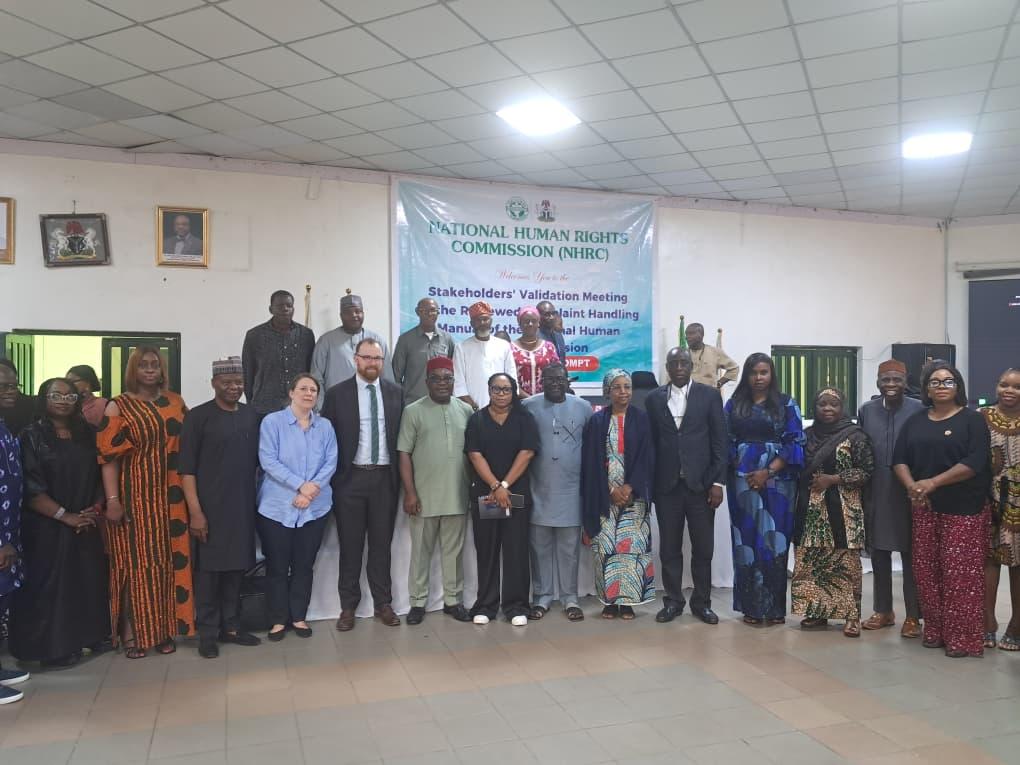
The National Human Rights Commission (NHRC) said on Friday that it recorded 659,617 complaints from January to March.
- +NHRC receives 659,617 complaints in first quarter of 2026
The tally represents a sharp decline by about 50 percent from the cumulative 1,171,634 human rights complaints received by the commission in the last quarter of 2025.
The tally represents a sharp decline by about 50 percent from the cumulative 1,171,634 human rights complaints received by the commission in the last quarter of 2025.
PREMIUM TIMES observed that in November 2025 alone, the complaints received were more than half of what it recorded in the first quarter of 2026.
There is no immediate explanation for the steep decline in the number of human rights abuses reported to the commission in the last three months, but the tallies fit with the fluctuating patterns of the records across months.
Friday was the first time the NHRC would release a quarterly report of the complaints. The report have always been a monthly trend since inception in 2024.
The consolidated quarterly report released on Friday identified law enforcement and human dignity as the most prevalent complaint categories, with over 130,000 reports.
Giving a month-by-month breakdown of the complaints at the NHRC headquarters in Abuja, the Senior Human Rights Adviser of the commission, Hilary Ogbonna, said 180,341 complaints were recorded in January, 223,144 in February, and 256,132 in March.
Shedding light on the figures, the Executive Secretary of the NHRC, Tony Ojukwu, said, “The first quarter of 2026 reflects a complex and evolving human rights environment, shaped by insecurity, socio-economic pressures, and institutional challenges.”
While the cumulative summary of the report ranked law enforcement and human dignity as the highest, Mr Ojukwu reflected on the most common issues in each of the three months under review.
He noted that the freedom of discrimination emerged as a common complaint in January.
“This underscores persistent structural inequalities and highlights the need for stronger safeguards against discriminatory practices in both public and private spheres,” he said.
He noted that law enforcement and the protection of human dignity ranked highest in February, signifying “the need for accountability, professionalism, and human rights compliance within law enforcement institutions.”
According to the report, March recorded frequent complaints about freedom from discrimination breaches, a trend Mr Ojukwu described as concerning.
The geopolitical breakdown of the complaints indicated the North-central region led the quarterly chart with 276,099 complaints, followed by the North-east with 123,939, the North-west with 126,313, the South-east with 82,839, the South-south with 25,370, and the South-west with 25,057.
Among the grave violations, the commission said it recorded 1,647 cases of child abandonment.
It added it recorded 1,303 cases of children caught between custody battles, 1,111 child labour cases and 1,074 cases of children forced into marriage.
While presenting the report, Mr Ogbonna highlighted several cases of defilement, especially in Niger State.
For instance, the commission presented eight cases of child defilement, among which a 19-year-old was said to have sexually assaulted a 12-year-old with his fingers. He also referenced another case of a 19-year-old allegedly raping two girls aged four and five. According to the commission, there was also another case of a 59-year-old raping a 10-year-old.
This disturbing trend reflects the vulnerability of children in Nigeria despite the existence of the Child Rights Act. In October 2025, the Nigerian Senate passed amendments to the Criminal Code Act, prescribing life imprisonment for anyone convicted of defiling a minor, and removed the option of fines.
Yet the delays in judicial processes stall justice for the young victims. In August, PREMIUM TIMES reported how a pastor, Amos Isah, in Abuja, returned to the pulpit after allegedly defiling a 14-year-old. The case has since stalled.
In the three months under focus, the NHRC recorded 992 killings and 651 kidnappings. The commission said bandits are the perpetrators responsible for 525 deaths, followed by Lakurawa blamed for 162, Boko Haram, 113; unknown gunmen, 74, and “others”, 118.
The commission presented the top 10 states. It noted that 170 deaths occurred in Kwara, 91 in Niger, 89 in both Benue and Borno, 86 in Plateau, 81 in Zamfara, and 62 in Kebbi.
Others include 59 deaths in Katsina State, 42 in Kogi State, and 30 in Adamawa State.
“The continued prevalence of insecurity-related killings and abductions all point to the urgency of translating policy commitments into concrete action,” the report stated.
Some of these killings are linked to incidents of insurgency, which have led to displacements and impacted economic livelihood. Mr Ojukwu cited the recent Palm Sunday attack in Jos, Plateau State, and reported incidents in Nasarawa State as examples.
On 29 March, gunmen attacked Angwan Rukuba, killing several residents. This attack triggered violence, which led to a 48-hour curfew hampering economic activities in the state.
The attack also led to the loss of two students at the University of Jos. The tragic deaths and unrest indirectly represent an attack on education.
Mr Ojukwu emphasised that the first quarter report is not merely a presentation of data but a “clear call to action.”
He urged for more responsive governance and renewed national commitment to the protection of human dignity.
“We must work to build a Nigeria where human rights are not only guaranteed in law, but realised in the daily lives of all people,” Mr Ojukwu said.