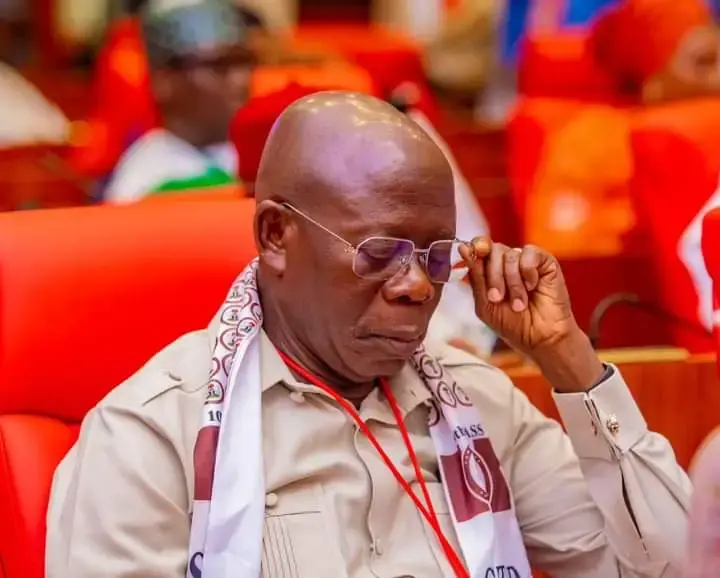
The Senator representing Edo North, Adams Oshiomhole, on Friday said the rising insecurity in the country was not due to a lack of “political will” from President Bola Tinubu.
- +Insecurity not due to weak leadership, Tinubu has political will — Oshiomhole
He argued that the President had instead provided the necessary resources and leadership to address security challenges across the country.
He argued that the President had instead provided the necessary resources and leadership to address security challenges across the country.
Oshiomhole made the remarks in Abuja at the public presentation of a book authored by the Nigeria Security and Civil Defence Corps (NSCDC) Federal Capital Territory Commandant, Olusola Odumosu.
He dismissed claims that the executive arm of government had failed to prioritise security, pointing to financial commitments and administrative decisions as evidence of political resolve.
“What is the difficult thing in political will? The commander-in-chief give the order: Go and ensure that the country is safe. As President Bola Tinubu has done repeatedly.
“I am putting my mouth where I am putting resources and he has prepared more money even supplementary budget at the National Assembly, approved. What more political will do you need?”
He further noted that the President declared a state of emergency and replaced former service chiefs as part of efforts to strengthen national security.
According to Oshiomhole, the President has political will “in abundance”.
He said, “The Commander-in-Chief decided to declare State of Emergency and even told the armed forces no more excuse. He even replaced the former security chiefs with these ones. To sack chiefs in a village you know the challenges not to talk of sacking security chiefs. There is no question that there is no political will.
“So I think all of us as a people, particularly those who are in politics, whether they are in the opposition, we need to understand that when it comes to security, there is one Nigeria. There is no APC, no PDP, or whatever.
“I’m not aware that anybody has been queried for apprehending a dangerous criminal. So what is political will, the President has it in abundance.”
Oshiomhole, however, raised concerns about the implementation of security directives, questioning whether instructions from leadership are effectively carried out at operational levels.
“But between the commander and the other guy in the battlefield, I think it’s where we probably can benefit from relations, how the system goes, because the system works on a command basis.
“On that one, I have not read the book and I don’t know if you addressed it, because as a commander of a FCT when you give out these instructions, go and do X, Y, Z on the field, and this is to be carried out by other ranks, do you always find out these people in the other ranks share your concerns and are willing and have the equipment, the morale, the allowances required to do what you have commanded?”
The senator also suggested a review of the name of the Nigeria Security and Civil Defence Corps, arguing that the term “civil” appears inconsistent with its armed operational role.
“And lastly, I think, from what I can see now, we might need to review the name of the Nigerian Civil Defence. Because the concept of ‘civil’ means do not bear firearms.
“So if you bear firearms to deal with very deadly criminals who are doing illegal oil pumping or destroying public property, which you are tasked to protect, can you preach while they carry weapons?
“So if the criminals you have to fight have sophisticated weapons, you who is fighting them, your weapon should not be less sophisticated. If you are civil, how do you deal with hardened criminals?”
He added that coordination among security agencies remains critical to effective national response.
“When I see service chiefs holding meetings and I don’t see the CG of NSCDC, I am like something is missing.”
The author of the book, Commandant Olusola Odumosu, also called for stronger collaboration among security agencies, saying his work advocates a “united front” in tackling insecurity.
Odumosu identified “unhealthy inter-security agency rivalry” as a major obstacle to effective national security.
He said, “I am looking at security from a very holistic perspective and then looking at all the intricate webs of insecurity and challenges that we have, there is need for a united front between security agencies because the challenges are beyond what one agency or individual can do.
“No one has a monopoly of wisdom or knowledge or strategy. So there is need for us to come together and wage war against criminality, against insecurity, against banditry, against kidnapping with a common front and that is what I’m trying to preach.
“Of course we have been having issues around unhealthy inter-security agency rivalry which of course has been a bane to national responses to our security challenges. So I’m looking at it from that perspective, where all the security agencies can understand that we must have the same focus, the same goal and that whether your mandate is intertwined or interwoven we have a collective responsibility to ensure peace and order in Nigeria.”
Amid rising insecurity across the country, critics have continued to attribute the persistence of banditry, kidnapping, terrorism and oil theft to a perceived lack of political will to decisively confront the challenges. Oshiomhole, however, disagreed with such arguments.