Utomi calls for ‘entrepreneurial people’s capitalism’ to replace current Ponzi scheme economics
Economist and former presidential candidate, Pat Utomi has described Nigeria’s current economic management as a “Ponzi scheme” and urged opposition parties to unite to rescue the country from what he termed a “moral crisis” of poverty, profligate spending, and state capture.
Economist and former presidential candidate, Pat Utomi has described Nigeria’s current economic management as a “Ponzi scheme” and urged opposition parties to unite to rescue the country from what he termed a “moral crisis” of poverty, profligate spending, and state capture.
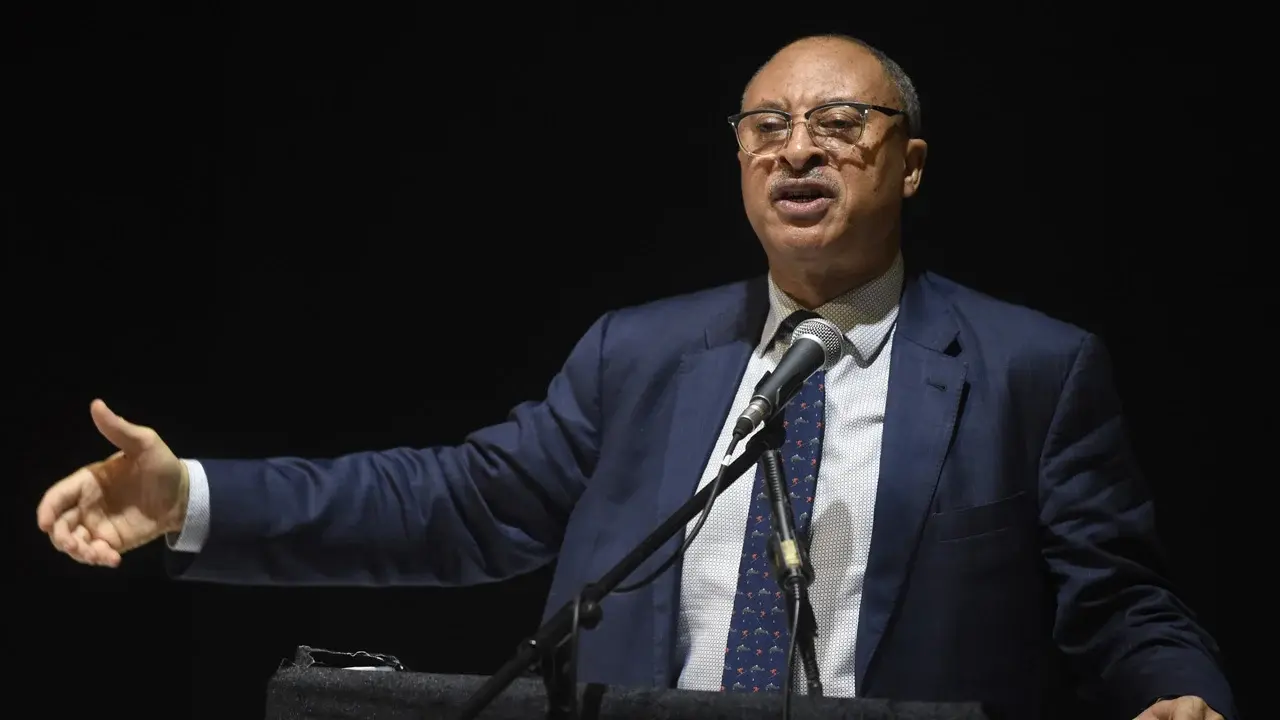
Speaking at an opposition summit in Ibadan, Utomi said the pain of ordinary Nigerians had become a “moral outrage,” citing a Piggyvest Savings Report which found that 58percent of Nigerians earn less than N100,000 per month.
“Yesterday (Saturday), as I pulled into a petrol station in Lagos to fill my tank for the journey to Ibadan, two and a half times the salaries of my compatriots had gone into that tank,” Utomi told the audience.
“Just then, a siren-blaring motorcade went by. It was at least a seven-car convoy. I could not help but imagine the monthly income of 20 people.”
He warned that those who remain neutral in the face of such a crisis risk “the hottest part of hell,” quoting Dante’s Inferno.
Utomi, a former presidential candidate and respected governance expert, titled his address: ‘From Ponzi Scheme Economics to Liberation Economics – The Imperative of Opposition Rescue of Nigeria.’
He criticised what he called Tinubunomics and dismissed official calls for patience as a hope that may arrive “when we may be dead.”
He also compared Nigeria’s current economic performance unfavourably with that of the immediate post-independence era, noting that manufacturing had grown from nearly zero per cent of GDP in 1956 to 20percent by 1960 under regional industrialisation drives.
“Today, those in charge ask us to trust them, saying that after three years of suffering, the result is something we should hope for,” Utomi said. “Looks like we may be dead when hope shows up on the horizon.”
The economist reserved sharp criticism for what he described as profligate government spending – including purchases of presidential jets, a yacht, and luxury cars – while nearly 130 million Nigerians live in multidimensional poverty, according to World Bank statistics.
He called on opposition parties to adopt a “character checklist” for candidates and to embrace an “entrepreneurial people’s capitalism” centred on production clusters, innovation hubs, and large-scale job creation.
“Our relevance as political parties depends not only on socialising our members… but also on training aspirants to understand the economics of sustained growth and progress,” Utomi said.
The summit, hosted in Ibadan, brought together leaders from several opposition parties. Utomi ended with a note of cautious optimism: “I am persuaded that with such thinking the people will come with us, and that with faithful implementation, they will stay with us and Nigeria will rise again.”