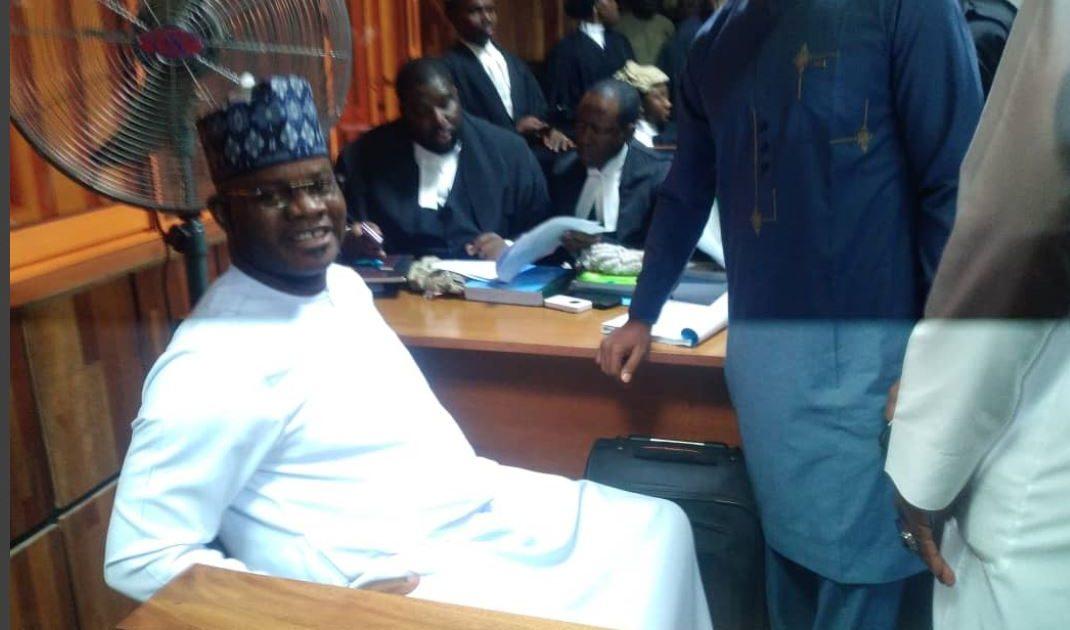
The Federal High Court in Abuja on Thursday adjourned till April 24, 2026, for ruling on an application by the Economic and Financial Crimes Commission seeking to re-present a document to one of its witnesses in the ongoing trial of former Kogi State Governor, Yahaya Bello.
- +Court to decide on Yahaya Bello’s trial evidence Friday
Justice Emeka Nwite fixed the date after counsel argued over whether the prosecution could confront its witness with an earlier statement made to the anti-graft agency.
Justice Emeka Nwite fixed the date after counsel argued over whether the prosecution could confront its witness with an earlier statement made to the anti-graft agency.
The EFCC is prosecuting Bello on allegations bordering on money laundering.
The commission alleges that Bello used proxies and companies to divert state funds and conceal proceeds through complex financial transactions amounting to N80.2 billion.
At the resumed hearing, counsel to the EFCC, Kemi Pinheiro (SAN), sought to re-present Exhibit 46, the statement of the 12th prosecution witness, to clarify aspects of the witness’s testimony which appeared inconsistent with his earlier account.
However, defence counsel, Joseph Daudu (SAN), opposed the application, arguing that the prosecution could not confront its own witness without first declaring him hostile.
“My Lord, I object. If learned counsel intends to contradict his witness, he must first apply to have him declared a hostile witness,” he said.
“The witness has clearly stated that the transactions took place only at his office and that of Abba Adaudu. Counsel cannot rely on this document to contradict or augment the witness’s oral evidence without following due procedure,” he added.
The objection followed testimony by the witness, Abdullahi Jamilu, owner of Kumfayakum Global Limited, who told the court that he converted funds received from one Abba Adaudu into United States dollars and handed them over at different times.
The witness, however, maintained under cross-examination that he only delivered the funds at his office or that of Adaudu, and could not confirm making deliveries at any other location.
In response, Pinheiro said he was not contradicting the witness but merely seeking to refresh his memory, noting that the transactions in question occurred in 2022.
He relied on Section 239(1), (2) and (3) of the Evidence Act, which permits a witness to refresh his memory with prior statements, and cited relevant judicial authorities in support of his argument.
But Daudu disagreed, insisting that the prosecution’s reliance on the provision was misplaced.
“My contention is that my learned friend is attempting to treat his witness as hostile by confronting him with prior statements already tendered as exhibits,” he said.
“This amounts to contradiction without first seeking leave of court to declare the witness hostile, contrary to Section 230 of the Evidence Act,” he added, citing Ibe v. State (1997) LPELR-1389 (SC).
After listening to both parties, Justice Nwite adjourned the matter till April 24, 2026, for ruling on the application and continuation of the trial.
Earlier in his evidence-in-chief, the witness denied making cash deposits at the Lokoja branch of Access Bank.
He said the names Abdullahi Jemilu or Jemilu Abdullahi might have appeared in deposit narrations, but insisted he did not personally make the deposits.
Speaking on transactions dated October 8 and 11, 2021, as well as March 17, 2022, he told the court that Abba Adaudu made the deposits at the Lokoja branch.
According to him, after receiving the funds from Adaudu, he converted them to US dollars and handed them over to him.
The witness was also shown Exhibit 37(1), the statement of account of Kumfayakum Global Limited, particularly entries for December 15 and 17, 2021.
He identified inflows of N100 million and N400 million from Keyless Nature Limited on the respective dates and told the court that the company belongs to Abba Adaudu.
He further confirmed a transaction on February 18, 2022, involving an inflow from Ejadams Essence Limited into his account.
The court is expected to determine whether the prosecution can re-present the disputed exhibit to the witness without first declaring him hostile.