Kudos for 4 new Army Divisions; cries from terrorists’ dens, and Fubara’s prodigal son mimicry?
- +…………………………………………………………………………………………………………
There is an interplay of the good and the bad on the Nigerian political firmament. While the country is electric with happiness over the creation of additional four Army Divisions, there are, however, cries from many families over their relations in captivity in terrorists’ dens across the country.
There is an interplay of the good and the bad on the Nigerian political firmament.
I hope you are aware that Governor Siminalayi Fubara adorned the prodigal son’s garb in his recent declaration?
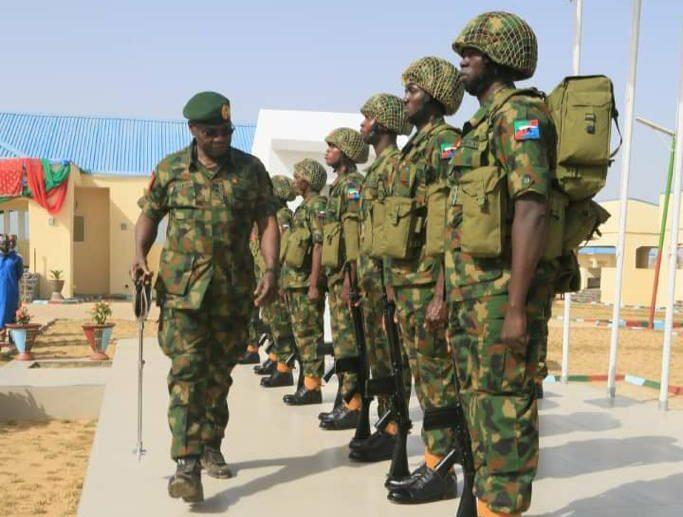
A few days ago, President Bola Ahmed Tinubu announced the creation of additional four Army Divisions- Makurdi (Benue), Ilorin (Kwara), Jalingo (Taraba) and Benin City (Edo). The new divisions brought the number to twelve.
The aims, the President said, were to improve command and control, decentralise operational decision-making, strengthen border security, enhance the protection of critical national infrastructure, bolster counter-insurgency and internal security operations, and ensure a faster military response to emerging threats across the country.
Beyond the announcement, security experts have continued to react. While commendation has been on everyone’s lips, the workability of the Divisions in the immediate has been one of the major fears being expressed.
Bish Johnson, a retired United States Army captain, though commended the President over the steps, noted that what has happened was just a building block that would take deliberate efforts and huge spending to bring the dream into reality.
He noted that the investment in recruitment of personnel and provision of required equipment was urgently needed if the dream should come to fruition.
The efforts of the Military in combating the insecurity challenge in the country has continued to receive commendation. The major concern of many Nigerians is the low level of support the military receives from the federal government. There are allegations bordering on poor remuneration of personnel and abysmal release from the annual budgetary allegation.
The alleged poor remuneration is said to have discouraged many Nigerian youths from enlisting in the Army. There are stories of soldiers who are today deserting their posts, going on AWOL (absent without leave).
Lack of adequate funding of Defence has constrained operational success and troop welfare.
This was the point expressly made by former Chief of Defence Staff, General Lucky Irabor (rtd.), in Abuja Tuesday, when he criticised the severe underfunding of Nigeria’s military, highlighting unfulfilled budget releases and low Gross Domestic Product (GDP) allocation.
Irabor noted that less than one percent of Nigeria’s GDP goes to the armed forces.
According to him, the Nigerian Army received only N1.7 trillion (25 percent) of its proposed N4.52 trillion expenditure. He also deplored a situation where only N16.71 billion (4.96 percent) of the N336.76 billion budgeted for army defence equipment was released.
The former Army Chief also said that Aircraft maintenance budget allocations saw only 13.9 percent released from a total of N34.71 billion.
While expanding Army Divisions, the federal government should address the most critical issues that are militating against the effectiveness of military efforts.
I hope the federal government is aware that many Nigerian youths are, these days, reluctant to join the military due to severe security risks in combat zones, poor welfare conditions, and deep-seated trust issues regarding institutional fairness.
Talking about high-risk deployments, many youths fear being sent to frontline areas battling insurgents and bandits without adequate protection and with far less superior equipment than the ones deployed by the enemies.
There is also the problem of low pay, poor medical care for injured soldiers, and delayed benefits, which have made the career unattractive compared to the risks involved.
Other concerns border on the perceived marginalisation of certain regions, who feel underrepresented in key security leadership or targeted during internal security operations.
Also, of serious pain is what some critics have termed “Controversial policies.” For instance, the handling or reintegration of captured insurgents has created scepticism about the direction of the armed forces.
The questions being asked across the country are: what is the immediate benefit of the additional Army Divisions when the existing ones are lacking funding? Would the new creation lead to the rescue of several kidnap victims across the country?
Beyond other efforts being made, the federal government must ensure that the feat recorded in the rescue of the Oriire 44 kidnap victims, and the 32 victims in Maikujera village, Sokoto State, is replicated across the country.
Today, Nigeria still has numerous unrescued kidnap victims, including hundreds of individuals from past mass abductions in regions like Borno and Kwara states.
At least 176 residents of Woro Village, Kwara State, abducted by armed groups remain in captivity following an attack on February 3, 2026.
According to reports, hundreds of other victims—including school pupils, farmers, and travellers—continue to languish in forest camps across northern and central states.
Nearly 100 schoolgirls from the original 2014 Chibok abduction remain missing years later.
Somewhere in Borno State, families are anxiously waiting for news of their children close to four months after they were abducted.
The 16 travellers abducted along the Biu-Buratai Road on April 16, 2026, are still with the abductors. The 42 pupils abducted by Boko Haram insurgents from Mussa Primary and Junior Secondary Schools in Askira-Uba Local Government on May 15, some of them as young as seven years, are still with the terrorists.
The insurgents, who attacked Government Secondary School Lassa, the same LGA in Borno, are still with the over 36 students who were writing the National Examinations Council (NECO) examination and a teacher.
Recently, the Minister of Defence, General Christopher Musa, ordered troops to shoot terrorists and bandits on sight without waiting for further clearance.
This, perhaps, may be the reason why we are no longer hearing about the non-kinetic strategy that attracted opprobrium to the government.
The country cannot be said to be “kampe” when its forests are littered with citizens under the captivity of terrorists.
It is expected that the newly created Divisions would soon rev into action with the appointment by Waidi Shaibu, Chief of Army Staff (COAS), of four general officers commanding (GOC) for the four divisions.
…………………………………………………………………………………………………………
When Ambrose Bierce (1842-1914), American writer, defined politics as “a strife of interests masquerading as a contest of principles, the conduct of public affairs for private advantage,” he was not referring to Governor Siminalayi Fubara of Rivers State; he wrote based on his observation of politics and politicking across the globe.