Seplat Energy Plc has brought 24 previously idle wells back into production across its offshore portfolio during the first half of 2026, adding a combined 26,000 barrels of oil per day in gross production capacity, as the Nigerian producer leans on brownfield work to offset a decline from an outage at its Yoho field.
- +Seplat Energy revives 24 idle wells, adds 26,000 bpd output boost in H1 2026
Data sourced from Seplat Energy’s latest unaudited results for the six months ended 30 June 2026 showed the Lagos-listed company restored 15 wells in the second quarter alone, contributing an incremental 16,000 bpd in gross capacity, or 6,400 bpd on a working-interest basis.
Data sourced from Seplat Energy’s latest unaudited results for the six months ended 30 June 2026 showed the Lagos-listed company restored 15 wells in the second quarter alone, contributing an incremental 16,000 bpd in gross capacity, or 6,400 bpd on a working-interest basis.
That builds on nine wells brought back online in the first quarter, which added a further 10,000 bpd gross. Combined, the two-quarter effort accounts for the 26,000 bpd of restored capacity and keeps the programme on track with the company’s own targets for the year.
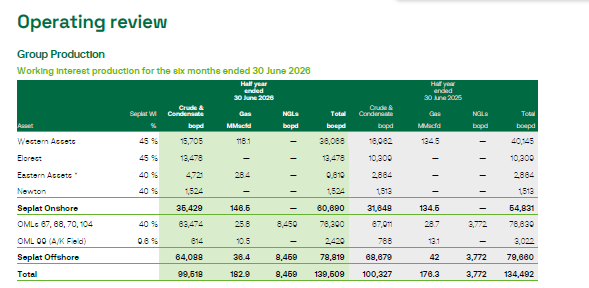
The wells sit within Seplat’s OMLs 67, 68, 70 and 104 blocks, where the company holds a 40 percent working interest.
Crude and condensate output from those blocks averaged 65,028 bpd in the second quarter, up 5 percent from 61,903 bpd in the first quarter. Seplat attributed the gain to the restoration work and to broader production-optimisation efforts across the offshore assets, which lifted facility uptime.
Even so, output for the first half remained below year-earlier levels. Working-interest crude and condensate production from the four blocks totalled 63,474 bpd over the six months, a 4 percent decline from 67,911 bpd in the same period of 2025. Seplat pointed to the lingering effect of an outage at its Yoho field as the main drag on that comparison.
The non-operated Amenam-Kponno field, in which Seplat holds a 9.6 percent stake, added 694 bpd of crude and condensate in the second quarter, up 30 percent from 533 bpd in the first quarter. Total crude and condensate production across both fields reached 65,722 bpd for the quarter, also up 5 percent from the prior three months, though still down 4 percent year-on-year on a first-half basis.
Working-interest NGL output fell 27 percent quarter-on-quarter to 7,131 bpd, after accidental third-party damage to the Oso-BRT subsea gas pipeline in June halted gas production at Oso and forced a temporary suspension of NGL processing at the BRT facility. Seplat said repair work is under way and it expects a return to full operations in the third quarter. Despite the setback, first-half NGL production still climbed 89 percent from a year earlier, to 8,459 bpd, against 3,772 bpd in the same period of 2025.
Idle well restoration has become a central plank of Seplat’s offshore strategy, offering a capital-efficient route to near-term barrels without the cost and lead time of new drilling. The company has framed the programme as evidence of untapped value in its existing asset base and said the pace of restorations in the first half met its expectations, with 24 wells returned to production against the target it set for the year.
The results are drawn from Seplat’s unaudited financial statements for the six months ended 30 June 2026, which detail crude, condensate and NGL output across its offshore operating and non-operated interests.
The company is scheduled to report full first-half results in the coming weeks, with investors likely to focus on whether the pipeline repair at Oso-BRT stays on schedule for a third-quarter resumption of NGL volumes.