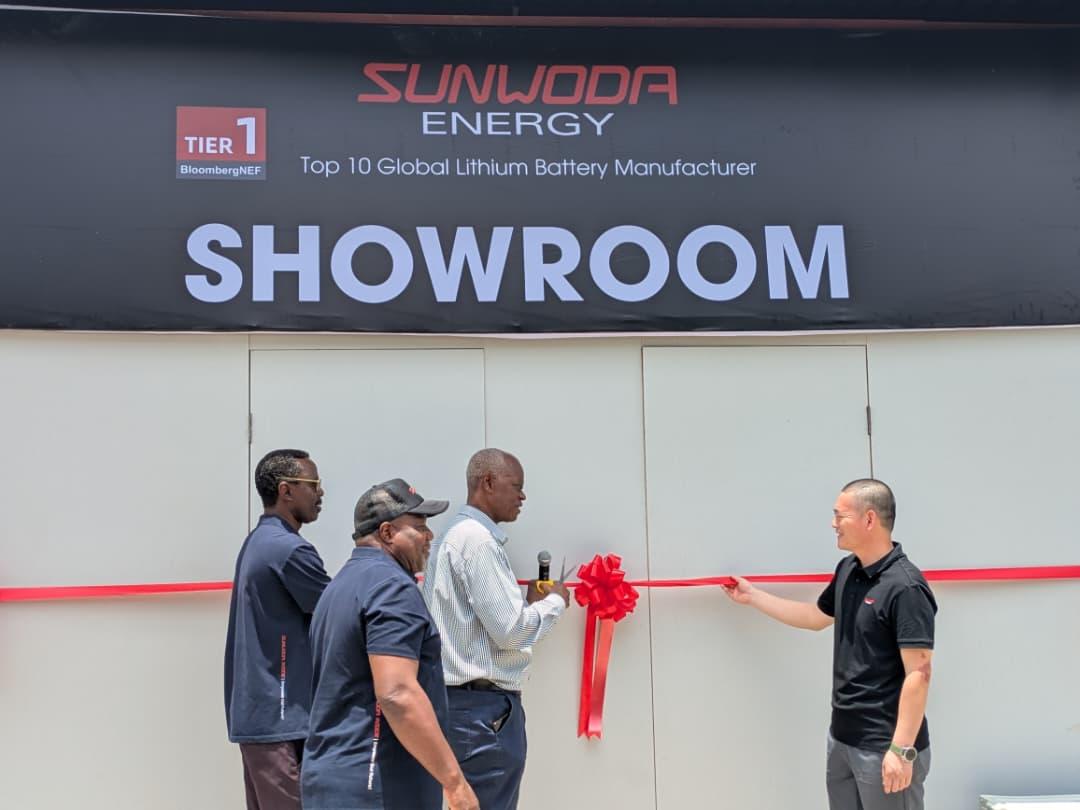
Farmtech Integrated Services has formally introduced Sunwoda Energy’s battery storage technologies to the Nigerian market, positioning itself as a bridge between global clean-energy hardware and a country where grid unreliability has long suppressed economic output and dampened investor confidence in the power sector.
- +Nigeria gets new bet on solar as Farmtech brings Sunwoda Energy to market
The launch, held at the Komponents and Solutions Rack Limited facility at 27B Ize-Iyamu Street, off Billings Way, Oregun, Lagos, drew industry professionals, energy stakeholders, and commercial partners to witness the unveiling of Sunwoda’s scalable storage systems — products calibrated for residential, commercial, and industrial deployment across West Africa’s most populous nation.
The launch, held at the Komponents and Solutions Rack Limited facility at 27B Ize-Iyamu Street, off Billings Way, Oregun, Lagos, drew industry professionals, energy stakeholders, and commercial partners to witness the unveiling of Sunwoda’s scalable storage systems — products calibrated for residential, commercial, and industrial deployment across West Africa’s most populous nation.
Farmtech is a subsidiary of Komponents and Solutions Rack Limited, a Lagos-based distributor with roots stretching back to 1997 that rebranded in 2014 to reflect an expanded focus on tier-one renewable energy components. The parent company already represents global original equipment manufacturers including BYD Energy Storage, Victron Energy, and Fronius — a portfolio that signals the kind of supply-chain depth that most Nigerian energy distributors struggle to match.
Kenny Ogunrombi, Farmtech’s Marketing Manager, used the occasion to underscore what the company sees as the defining logic of its market entry: that Nigeria’s energy deficit is not a resource problem but a systems problem — one that can be cracked by pairing reliable hardware with local expertise and deliberate deployment strategy. “Partnerships with Sunwoda Energy become critical,” the company said, in language that suggests this launch is the beginning of a longer commercial commitment rather than a one-off product reveal.
What distinguished the event from a conventional product showcase was Komponents’ decision to host it at a working off-grid installation. The Lagos facility runs a fully operational office environment — extensive cooling systems, an ultra-modern training infrastructure — entirely on integrated energy solutions. The demonstration was a pointed rebuttal to the perception, still common among Nigerian businesses, that solar storage is aspirational hardware ill-suited to the demands of real commercial operations in a tropical climate.
Farmtech’s core business model sits at the intersection of solar energy and agricultural production — a niche known as agrivoltaics. The approach places solar panels above or alongside farmland, generating electricity while simultaneously providing shade that can reduce water evaporation and protect certain crops. For Nigeria, where rural electrification remains chronically underfunded and farming communities often operate entirely off-grid, the model offers a dual economic argument: lower energy costs and higher agricultural yields from the same parcel of land.
The company frames Sunwoda Energy’s storage products as the hardware complement to that strategy, providing the capacity to store solar-generated power and dispatch it reliably — a function that remains the weak link in most small-scale renewable installations across sub-Saharan Africa. The product line is designed to scale, suggesting Farmtech is eyeing microgrid deployments in addition to standalone residential and commercial customers.
Komponents reaffirmed commitments to customer-focused service delivery at the event, emphasising quality, accountability, and technical after-sales support — a signal directed at commercial buyers who have historically been burned by imported equipment that arrived without credible local service infrastructure. The company also highlighted its standing as a world-class second-level repair centre, a credential that could prove decisive in a market where hardware downtime translates directly into lost revenue for business owners already operating on thin margins.
Nigeria’s energy transition has attracted a steady flow of international interest in recent years, but execution at scale has remained elusive. The Farmtech-Sunwoda partnership, if it delivers on its stated ambitions around capacity building and technical training, could represent one of the more credible attempts to translate that interest into durable infrastructure on the ground.