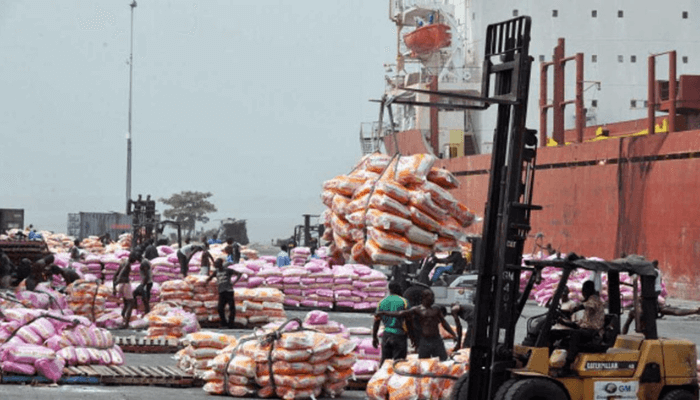
Nigeria spent $2.34 billion on food imports in 2025, according to data from the Central Bank of Nigeria’s latest Quarterly Statistical Bulletin.
- +Nigeria spends $2.34 billion on food imports in 2025 – CBN
The figure represents a 7.37% decline from the $2.53 billion recorded in 2024, showing a moderation in food-related foreign exchange demand despite Nigeria’s continued reliance on imported food products.
The figure represents a 7.37% decline from the $2.53 billion recorded in 2024, showing a moderation in food-related foreign exchange demand despite Nigeria’s continued reliance on imported food products.
However, the share of food imports in total foreign exchange utilisation fell more sharply, dropping from 9.49% in 2024 to 4.97% in 2025, as total foreign exchange utilisation rose from $26.65 billion to $47.17 billion during the period.
The CBN data showed that food imports consumed an average of $195.28 million monthly in 2025.
Food importers also utilised $193.05 million in October, $185.45 million in November and $245.86 million in December.
Although food imports remained significant, their share of total foreign exchange utilisation declined by 4.52 percentage points, from 9.49% in 2024 to 4.97% in 2025.
This means food imports took up a smaller portion of overall forex demand, even though the economy used more foreign exchange across sectors.
Total foreign exchange utilisation increased by $20.52 billion, or 77%, from $26.65 billion in 2024 to $47.17 billion in 2025.
By contrast, food import utilisation fell by $186.40 million, from $2.53 billion to $2.34 billion.
The decline in food import spending may suggest weaker import demand or improved local substitution in some categories.
However, the continued use of more than $2.3 billion for food imports shows that Nigeria still depends heavily on foreign food supply chains.
Nairametrics earlier reported that Nigeria’s spending on the importation of food and beverage products surged to N7.65 trillion in 2025, highlighting the country’s increasing reliance on foreign food supplies amid rising domestic demand and structural challenges in the agricultural sector.
The figures were based on the Foreign Trade Statistics report released by the National Bureau of Statistics (NBS).
In an interview with Nairametrics, Opeoluwa Runsewe, CEO of Terroso Group, a diversified company spanning agriculture, manufacturing, energy, and resources, warned that Nigeria is “exporting jobs and importing inflation.”
He highlighted how structural inefficiencies, coupled with global disruptions such as the ongoing Middle East conflict, are straining Nigeria’s logistics chain and worsening the food security challenge.