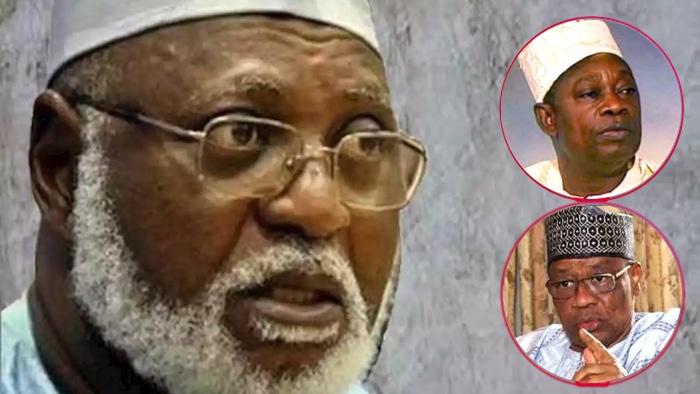
Abdulsalami: Babangida Never Discussed June 12 Annulment With Me, Abiola Not Poisoned
Abdulsalami Abbubakar says he learned of June 12 annulment through news reports and dismisses claims Abiola was poisoned.
Abdulsalami Abbubakar says he learned of June 12 annulment through news reports and dismisses claims Abiola was poisoned.
A former military Head of State, Gen. Abdulsalami Abbubakar (rtd), has revealed that he heard the announcement of the annulment of the June 12, 1993 election, like every other Nigerian, insisting that, though he was a high-ranking military officer at the time, the then military President, General Ibrahim Babangida (rtd), did not discuss the annulment with him.Abdulsalami also disclosed that the hours surrounding the death of General Sani Abacha on June 8, 1998, left him with a lingering sense that “something was fishy,” adding that he and the late Chief of Army Staff, Lt. Gen. Ishaya Bamaiyi, were mysteriously locked inside a waiting room at the Presidential Villa for nearly an hour before being informed that the Head of State had died.This is just as President Bola Tinubu; President of Sierra Leone and Chairman of the Authority of Heads of State and Government of the Economic Community of West African States (ECOWAS), Julius Maada Bio; former Military Head of State, Gen. Yakubu Gowon (rtd); and former Presidents, Chief Olusegun Obasanjo; Dr Goodluck Jonathan, and former President of South Africa, Thabo Mbeki, on Saturday poured encomiums on the former Head of State for his role in returning Nigeria to democracy.
In his autobiography titled: ‘Call of Duty,’ which was one of the three books he publicly presented on Saturday in Abuja, Abdulsalami said that because of his closeness to Babangida, people thought he was in the know of everything that happened.The two other books include, ‘Nigeria’s Grand Patriot’, and ‘Mediating for Peace in Africa’.In ‘Call of Duty’, the former Head of State wrote: “At the time of the annulment, I was at the Army Headquarters as the Chief of Policy and Plans (COPP). I was fully engaged in the military in any capacity. I was not even a member of the Armed Forces Ruling Council (AFRC), the country’s highest ruling body. I heard of the annulment in the news like every other Nigerian.”The former Head of State has also dismissed claims that Chief MKO Abiola was poisoned, insisting that an autopsy conducted by pathologists from four countries attributed his death to natural causes.The revelations are also contained in Chapter 21 of Abubakar’s 264-page, 27-chapter autobiography titled ‘Call of Duty.’Writing on the events leading to Abiola’s death on July 7, 1998, Abdulsalami said Abiola collapsed during a meeting with a visiting American delegation comprising the then United States Undersecretary of State for Political Affairs, Mr. Tom Pickering, and then Assistant Secretary of State for African Affairs, Ms Susan Rice.“I do not believe Abiola was poisoned. The family requested an autopsy, and we assembled American, British, Nigerian, and Canadian pathologists to conduct it. The autopsy report attributed his death to natural causes,” he wrote.
Writing on Abacha’s death, Abdulsalami also wrote that he and Bamaiyi were mysteriously locked inside a waiting room at the Presidential Villa for nearly an hour before being informed that the Head of State had died.He also explained how he succeeded Abacha and emerged as the 11th Nigerian Head of State.The revelations are contained in Chapter 19 of ‘A Call to Duty’.
Tinubu, Bio, Gowon, Obasanjo, Jonathan Shower Encomiums on Abdulsalami at his Book launch
Meanwhile, Tinubu, Bio, Gowon, Obasanjo, Jonathan, and Mbeki poured encomiums in Abuja during the public presentation of his three books.Eulogising the former Nigerian leader at the book launch, which coincided with his 84th birthday, President Tinubu, represented by Vice President Kashim Shettima, also hailed the former Head of State for continuing “to serve as a respected elder statesman, promoting peace, national unity, democratic stability, and responsible political engagement” through the National Peace Committee.Tinubu also directed the Minister of the Federal Capital Territory (FCT), Nyesom Wike, to allocate a befitting parcel of land within the nation’s capital to build an office for the Abdulsalami Abubakar African Resource Centre (AAARC).
Tinubu described the presence of dignitaries from both home and abroad at the event as a fitting tribute to Abdulsalami’s life.He justified why the AAARC deserves a befitting office in Abuja, saying “the establishment of the Abdulsalami Abubakar Africa Resource Centre is a worthy initiative that aligns with the values General Abubakar has championed throughout his life. The president said Abdulsalami’s life had been defined by duty, moderation, courage, and an unwavering commitment to the public, noting that he “occupies a unique place in the history of our nation. “At a moment of profound uncertainty, when Nigeria stood at a crossroads, providence entrusted him with the responsibility of leadership. He understood both the weight of that responsibility and the demands of the moment. He pledged to return the country to democratic rule, and he fulfilled that pledge faithfully and honourably”.Tinubu recalled how Abdulsalami “rendered one of the greatest services any leader can render a nation,” placing country above self and principle above power. He said the peaceful transition the former Head of State supervised in 1999 “gave birth to the Fourth Republic, the longest uninterrupted democratic period in Nigeria’s history.” The president acknowledged that millions of Nigerians, including him and others privileged to serve in public office, “are beneficiaries of the stability and democratic foundation that his stewardship helped secure.”His words: “Like many pro-democracy activists of that era, I returned to participate in the democratic process because I was convinced of General Abdulsalami Abubakar’s sincerity and determination to restore constitutional rule.”