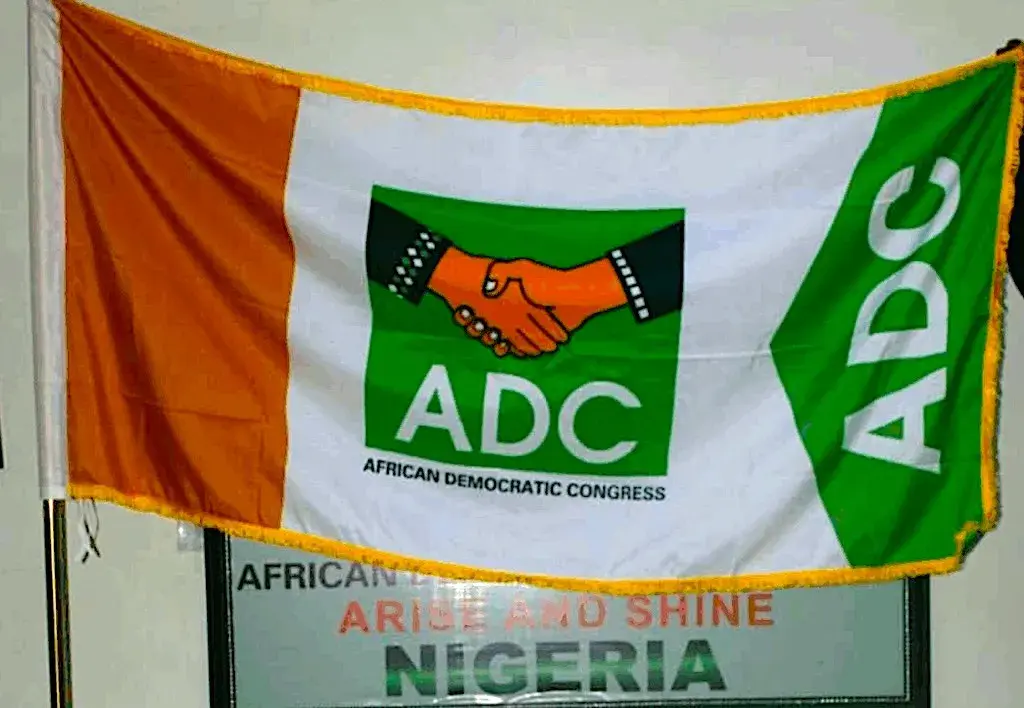
Rising tensions between the African Democratic Congress (ADC) and the Independent National Electoral Commission (INEC) have thrown the party into uncertainty just weeks before the commencement of primaries for the 2027 general elections.
- +ADC crisis: Bigwigs weigh options as primaries near
- +….NDC, ADP may emerge as alternative platforms
INEC recently announced it would suspend official engagement with the ADC leadership and would not monitor its scheduled national convention of April 14, citing a subsisting Appeal Court ruling.
….NDC, ADP may emerge as alternative platforms
INEC recently announced it would suspend official engagement with the ADC leadership and would not monitor its scheduled national convention of April 14, citing a subsisting Appeal Court ruling.
The decision has been strongly rejected by the party, which insists the commission misinterpreted the judgement and lacks the authority to abandon its statutory responsibilities.
Despite the standoff, ADC leaders have vowed to proceed with the convention and other internal processes. However, the legal tussle involving a rival faction led by Nafiu Bala Gombe, at the Federal High Court Abuja, continues to cast a long shadow, with no clear timeline for resolution.
The uncertainty comes at a critical moment. INEC has fixed April 23 to May 30, 2026, as the window for all political parties to conduct primaries and submit names of candidates.
With the deadline fast approaching, the ADC’s internal crisis is beginning to disrupt strategic calculations, especially among politicians who had been considering the party as a platform for 2027.
Credible sources disclosed that key figures within the Peoples Democratic Party (PDP), Labour Party (LP), and others who planned to defect to the ADC are now reassessing their options.
Political pundits warn that if the crisis lingers beyond INEC’s window for party primaries, presidential aspirants on the ADC platform, including Atiku Abubakar, Peter Obi, Rotimi Amaechi and Chukwuemeka Nwajiuba, may be compelled to explore alternative platforms.
Findings indicate that most of the federal lawmakers who defected to the ADC in recent times are first-term lawmakers who are already weighing their chances of re-election, with many said to be considering alternative platforms should the crisis within the ADC persists.
BusinessDay reports that nine senators from various political parties recently announced their defection to the ADC during plenary.
The lawmakers include the senator representing Sokoto South, Aminu Tambuwal; Enyinnaya Abaribe (Abia South); Binos Yaroe (Adamawa South); Victor Umeh (Anambra Central); Tony Nwoye (Anambra North); Lawal Usman (Kaduna Central); Ogoshi Onawo (Nasarawa South); Austin Akobundu (Abia Central); and Ireti Kingibe (Federal Capital Territory).
Their letters of defection were formally read on the floor of the Senate by Senate President Godswill Akpabio during plenary.
In a related development, five members of the House of Representatives also defected to the ADC. From Anambra State, Peter Uzokwe left the Young Progressives Party (YPP) to join the party. Similarly, three Anambra lawmakers, Afam Ogene, Peter Aniekwe and Lilian Orogbu, dumped the Labour Party for the ADC.
Also, Jessey Onakalusi (Lagos) and Murphy Osaro (Edo) defected from the Labour Party to the ADC.
Top sources told our correspondent that attention is increasingly shifting to the newly registered Nigeria Democratic Congress (NDC), which has begun to attract prominent defectors.
Among them is Seriake Dickson, a former governor of Bayelsa State and senator representing Bayelsa West, whose recent move has triggered fresh alignments within the opposition space.
Sources close to Dickson disclosed that he has intensified efforts to woo influential figures, including Governors Bala Mohammed and Seyi Makinde, into the NDC. Governor Mohammed, who had earlier indicated interest in joining the ADC, is said to have suspended his plans in light of the party’s deepening crisis.
There are also indications that some politicians who recently joined the ADC in anticipation of securing tickets for a second term may reconsider their positions if the crisis persists beyond the INEC deadline.
The momentum behind the NDC became more evident on March 2, 2026, when Dickson formally received defectors from the ADC, SDP and LP in Guzape, Abuja.
The defection led by Barrister Amanda Pam, a former ADC senatorial aspirant, saw a significant portion of the party’s structure in the Federal Capital Territory align with the NDC.
Also among the defectors were Farouk Dantsama, a former deputy state chairman of the Labour Party, and Hon. Nurudeen Bisalla, a former FCT chairman of the SDP, alongside several grassroots officials.
Dickson confirmed that the entire FCT structure of the SDP had been absorbed into the NDC, describing the development as part of a broader nationwide movement. “What you are seeing in the FCT is happening across the country. This is not a regional movement; it is national,” he said.
He warned that instability within opposition parties, particularly the ADC crisis, could weaken Nigeria’s democratic framework, alleging undue interference in party affairs by state institutions.
“A threat to one opposition party is a threat to all opposition parties. We stand united to defend Nigeria’s multi-party democracy,” Dickson added.
Political analysts say the growing appeal of the NDC lies in its status as a relatively new platform, free from entrenched factional disputes that have plagued older parties. This perception has made it an attractive option for politicians seeking stability ahead of the 2027 elections.
A founding member of the PDP, Aminu Yakudima, attributed the wave of defections to a combination of internal party crises and strategic repositioning.
“Many defections are coming from parties like the ADC, PDP, LP and SDP because of deep internal conflicts and leadership disputes,” he said.
“In simple terms, politicians are leaving unstable platforms that may struggle to even field candidates in 2027. The NDC offers a fresh start—less factionalised and more open,” he added.
Yakudima, who is also political analyst, added that the emerging trend reflects a broader realignment rather than isolated movements. “This is not random; it is a calculated pre-election strategy,” he noted.
Meanwhile, the Action Democratic Party (ADP) is also witnessing increased interest from politicians exploring alternative platforms.
Party officials confirmed that chieftains from the ADC, LP and PDP have initiated contacts as part of ongoing consultations.
This came on the heels of a recent meeting between former Vice President Atiku Abubakar and ADP leaders in Abuja, where discussions reportedly focused on coalition-building ahead of 2027.
National Chairman of the ADP, Yabagi Yusuf Sani, confirmed that the engagement formed part of broader efforts to strengthen opposition collaboration and prevent what he described as a drift towards one-party state.
“The APC-led government is consolidating power, while opposition institutions are weakening. That is why we are engaging key stakeholders to safeguard Nigeria’s pluralism,” he said.