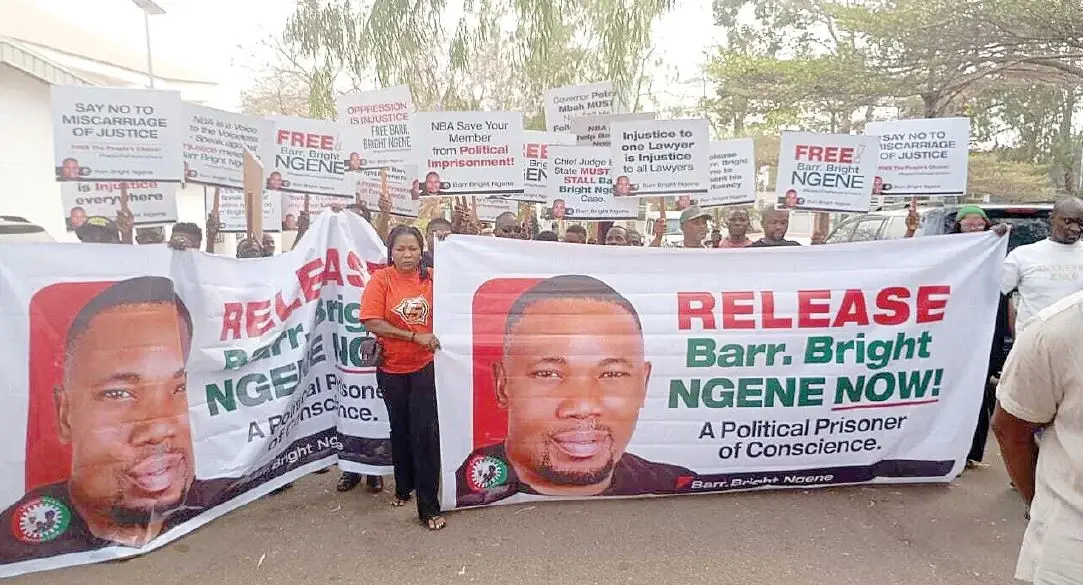
Once regarded as the last hope of the common man, the judiciary is facing growing public distrust amid allegations of corruption, delayed justice, conflicting judgments, and political interference, raising serious concerns about the integrity and independence of the nation’s courts. CHIJIOKE IREMEKA examines the alleged political conviction of Barrister Emeka Ngene and others
- +Imprisoned mandate: Inside ‘controversial’ conviction of Enugu Assembly winner
- +Investigation by Saturday PUNCH
Barrister Emeka Ngene’s incarceration echoes a warning about the dangers of politics infiltrating the judiciary, as once expressed by former President of the Court of Appeal, Justice Ayo Salami.
Barrister Emeka Ngene’s incarceration echoes a warning about the dangers of politics infiltrating the judiciary, as once expressed by former President of the Court of Appeal, Justice Ayo Salami.
He had warned that while the judiciary is meant to remain the hope of the common man, once politicians penetrate the courts, the institution risks becoming the “hope of politicians” instead.
His position reflects a broader and enduring concern that judicial independence becomes compromised when partisan interests or corruption influence legal outcomes, as was alleged in the case involving Ngene and other alleged victims of judicial misfires.
In 2024, Ngene was convicted and sentenced to seven years’ imprisonment by a magistrate’s court sitting in Enugu over allegations of theft and conspiracy involving community funds, at a time when he was on the verge of winning the Enugu South Urban 1 State Constituency seat in the House of Assembly and participating in all reruns ordered by the tribunal.
Elected on the platform of the Labour Party, he was eventually declared the winner by the Independent National Electoral Commission while still in prison, under circumstances that raised troubling questions about justice and cast a shadow over the long-held belief that the judiciary remains the last hope of the common man.
In the words of former Justice of the Supreme Court of Nigeria, Chukwudifu Oputa, “Justice must not only be done but must also be seen to be done.”
Though the dictum was originally laid down by the then Lord Chief Justice of England, Lord Hewart, in Rex v. Sussex, the principle became a cornerstone of Oputa’s judicial philosophy.
The late jurist, widely celebrated as the “Socrates of the Supreme Court,” built a lasting legacy around fairness, transparency, and the humanity of the law.
Explaining what justice means to the accused, the complainant, and society at large, Oputa famously stated, “Justice is not a one-way traffic. It is not justice for the appellant only. Justice is not even a two-way traffic. It is really a three-way traffic.”
He explained that justice for the accused requires that the individual receive a fair hearing and be neither railroaded nor unduly punished, as alleged in Ngene’s case, where claims persist that he was denied a fair hearing because several judges recused themselves.
Oputa also stressed the need for justice for the victim or complainant, whose rights, property, or life may have been violated, as well as justice for society at large, whose values and laws are undermined when wrongdoing occurs.
It is on this tripod of justice that Saturday PUNCH’s investigation rests, as it revisits the circumstances surrounding the trial and conviction of Ngene, which were delivered within a short period.
Investigation by Saturday PUNCH
Judicial experts, who spoke to Saturday PUNCH said Ngene’s case generated significant anxiety and concern within the judiciary and among residents about the administration of justice, especially with several recusals by judges reportedly assigned to hear the case at the High Court.
A member of Ngene’s legal team, Chief John Okereke, told our correspondent that an appeal had already been filed and that the defence team was awaiting the commencement of the appropriate legal processes.
According to him, the aim was to ensure justice prevails and to establish whether Ngene truly committed the offence for which he was convicted.
He confirmed that although Ngene was sentenced to seven years’ imprisonment, the sentence runs concurrently, meaning he would effectively serve four years before becoming eligible for release.
“Even if he has served out his term, we still need to clear his name at the Court of Appeal to determine whether he actually committed the offence or whether there were ulterior motives behind the conviction,” the lawyer said.
Okereke described the case as “an open secret,” insisting that many petitions written on Ngene’s behalf before and after the conviction received little or no attention.
At one stage, he claimed that multiple judges recused themselves from the matter, further delaying proceedings and prolonging his incarceration.
Ngene was first arraigned in 2017 alongside two others by the police in Enugu State over the alleged theft of N15m belonging to the Akwuke community in Enugu South Local Government Area.
He had served as secretary and legal adviser to a sub-committee set up to manage the community’s finances following a leadership crisis that emerged around 2009.
Akwuke is known in Enugu State for sand excavation activities, from which the community generated revenue through tolls paid by tipper drivers.
The heavy movement of trucks reportedly damaged community roads.
According to the handover documents obtained by Saturday PUNCH, Ngene was directed by the community to pay about N11m to a contractor for road repairs.
However, in 2017, a petition alleging theft and conspiracy was filed against Ngene and his associate, John Ewoh.
Community sources claimed the petition came from members of a rival faction within the community leadership structure.
The police investigated the matter and filed charges against Ngene and Ewoh before a Magistrate’s Court in Enugu State.
Saturday PUNCH gathered that the case received little attention for several years and was later referred to the Alternative Dispute Resolution mechanism.
It gained renewed attention around mid-2022 when Ngene emerged as the Labour Party’s preferred candidate for the 2023 elections.
The case was initially presided over by Chief Magistrate A.O. Eze, but was transferred to Magistrate E.D. Onwu after Eze’s retirement.
According to an engineer, Uche Anikwu, who followed the proceedings, Ngene’s counsel petitioned the Enugu State Chief Judge for a transfer to another magistrate.
The Chief Judge transferred the case to Magistrate I.M. Mamah on November 9, 2022.
Mamah advised that the matter be settled through ADR.
While the case was still at the ADR stage, another directive reportedly returned it to Magistrate Onwu’s court in 2023.
Ngene’s counsel wrote for clarification over the conflicting directives from the Chief Judge’s office.
When another letter later directed the case back to Onwu’s court, the defence team raised concerns.
Onwu resumed hearing the matter, and the intervals between adjournments became shorter.