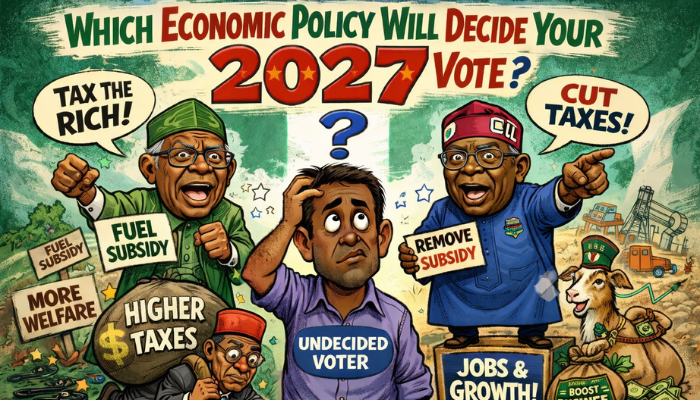
As Nigeria looks ahead to the 2027 general elections, economic concerns are shaping voter expectations in direct and practical ways.
- +Power supply tops voter priorities ahead of 2027 elections – Poll
BusinessDay 2027 Election Insight April poll shows that while issues such as rising living costs, taxation, and social services remain part of public debate, one issue stands out across all measures.
BusinessDay 2027 Election Insight April poll shows that while issues such as rising living costs, taxation, and social services remain part of public debate, one issue stands out across all measures. From daily survival to long-term growth, respondents point to electricity as the factor most likely to influence how they vote, assess candidates, and define economic progress.
Across multiple questions, respondents consistently identified power sector reform as the most decisive issue. When asked which economic policy would most influence their vote, 64.4 percent chose tackling power-sector challenges. This was far ahead of subsidies to reduce living costs at 20.3 percent, investment in education and healthcare at 11.9 percent, and tax cuts at 3.4 percent.
The same pattern appears when voters consider daily life. Reliable electricity supply was selected by 54.2 percent as the single most impactful improvement, ahead of subsidies (18.6percent), reduced taxes (13.6 percent), and better schools and hospitals (13.6 percent).
Looking at long-term impact, the margin widens further. Power sector reform and infrastructure lead with 72.9 percent, while education and health follow at 18.6 per cent. Tax reforms (6.8 percent) and sustained subsidies (1.7 percent) rank lower.
Trust in economic plans also hinges on electricity. A majority of 62.7 per cent said they would trust a candidate more if they presented practical solutions to power challenges. This compares with 23.7 per cent who prioritised commitment to social sectors, 8.5 per cent for tax clarity, and 5.1 per cent for immediate subsidy relief.
On urgency, respondents remain divided between electricity and the cost of living. Fixing the electricity supply leads at 49.2 percent, closely followed by addressing rising living costs at 42.4 percent. Other concerns, such as education, healthcare, and taxes, rank lower.
If limited to one promise in the first year of office, 71.2 per cent of respondents said improving power supply should take priority. This places it well ahead of upgrading education and healthcare (15.3 percent), expanding subsidies (8.5 percent), and cutting taxes (5.1 percent).
Voters speak: “Fix power supply” Open-ended responses reinforce the data. Many respondents used direct language such as “power”, “fix power supply problem”, and “stable electricity supply nationwide” to describe the single change that would influence their vote.
One respondent said, “A clear, strategic and practical plan to tackle our power problem would be non-negotiable for me.” Another noted, “Fixing electricity, which is a catalyst for economic growth.”
Others linked electricity directly to daily expenses. A respondent explained, “If I’m fueling my car, paying for prepaid electricity billing and still fueling my generator, imagine how much cost I would save if I finally cut down on generator fueling.”
Some pointed to wider economic effects. One response stated, “If we can fix our electricity, most of our issues as a nation will go away. Our industries will work, more jobs will be created, and people will be empowered.” Another added, “Electric power is central to all others: health, education, agriculture.”
There were also calls for structural reform, including “decentralised TCN”, “power sector reforms”, and “investment in infrastructure”. A few respondents linked electricity to broader governance, citing the need for “transparency”, “accountability”, and “track record”.
Cost of living and subsidies remain part of the debate While electricity dominates, the cost of living remains a key concern. Some respondents called for “reduction of fuel cost”, “bringing back subsidy”, and “implementation of policies that impact cost of living positively”.
Food prices and agriculture also featured. One respondent called for “ban importation of food and investing in massive production”, while another highlighted “agricultural reforms for better food supply”.
However, even within these responses, electricity often appeared alongside other demands, reinforcing its central role.
Trust gap persists on policy promises Responses to trust-related questions reveal scepticism. Some participants questioned past delivery, with one stating, “Tinubu failed in his electricity promise made 4 years ago,” while another said, “Govt has failed for 25 years on Power Sector.”
Others expressed broader distrust in political commitments. One response read, “So politicians lie, therefore, couldn’t be bothered any longer.” Another noted concerns about implementation, stating that policies are “not properly sequenced”.
Despite this, some respondents still emphasised continuity and stability. A few called for maintaining current reforms, including “forex reform” and “deregulation of the petroleum sector”.
A single-issue election? The poll suggests that electricity could become a defining issue in the 2027 elections. While voters acknowledge multiple economic challenges, power supply stands out as the point where daily life, business activity, and long-term growth intersect. As one respondent summarised, “Focus on electricity supply, and we’re good.”