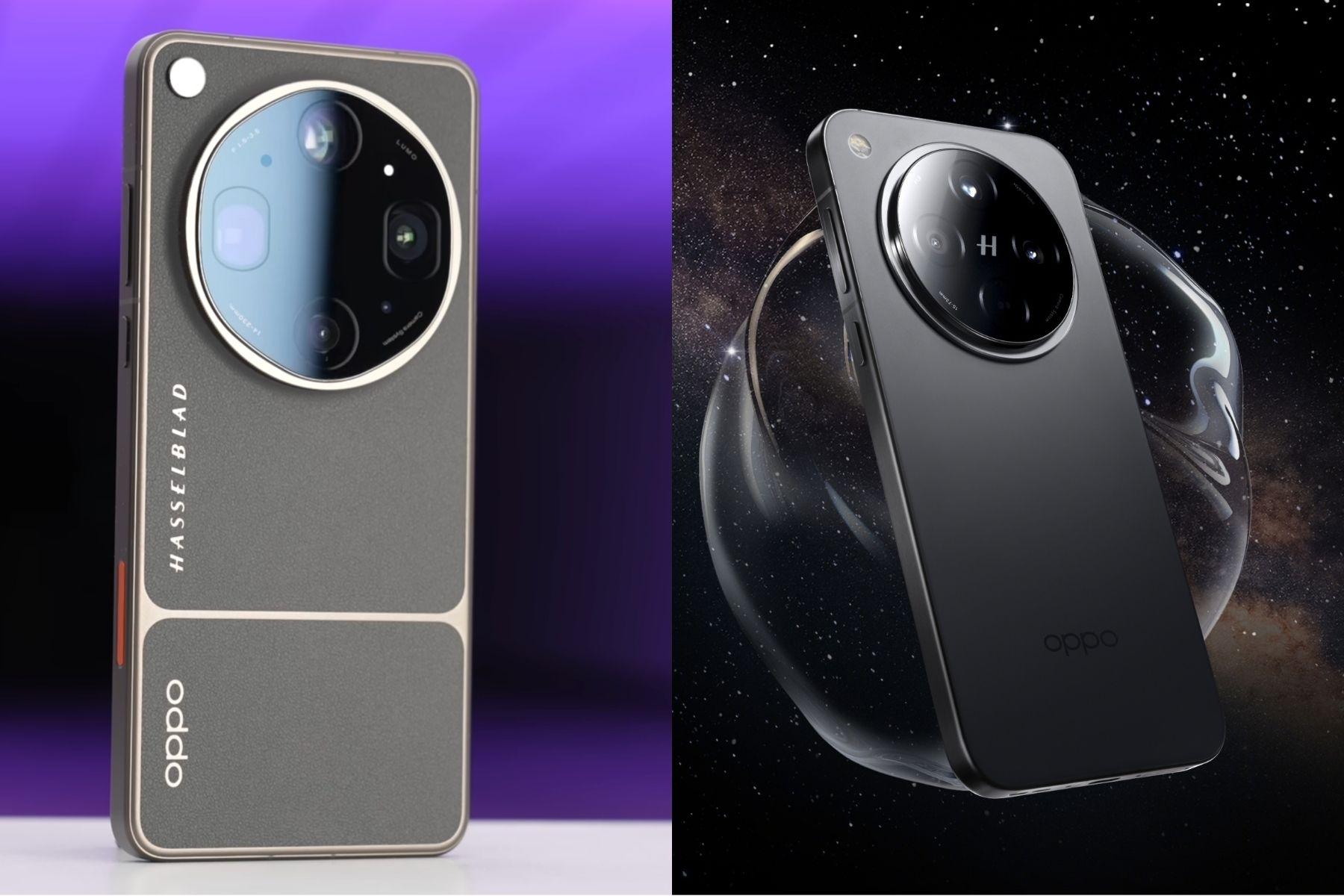
When OPPO launched the Find X9 Ultra at its headquarters in Chengdu, China, on April 21, 2026, the biggest story was the geography. For the first time since OPPO introduced the Ultra-tier label in 2024, an Ultra-range Find X phone is available outside China. The Find X8 Ultra, which launched a year earlier in April 2025, was never officially released outside China.
- +OPPO Find X9 Ultra vs Find X8 Ultra: Which should you buy?
- +The biggest upgrades on the Find X9 Ultra
- +OPPO Find X9 Ultra: Full specs and features
- +OPPO Find X8 Ultra: Full specs and features
That global shift changes everything for you as a Nigerian buyer.
The biggest upgrades on the Find X9 Ultra
OPPO Find X9 Ultra: Full specs and features
OPPO Find X8 Ultra: Full specs and features
That global shift changes everything for you as a Nigerian buyer. Both phones are imports for now since there is no official OPPO Nigeria channel for either. However, the X9 Ultra, with confirmed launches in the UK, Europe, and India, will be far easier to source through grey-market vendors than its predecessor ever was.
Here is how the two phones compare across every meaningful spec.
OPPO’s tagline for the X9 Ultra is Your Next Camera, and the phone mostly lives up to it. The most significant change over the X8 Ultra is the camera system. Where the X8 Ultra used a 50 MP 1.0-inch Sony LYT-900 main sensor alongside three 50 MP companions, the X9 Ultra moves to a five-camera rear setup led by two 200 MP sensors.
These are a Sony LYT-901 main camera and an OmniVision OV52A 3x telephoto. On top of that, OPPO added an industry-first 50 MP 10x optical periscope built around what the company calls a Quintuple Prism Reflection design. Engadget, which tested the phone ahead of launch, called the 1/1.12-inch main sensor the largest 200 MP sensor in a phone yet.
Beyond cameras, the X9 Ultra brings several other upgrades:
The X9 Ultra has a 6.82-inch LTPO 2.0 AMOLED panel at a resolution of 3168 x 1440, which works out to 510 pixels per inch. It runs at an adaptive 1-120 Hz refresh rate, with 144 Hz unlocked in select games. Touch sampling sits at 300 Hz.
Brightness is rated at 800 nits typical, 1,800 nits in high-brightness mode, and 3,600 nits peak HDR.
The panel supports Dolby Vision, HDR Vivid, and HDR10+ with 10-bit colour. PWM dimming runs at 2,160 Hz, the minimum brightness drops to 1 nit, and the top glass is Corning Gorilla Glass Victus 2. OPPO uses what it calls an X3 luminescent material with pixel-level gamma correction.
The X9 Ultra runs on the Qualcomm Snapdragon 8 Elite Gen 5, a 3 nm chip (model SM8850-AC) with two Oryon V3 Phoenix L cores at 4.6 GHz and six Oryon V3 Phoenix M cores at 3.62 GHz. The GPU is an Adreno 840 clocked at 1,200 MHz. RAM is LPDDR5X, available in 12 GB or 16 GB. Storage uses UFS 4.1 in 256 GB, 512 GB, or 1 TB options inside China. For global buyers, OPPO is selling only the 512 GB and 1 TB variants.
The Glacier Battery is a 7,050 mAh silicon-carbon cell. It supports 100 W SUPERVOOC wired charging, 50 W AIRVOOC wireless charging, and 10 W reverse wireless charging. The charger also works with 80 W SUPERVOOC, 18 W PD, 18 W QC, and 55 W PPS profiles. OPPO claims up to 31 hours of YouTube playback per charge, though that figure is based on manufacturer lab conditions.
OPPO’s partnership with Hasselblad, the Swedish camera brand whose cameras went to the moon, has been in place since 2022. The X9 Ultra marks the fourth generation of that collaboration, now branded the New-Generation Hasselblad Master Camera System. Hasselblad co-branded the launch event in Chengdu.
Video: 8K at 30 fps on both 200 MP sensors; 4K at 30, 60, or 120 fps; 4K Dolby Vision up to 120 fps; 1080p slow motion to 240 fps; 720p slow motion to 480 fps. The O-Log2 log profile supports real-time LUT preview, LUT burn-in, ACES colour management, and custom 3D LUT imports.
OPPO also introduced a feature called LUMO, an internal optical zoom processing system that quadruples the pixel count at the 2x and 6x focal lengths. Optional accessories include the Hasselblad Earth Explorer Kit (a grip-case with a 300 mm teleconverter for roughly 13x optical) and the TILTA KHRONOS Kit, which includes ND filters, manual focus handles, and an internal HDMI output.
The X9 Ultra measures 163.16 x 76.97 mm. Thickness is 8.65 mm for the Canyon Orange version and 9.10 mm for Tundra Umber, with weights of 235 g and 236 g, respectively. The frame is aluminium alloy. The Canyon Orange back is glass; Tundra Umber uses an eco-friendly vegan leather inspired by the Hasselblad X2D 100C Earth Explorer Edition camera.
Globally, the phone ships in Tundra Umber and Canyon Orange. Polar Glacier is China-exclusive. The phone carries IP66, IP68, and IP69 ratings, plus Swiss SGS five-star drop and shock certification.
There are two physical buttons besides the power and volume keys: a customisable Shortcut Button on the left and a pressure-sensitive Quick Button on the right that doubles as a camera shutter and zoom slider.
The X9 Ultra ships with Android 16 and ColorOS 16, with a confirmed commitment of up to five major OS upgrades and six years of security patches.
AI features include AI Mind Space, AI Recording (with live transcription and speaker identification), AI Writer, AI Bill Manager, AI Menu Translation, and Gemini Live integration. OPPO also bundles a complimentary three-month Google AI Pro subscription with 5 TB of cloud storage.
Cross-device tools include PC Connect, Touch to Share, Mac Connect, and AirDrop-compatible Quick Share.
UK pricing is confirmed at £1,449 for the 12 GB / 512 GB variant. EU pricing is €1,699 for the same variant. Hong Kong reseller Giztop is pre-selling global units at $1,499 (12 GB/512 GB) and $1,699 (16 GB/1 TB).
For Nigeria, there is no official distributor price yet. At the current exchange rate of ₦1,374 to $1, the Chinese base price of $1,099 works out to roughly ₦1.51 million. The Giztop price of $1,499 works out to roughly ₦2.06 million.
After import duties, shipping, and reseller margins, grey-market vendors at Computer Village are likely to price the phone between ₦2.2 million and ₦2.6 million when stock arrives.
The X8 Ultra also uses a 6.82-inch LTPO AMOLED panel at 3168 x 1440 (510 ppi) with a 1-120 Hz adaptive refresh rate and 240 Hz touch sampling. PWM dimming runs at 2,160 Hz. Brightness is rated at 800 nits typical, 1,600 nits in high-brightness mode, and 2,500 nits peak. The screen supports HDR Vivid, HDR10+, and Dolby Vision with 10-bit colour. GSMArena lists unspecified Corning Gorilla Glass for protection, though PhoneArena’s review references Gorilla Glass Victus 2.
The X8 Ultra runs on the Qualcomm Snapdragon 8 Elite (3 nm, SM8750-AB), with two Oryon V2 Phoenix L cores at 4.32 GHz and six Oryon V2 Phoenix M cores at 3.53 GHz. The GPU is the Adreno 830. RAM is LPDDR5X in 12 GB or 16 GB. Storage is UFS 4.1 in 256 GB, 512 GB, or 1 TB.