Africa must embrace accounting as a catalyst for economic transformation – Olowo
Rabiu Olowo, Executive Secretary and Chief Executive Officer of Financial Reporting Council of Nigeria (FRCN), says Africa must embrace accounting as a catalyst for economic transformation
Rabiu Olowo, Executive Secretary and Chief Executive Officer of Financial Reporting Council of Nigeria (FRCN), says Africa must embrace accounting as a catalyst for economic transformation
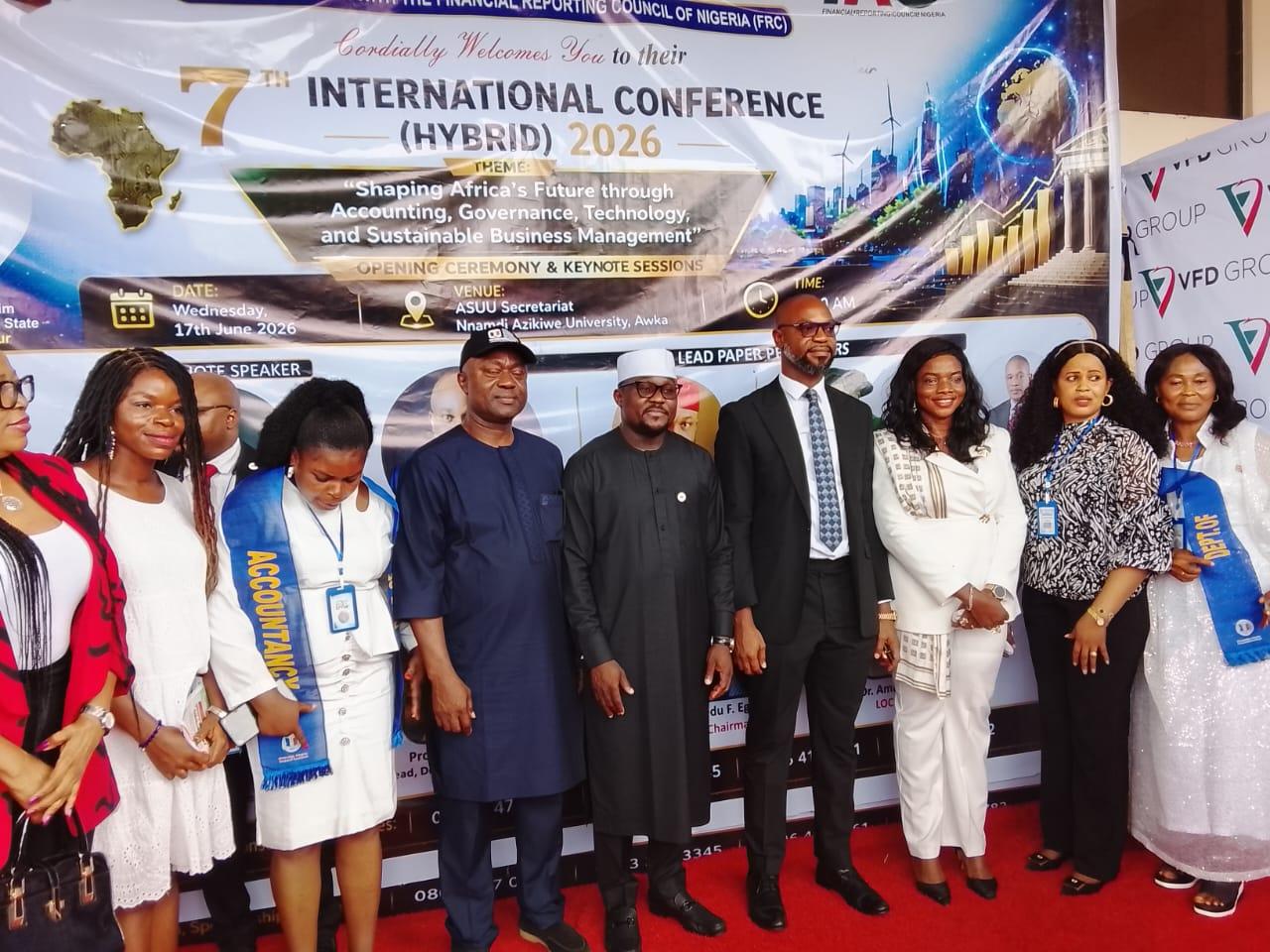
Olowo made the remark in a keynote address on Wednesday at the 7th International Conference Symposium (HYBRID) 2026, organised by the Department of Accountancy, Faculty of Management Science, Nnamdi Azikiwe University (UNIZIK), Awka, Anambra State.
He said the theme of the conference, “Shaping Africa’s Future through Accounting, Governance, Technology and Sustainable Business Management,” is both timely and significant
“It reflects the reality that the challenges confronting Africa today can no longer be addressed through isolated interventions. The complexity of modern economic systems requires integrated solutions.
“Accounting, governance, technology, and sustainability are no longer independent disciplines operating in separate spheres. They have become interconnected drivers of development whose collective impact will largely determine the trajectory of Africa’s future,” he stressed.
Olowo emphasisd that accounting must therefore be viewed not merely as a compliance function but as a strategic enabler of economic transformation.
“It provides the foundation upon which sustainable growth, investment attraction, and institutional credibility are built,” he affirmed.
He commended the Department of Accountancy and Nnamdi Azikiwe University for convening a gathering that brings together scholars, practitioners, policymakers, regulators, and industry leaders to reflect on one of the most pressing issues of our time: how Africa can shape a future that is prosperous, accountable, technologically advanced, environmentally sustainable, and socially inclusive.
“The lesson is clear. The future of Africa will not be determined solely by what lies beneath its soil or by the size of its population. It will be determined by the quality of its institutions, the effectiveness of its governance systems, the credibility of its reporting frameworks, and the sustainability of its development strategies.
“In the absence of reliable financial information, markets become inefficient. Capital is misallocated. Investors become reluctant to commit resources. Economic opportunities are lost,” he added.
According to him, in reality, accounting is one of the most powerful instruments for economic development because it provides the information infrastructure upon which markets, institutions, and governments depend.
“Every successful economy is built on trust. Investors invest because they trust the information available to them. Lenders provide credit because they trust financial reports and disclosures. Governments formulate policies because they trust economic data.
“Citizens place confidence in institutions when transparency and accountability are evident. Accounting, therefore, serves as a bridge between economic activity and public confidence.
“Accounting has traditionally been perceived as the process of recording, classifying, and reporting financial transactions. While this description is technically correct, it does not fully capture the transformative role that accounting plays in modern economies.
He concluded that the only way to shape the future of Africa lies not in any single policy, institution, or technology, but in collective commitment to building strong institutions, promoting transparency, embracing innovation, strengthening governance, and pursuing sustainable development.
The awardees, Osita Chidoka, former Minister of Aviation, Maj.-Gen. Charles Ofoche (rtd), and Suleiman Aruwa are lead paper presenters at the event.
Ugochukwu Bond Anyaehie, Vice- Chancellor of the University appreciated the department for the consistence in making the institution proud, while extolling all the guests, particularly the lead paper presenters.
Christian Udechukwu, Chairman of the event and a former Anambra State Commissioner for Commerce called for stronger collaboration between government, institutions of learning, civil society organizations, investors and communities to improve public education system in Nigeria saying that it would address socio-economic challenges confronting the country at the moment.