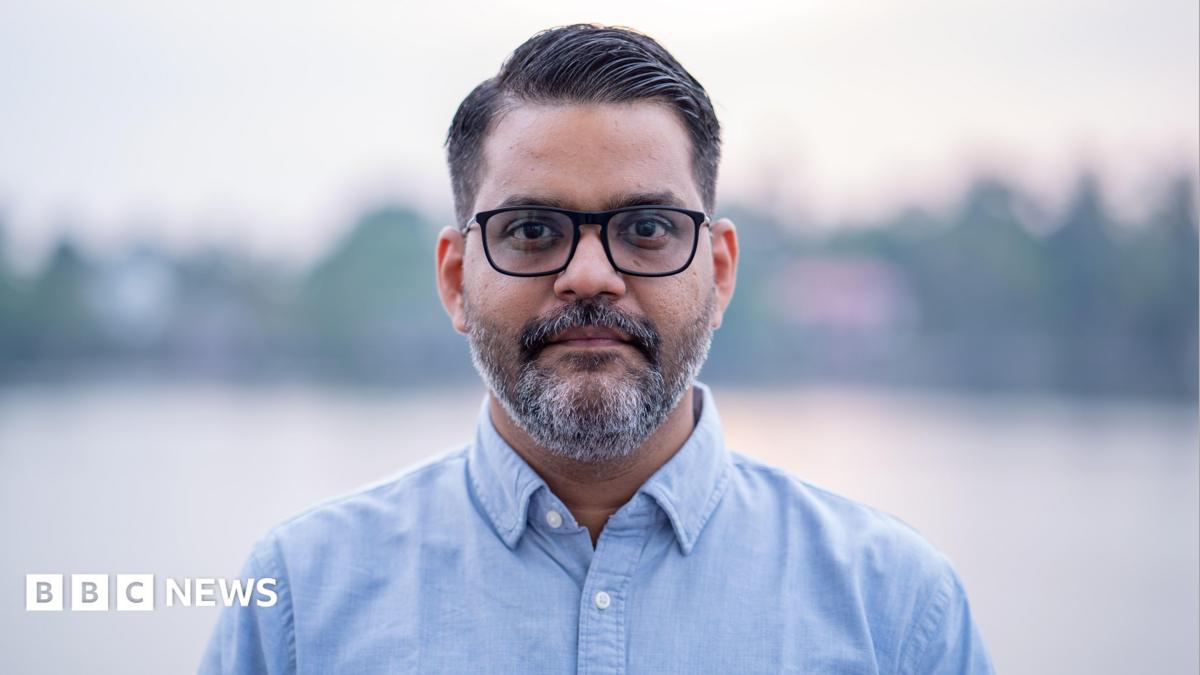
Cyriac Abby Philips became a divisive social media figure since he started questioning alternative medicine
- +Loved and loathed: The making of India's viral liver doctor
The waiting room outside the hepatology clinic at Rajagiri Hospital in Kochi is suspended between hope and despair.
The waiting room outside the hepatology clinic at Rajagiri Hospital in Kochi is suspended between hope and despair.
One man stares silently at the floor, weakened by advanced liver disease and in urgent need of treatment. Nearby, another family clutches a folder of old medical reports, hoping the hospital can still save their loved one.
Inside, Dr Cyriac Abby Philips is unhurried.
A patient sits across from him. Philips leans forward, asks a question, then falls silent. He listens - really listens. When he speaks again, his assessment is candid but delivered with compassion. He doesn't simply tell the family what comes next; he carefully walks them through the road ahead.
I spent two days in his clinic in the southern Indian state of Kerala expecting to find a very different man.
Philips is one of India's best-known - and most polarising - doctors online: admired by supporters as a fearless champion of evidence-based medicine, reviled by critics as an attention-seeking provocateur.
On X, where more than 300,000 people follow him as the "Liver Doc", he has called homeopathy "false medicine", labelled alternative practitioners quacks and told critics their brains were "for rent". Alternative practitioners accuse him of not understanding the Indian system and attacking them unfairly.
His feed is packed with public health information, but also with bitter feuds - including with celebrities - conducted in a style many describe as rude.
India's Ayush Ministry - the federal body overseeing traditional medicine - has held two formal committee meetings just to discuss him. A police inspector once travelled for two days by train from the northern state of Uttar Pradesh to question him over a social media post. In six years, Philips has faced 16 legal cases, some of which are still ongoing.
Yet the man behind the social media persona seemed markedly different in person.
During our conversation, he came across as measured and soft-spoken. Long-term patients, colleagues and doctors who know him also described him in similar terms: polite, unassuming and courteous.
"It's an adopted persona," he says, without apology. "They hate me. But they cannot invalidate the information I give."
"Sometimes you must make loud noises to be heard. I specially go after trolls, so they cannot deviate the attention from the message I am trying to give. If people think I'm rude or ill-tempered, even though it isn't true, I'm willing to pay that price."
Dr Philips has led crowdfunded investigations into the quality of protein powders sold in India
Ayurveda, India's ancient traditional medical system, and alcohol are the main targets of his criticism. Ayurveda is trusted by millions, backed by government-funded medical colleges and deeply woven into everyday life.
So why has he made it his mission to challenge it? And why adopt such a confrontational public persona?
The answer, he says, lies in his journey.
Philips never wanted to become a doctor. He wanted to write. He loved films. Medicine was never his calling.
But growing up in Kerala as the son of celebrated gastroenterologist Dr Philip Augustine, the decision had largely been made for him.
He failed the medical entrance exam on his first attempt and spent nine months at a residential coaching centre in Thrissur, where 40 boys shared cramped rooms.
"I cried myself to sleep the first week," he recalls.
He got in on his second attempt. "I was wild at St John's Medical College in Bangalore," he says with a grin. At one point, he was admitted to hospital under his own professor with alcohol toxicity.
Medicine only became real during his MD in Kolkata, at a 3,500-bed public hospital struggling with chronic shortages of medicines, equipment and staff.
He watched doctors treat critically ill diabetes patients without insulin because supplies had run out, and make impossible decisions about who could be saved with the limited resources available.
"Even with so little, people were doing the best they could. And patients were happy, even though they were struggling. I'd never seen that kind of relationship between human beings before."
He later trained in hepatology at the Institute of Liver and Biliary Sciences in Delhi and was building an academic career when his father's hospital was taken over by a business group.
He left Delhi to help rebuild his father's practice - another decision that, he says, wasn't entirely his own.
Dr Philips takes his time to explain the disease and course of action to his patients
Working at a new hospital in Kerala, it was here that he first began seeing the devastation caused by alcohol-use disorder and unregulated herbal remedies.
A six-year-old with severe jaundice and acute liver failure was brought in after her family gave her a homemade herbal concoction for a fever and cold.
"You have no idea the nightmares I went through in those two weeks trying to save that child," he says.
The case sparked his interest in studying the impact of alternative medicines and alcohol-use disorder, which was rife at the time in his state.
He says he immersed himself in the science and history of alternative medicine. He wanted to be more than a clinician; he wanted to bring academic rigour to his practice.
He began sharing his case studies on social media. At first, few noticed. Then came the backlash.
Millions of people have deep faith in traditional medicine, and many argue that applying modern clinical standards to it amounts to cultural erasure. Critics say Philips doesn't just challenge those beliefs - he humiliates the people who hold them.
He does not yield. "I am not calling the practitioner a quack. I am saying the principles that drive that practice are not based on scientific thinking or rational logic. Modern medicine corrects itself. That maturity is absent in alternative medicine - it refuses to identify its own failures."
He has since published numerous peer-reviewed studies on liver injury linked to traditional Indian medicines. When the Ayush Ministry challenged one of them, he responded with a detailed scientific rebuttal - and moved on.
He has also led crowdfunded investigations into the quality of protein powders and generic medicines sold in India, and more recently published a book based on his experiences as a doctor.
But the path has come at considerable financial and emotional cost.
His day job alone, he says, is enough to send anybody into depression.
Most patients Dr Philips sees have advanced liver disease, often linked to alcohol-use disorder
Many of his patients have advanced liver disease. Alcohol-related liver disease has become one of India's fastest-growing causes of serious liver illness, especially among younger adults.