Presco Plc and Okomu Oil Palm Plc, listed Nigerian palm oil manufacturers, are beginning to feel the pressure from falling domestic prices as cheaper imports squeeze margins.
- +Nigeria’s top palm oil makers’ profits fall as cheaper imports bite
- +The tariff decision is changing the market
- +Backward integration projects threatened
- +Presco doubles down despite headwinds
The companies, which rely heavily on local agricultural production, struggled to pass on increased costs to customers, leading to a dip in profitability.
The companies, which rely heavily on local agricultural production, struggled to pass on increased costs to customers, leading to a dip in profitability.
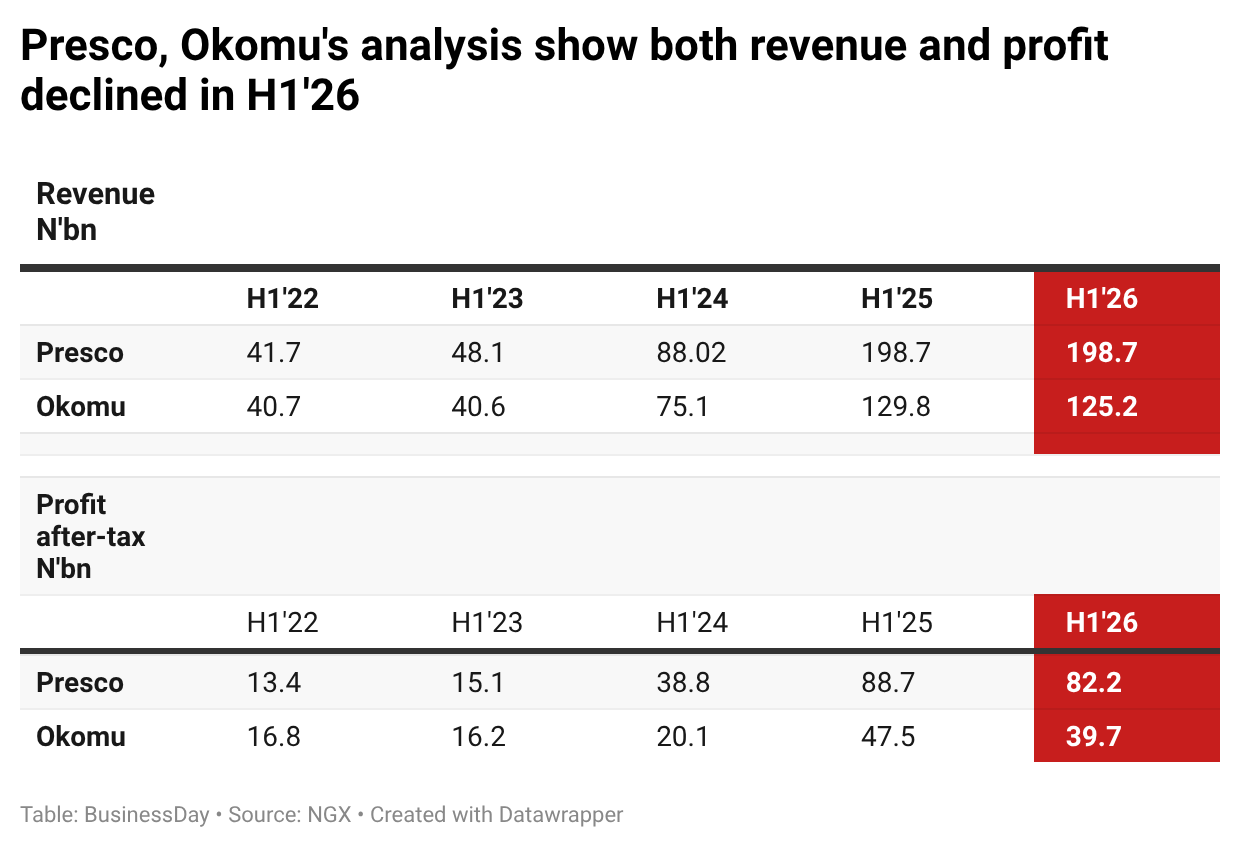
Half-year financial statements reviewed by BusinessDay show that the country’s two largest listed oil palm companies delivered a combined revenue of N323.9 billion and profit after tax of N121.9 billion in the first six months of 2026. However, beneath those headline numbers lies an emerging slowdown that mirrors the growing strains across Nigeria’s palm oil industry.
Presco reported revenue of N198.7 billion in H1 2026, unchanged from the same period last year, while profit after tax declined 7.3 percent to N82.2 billion from N88.7 billion.
Okomu’s performance weakened further. Revenue fell 3.5 percent to N125.2 billion from N129.8 billion, while profit after tax dropped 16.4 percent to N39.7 billion, compared with N47.5 billion a year earlier.
The earnings moderation comes after an extraordinary period of expansion.
Combined revenues of both companies have increased from N82.4 billion in H1 2022 to N323.9 billion in H1 2026, representing almost a four-fold increase in four years. Combined profit after tax climbed from N30.2 billion to N121.9 billion over the same period, reflecting how soaring palm oil prices and capacity expansion transformed the economics of Nigeria’s plantation business.
Yet the industry’s strongest growth phase appears to be giving way to a more uncertain operating environment.
The tariff decision is changing the market
In April, the Federal Government approved new fiscal policy measures that reduced import tariffs on crude palm oil to 28.75 percent from 35 percent, alongside duty reductions on several food commodities as part of efforts to moderate inflation.
The decision was intended to lower food costs, but plantation operators argue that it has also opened the domestic market to cheaper imports at a time when local producers are investing heavily to expand capacity.
According to the Foreign Trade Statistics report for the first quarter of 2026 released by the NBS, crude palm oil ranked among the agricultural products imported into the country between January and March 2026.
The data disclosed that Africa’s most populous country spent N23 billion, representing a 30.26 percent increase from the same period of last year in importing crude palm oil from fellow West African countries within three months.
“The industry is at an existential moment,” Emmanuel Ibru, chairman of the Plantation Owners Forum of Nigeria (POFON), said, warning that billions of dollars invested by indigenous and foreign companies could be undermined by rising imports of cheaper crude palm oil.
According to Ibru, imports should only bridge Nigeria’s production deficit rather than become a permanent feature competing directly with domestic producers.
Industry data suggest those concerns are already feeding into market prices.
Fresh fruit bunch prices have fallen by about 43 percent, from N2.8 million per tonne to N1.6 million per tonne, reflecting what producers describe as increased imports and the influx of allegedly smuggled vegetable oils. The weaker pricing environment has quickly filtered into company earnings.
Backward integration projects threatened
Nigeria’s oil palm sector has spent more than a decade rebuilding under the 2011 backward integration policy, which used tariffs and import controls to justify long-dated capital spending on plantations that take years to mature.
The results were real: oil palm fruit production rose from 8 million metric tons in 2013 to 11.6 million metric tons in 2024, according to the Food and Agriculture Organisation, a 45 percent increase over 11 years.
Major players — Presco, Okomu, Wilmar, Dufil Prima Foods, and Agric Palm, among them, expanded plantation footprints on the strength of that predictability.
That predictability is what industry leaders say is now being tested. Fatai Afolabi, managing director of Foremost Development Services Limited, said sudden import surges create instability that discourages long-term capital allocation.
“When investors cannot predict policy direction, confidence erodes. That slows expansion and new planting,” he said.
Christopher Uwala, president of the Soybean Association of Nigeria, put it more starkly: continued import pressure is pushing farmers into financial distress, with stakeholders running into debt.
Manufacturers are feeling the other side of the same squeeze. Mohammed Tahir, chairman of the vegetable oil subsector of the Manufacturers Association of Nigeria, said several processors are operating below capacity as imported oil undercuts domestic supply.
“When you talk about food security, it is not just about bringing food into the country,” Tahir said. “If you are not self-reliant, you remain exposed to external shocks.”
Industry groups argue that imports should be used strictly to close production gaps rather than become a structural feature of the market. Nigeria’s population is expanding at roughly 2.1 percent annually, increasing edible oil demand and widening the supply-demand gap.
Backward integration programmes rely on predictable tariff regimes and import controls to justify large upfront capital expenditure in plantations that take years to mature. Policy reversals or temporary waivers, even if intended to ease short-term food price pressures, can alter investor calculations.
If import volumes continue to rise without a clearly defined quota or gap-filling framework, analysts say Nigeria could slow the production gains achieved over the past decade and re-entrench dependence on foreign supply. For an industry that has rebuilt itself over two decades, the next policy move may determine whether 2028 marks a peak.
Presco doubles down despite headwinds
Despite the emerging challenges, Presco is expanding.
The company recently announced plans to invest about $100 million to establish operations in Ogun State, extending its plantation footprint beyond Edo and Delta States.
Adewale Arikawe, group chief executive officer, announced the investment after meeting Ogun Governor Dapo Abiodun Abeokuta recently. Nigeria, which once accounted for 43 percent of global palm oil supply, is now a net importer with less than five percent of global output.
The investment aims to expand domestic production and reduce reliance on foreign supply, while creating jobs in processing, farming and logistics.