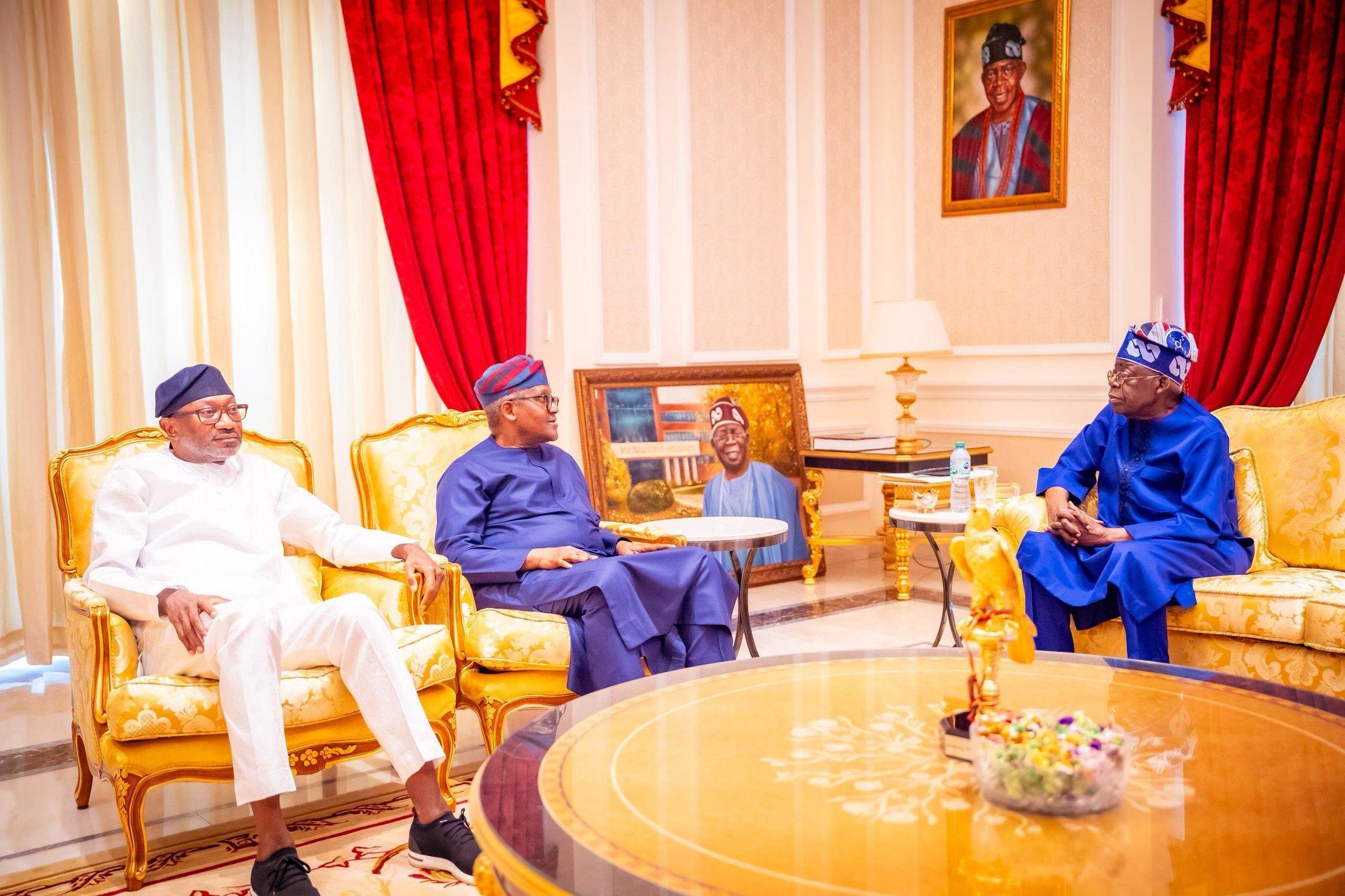
On Sunday, April 5, 2026 billionaire businessman Femi Otedola and Africa’s richest man, Aliko Dangote, met with President Bola Tinubu to discuss Nigeria’s economy and how ongoing reforms could benefit citizens.
- +Otedola and Dangote meet President Tinubu to discuss economy
The meeting was confirmed in a statement by Otedola on his personal Instagram page on Monday afternoon, April 6, 2026
The meeting was confirmed in a statement by Otedola on his personal Instagram page on Monday afternoon, April 6, 2026
Otedola had disclosed that discussions with the President focused on Nigeria’s economy and how ongoing reforms can benefit citizens.
However, reactions on social media suggest that many Nigerians remain unconvinced about the tangible impact of such high-level meetings.
In his Instagram post, Otedola wrote:
The post framed the meeting as both a personal engagement and a broader discussion on national economic policy.
The post has generated significant engagement on social media, with over 1,000 comments and 170 reshares. A significant portion of commenters questioned the substance of the discussions, with some dismissing the meeting as symbolic rather than outcome-driven.
Others interpreted the post as a subtle political endorsement of President Tinubu, suggesting that influential business figures should be more explicit about their political alignments rather than framing engagements as economic discourse. Some comments include:
The meeting comes against the backdrop of recent initiatives by the Tinubu administration.
Nairametrics previously reported that President Tinubu inaugurated a N73 billion customs complex in Iperu, Ogun State, aimed at strengthening trade facilitation, enforcement, and revenue generation.
The complex houses the Federal Operations Unit (FOU) Zone ‘A’, spans 142 buildings on 100 hectares, and delivers international-standard operational capacity.
Also, Nairametrics reported that the president approved a N3.3 trillion payment plan to settle longstanding debts in the power sector under the Presidential Power Sector Financial Reforms Programme. The settlement covers debts accumulated between February 2015 and March 2025 and is expected to stabilize electricity generation and improve service delivery.
Despite these reforms, several crises caution that rising insecurity in states like Benue, Plateau, Zamfara, and Borno continues to dampen the impact of policy measures, limiting economic gains and investor confidence.