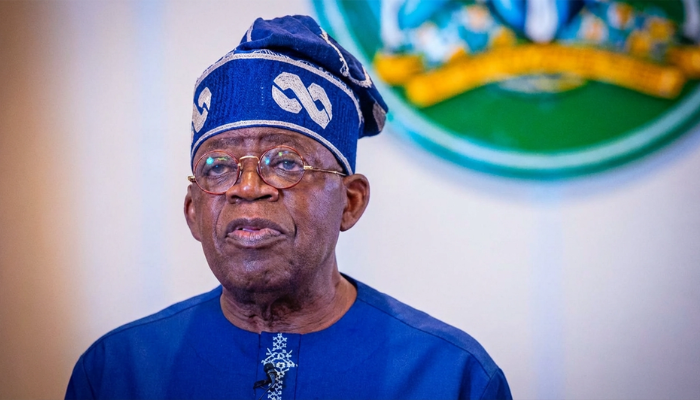
Tinubu welcomes APC presidential nomination, pledges deeper economic consolidation
- +…Promises a bankable, investable power sector in 2nd term
- +….Says ‘ I want to build a Nigeria where everyone is secured’
President Bola Tinubu stated on Sunday that his administration has recorded significant progress across several sectors.
….Says ‘ I want to build a Nigeria where everyone is secured’
President Bola Tinubu stated on Sunday that his administration has recorded significant progress across several sectors. He highlighted milestones in the power sector, where generation has occasionally peaked at 6,000 megawatts (MW)—representing a 50% increase over the capacity inherited by his government.
The President outlined these achievements during his acceptance speech at the Bola Ahmed Tinubu International Conference Centre in Abuja. The address followed the presentation of his certificate of return and the All Progressives Congress (APC) flag, solidifying his victory in the party’s presidential primary held on Saturday.
Results collated by returning officers, primarily APC governors across the 36 states, showed that President Tinubu secured 10.6 million votes. He defeated Stanley Osifo, who received approximately 16,546 votes.
The President commended the ruling party for its confidence in returning him as the presidential candidate for the 2027 general election. He expressed gratitude to the party leadership, governors, the National Working Committee, federal lawmakers, and loyal members for maintaining party unity.
“I accept, with humility and profound gratitude, the nomination of our great party, the All Progressives Congress, to stand again as its presidential candidate in the 2027 general election,” President Tinubu said. He assured supporters that his second tenure would be dedicated to rebuilding Nigeria into a secure nation.
Reflecting on his first-term commitments, President Tinubu noted that his administration has successfully eliminated financial barriers to higher education for Nigerian youth. The newly established Nigerian Education Loan Fund has disbursed over ₦282 billion to more than 1.5 million beneficiaries.
The President also emphasised structural updates to the electricity market, citing promises to improve power supply and eliminate estimated billing. Through the Presidential Metering Initiative, the administration has supplied 2.5 million meters over the past three years to close the metering gap.
Furthermore, the federal government has established a ₦4 trillion bond programme to settle verified legacy debts owed to generation companies (GENCOs) and gas companies (GASCOs). President Tinubu explained that the strategy focuses on redesigning the power sector into a bankable, investable, and capable framework that reliably serves homes and industries.
The administration has transitioned away from wasteful fuel subsidies, volatile exchange rates, and weak infrastructure. President Tinubu reported that these interventions have strengthened macroeconomic stability through improved revenue performance, robust financial management, and enhanced fiscal coordination.
“Today, we are witnessing a turnaround: the naira is strengthening, foreign reserves are rising, and our economic outlook is positive,” President Tinubu stated. He noted that this progress has been sustained despite inflationary disruptions triggered by the war in Iran and broader geopolitical crises in the Middle East.
The President compared the current structural realities with the political landscape of 2022, when he competed at Eagle Square alongside former President Muhammadu Buhari. He stated that subsequent electoral reforms have strengthened the credibility of the democratic process, while fresh tax laws and fiscal policies have boosted revenue collection for the federation.
President Tinubu acknowledged that despite these policy successes, significant domestic challenges remain. Many citizens continue to navigate rising costs and economic adjustments, concerns that the President stated his administration handles with honesty and practical action rather than dismissal.
Insecurity remains a prominent concern, prompting intensified efforts to upgrade national security architecture, support the armed forces and police, and expand community partnerships. The federal government continues to invest in intelligence, surveillance, and modern equipment to address the root causes of volatility.
To provide a sustainable structural framework for internal security, President Tinubu reiterated his expectation for constitutional amendments. He urged the National Assembly to allow the creation of state police as a matter of national emergency to restore peace across all regions.
Looking ahead, the President emphasised that his mission is to place Nigeria on an irreversible path of industrialisation, energy security, infrastructure development, and food sufficiency. He stated that infrastructure projects across transportation, digital connectivity, and housing remain central engines for inclusive growth. Among these are durable concrete superhighways along the coast and the Sokoto-Badagry route designed for long-term resilience.
The administration is also upgrading airports and seaports, while driving fresh billions of dollars in investments into a reformed oil and gas sector. Social investment programmes continue to target vulnerable households, small businesses, youth, and women to preserve social cohesion.
President Tinubu extended an invitation to his political opponents, offering dialogue and engagement to consolidate national gains. “Democracy is sustained not by uniformity, but by diversity, by a shared belief in the nation and the blending of ideas,” he concluded, urging citizens to avoid complacency in the upcoming elections.