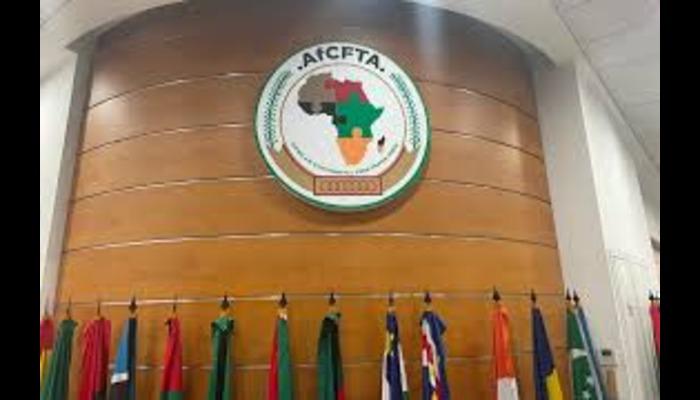
An African commodity exchange could be the missing piece in unlocking the full potential of the African Continental Free Trade Area (AfCFTA).
- +AfCFTA faces new test with Tinubu’s push for African commodity exchange
By creating a central platform for buyers and sellers, it would enable transparent price discovery, reduce transaction risks, and allow African countries to capture more value from their commodities.
By creating a central platform for buyers and sellers, it would enable transparent price discovery, reduce transaction risks, and allow African countries to capture more value from their commodities.
President Tinubu, at the Africa CEO Forum in Kigali, emphasizes that an African commodity exchange is “non-negotiable” for Africa’s producers and traders.
Tinubu’s call to stop routing transactions through external currencies and markets aligns with the AfCFTA’s goals. Reliance on the dollar introduces costs and volatility that Africa “can no longer afford,” he argued.
AfCFTA has created a unified legal and tariff framework across 54 countries and intra-African trade is rising, reaching $220.3 billion in 2024, according to data from Afreximbank, though it remains low at 15-18 percent of the continent’s commerce.
“An exchange is the only way commodities can be traded effectively across many countries and for industries to also be competitive,” Ayodeji Balogun, group chief executive officer of AFEX Commodities Exchange.
AfCFTA already has the Pan-African Payment and Settlement System, PAPSS – a game-changing payment platform which experts say represents the complementary settlement architecture that the continental commodity exchange would require.
“The continental exchange will handle the trade infrastructure while PAPSS will be used for settlement,” Balogun said. “Nestle can buy cocoa from Nigeria, Côte d’Ivoire, and Ghana through an exchange and use PAPSS for payments to the sellers from each of these countries,” Balogun explained citing an example.
“Instead, today they have to go to the London International Commodities Exchange (ICE) to buy cocoa,” he noted. The UN Trade and Development (UNCTAD) had projected that the full implementation of AfCFTA would narrow Africa’s trade deficit by more than half.
Experts say the realisation of this depends on the emergence of institutions capable of supporting transparent price discovery, reliable settlement, and cross border logistics, precisely the functions that a continental commodity exchange would be expected to perform.
“The international practice of purchasing a commodity across countries is through commodity exchanges or licensed warehouses,” said. AfricanFarmer Mogaji, chief executive officer of Agbado Value Chain Ltd.
“With a unified commodity exchange, intra-Africa trade will scale with businesses getting better deal,” he said.
Existing country-specific commodity exchanges Africa has around 15 operational commodity exchanges, but they’re country-specific, and there’s no unified continental exchange yet.
The continent accounts for roughly 30 percent of the world’s mineral resources and is home to major agricultural commodities, but is vastly recognised as a price-taker in international commodity markets.
Commodity exchanges have long been touted as a means to disrupt the status quo in Africa’s resource-rich economies, promising improved price discovery, better market coordination, and greater participation for producers in the value chains that shape the continent’s own resources.
Several country-specific commodity exchange platforms and supporting institutions have spent years attempting to build the requisite infrastructure, yet tangible progress has remained elusive.
Nigeria hosts three active commodity exchanges with varying levels of activity, two of which are privately owned. The Nigeria Commodity Exchange (NCX), supervised by the Ministry of Industry, Trade, and Investment, has operated since 2006 but struggled to build liquidity and participation for scale.
The Lagos Commodities and Futures Exchange (LCFE), launched in 2015, is the second such entity, aiming to provide a broader multi-asset framework spanning agriculture, minerals, and energy products.
LCFE has since integrated warehouse receipts and a three day settlement cycle, but remains in the early stages of market development for several products and initiatives.
The third and most active, AFEX Commodities Exchange, initially began operations in Nigeria in 2013 through a collaboration with the Federal Ministry of Agriculture under the Agricultural Transformation Agenda. The initiative sought to modernise market systems by expanding structured warehousing, quality standards, and warehouse receipt infrastructure.
That foundation shaped AFEX’s development into a platform that combines trading with a wider set of market support functions, including storage, grading, logistics coordination, and financing mechanisms. Over the past decade, AFEX has expanded operations into Kenya and Uganda, now owning the broadest regional footprint.
Across Africa, the Johannesburg Stock Exchange’s commodities market, built on the former SAFEX platform, remains the continent’s most technically successful commodity exchange, offering deep and sustained liquidity in agricultural futures for more than two decades.
Its model, however, reflects the specific conditions of South Africa’s financial system and commercial farming sector, and is oriented primarily toward derivatives trading rather than the physical aggregation, warehousing, and smallholder participation that many African markets require.
Other countries’ specific commodity exchanges across the continent illustrate different approaches and their constraints. Ethiopia’s Commodity Exchange (ECX), established in 2008, demonstrated that structured trade can scale rapidly under a coordinated framework but also showed how sensitive such systems are to policy shifts and market design choices.
Malawi’s Agricultural Commodity Exchange for Africa (ACE), launched earlier in 2005, highlighted the value of warehouse receipts and farmer level aggregation, yet faces persistent challenges around volumes, infrastructure, and market participation.
Similar patterns are evident in Rwanda and Kenya. Collectively, these experiences suggest that Africa’s challenge has not been a dearth of commodity exchanges, but rather the difficulty of sustaining policy stability, infrastructure, financial depth and market participation needed for them to operate at scale.
It is against this backdrop that President Tinubu is calling for an African commodity exchange to accelerate trade. The question now is whether governments and firms can build this infrastructure fast enough to accelerate AfCFTA’s impact and drive economic integration.