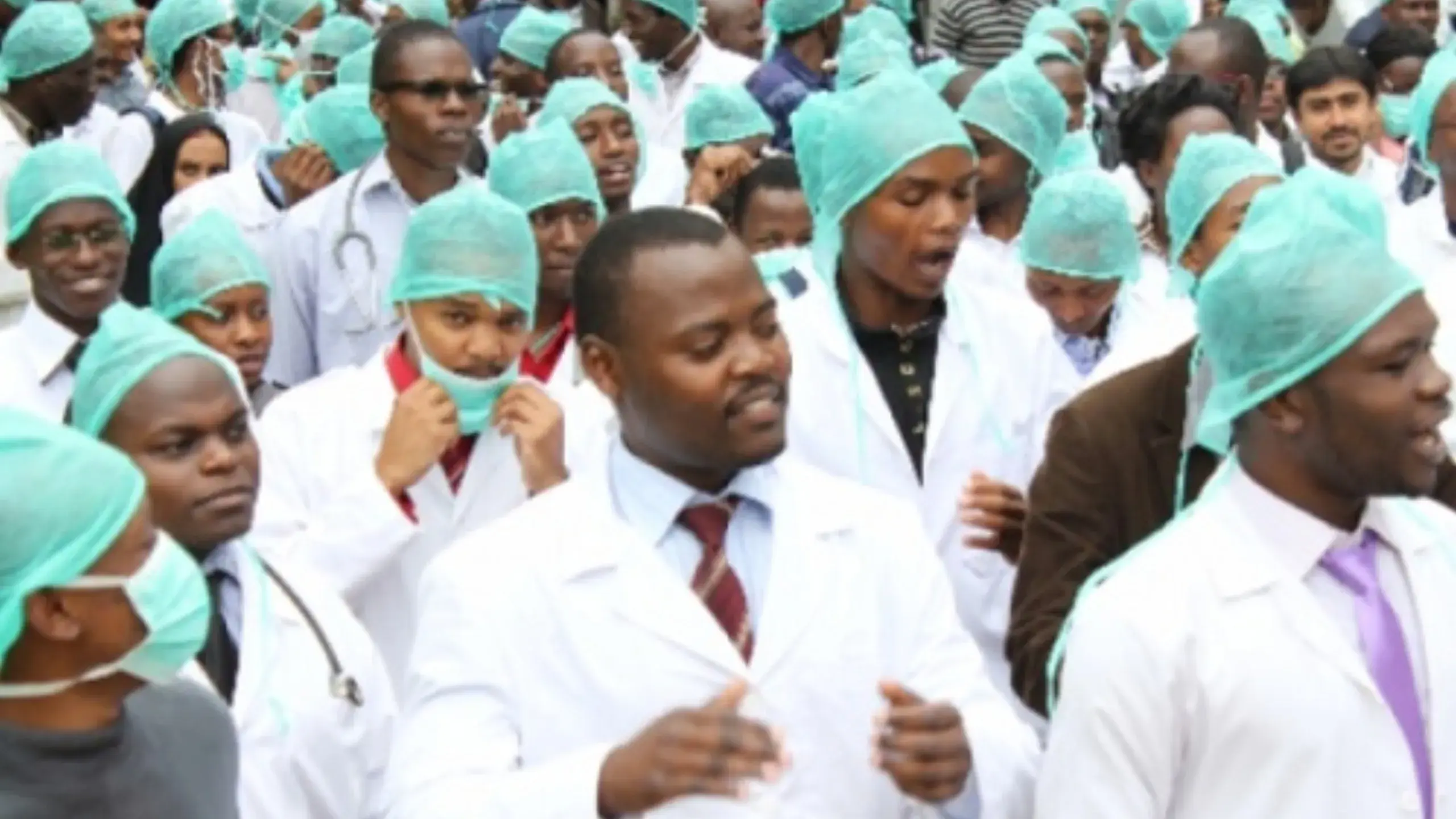
Nigeria’s healthcare sector is facing mounting pressure as the number of medical students graduated annually rise, while housemanship induction has remained a nightmare for many as universities violate the Medical and Dental Council of Nigeria (MDCN) quotas rule.
- +Revenue-driven admission outpace training for Nigerian doctors
For thousands of medical graduates, the journey to becoming licensed doctors has become an increasingly uncertain and frustrating ordeal.
For thousands of medical graduates, the journey to becoming licensed doctors has become an increasingly uncertain and frustrating ordeal.
Nubi Achebo, director of academic planning at Nigerian University of Technology and Management (NUTM), described the systemic failures as delaying careers, worsening workforce shortages, and exposing deep cracks in Nigeria’s medical education and licensing system.
“MDCN sets quotas based on teaching hospitals, lecturers, labs, beds, and supervision capacity. The idea is to protect quality. If you train 250 doctors with resources for 150, clinical rotations get crowded, supervision drops, and you risk producing doctors who haven’t seen enough cases.
“Admitting beyond quota brings more tuition, meets political pressure, and ‘hopes some will fail’, and that the gamble puts students at risk six to eight years later, because MDCN will only induct the approved number,” he said.
Many Nigerian medical students face delayed induction because universities routinely violate the Medical and Dental Council of Nigeria (MDCN) carrying capacities.
This quota system ensures that teaching hospitals and facilities are not overstretched, affecting both federal institutions and newer private medical colleges.
At least 44 MBBS graduates of the University of Ilorin are still waiting without a date for induction for their housemanship, as the university failed to present them to the MDCN for induction.
The MDCN approved a maximum of 150 as the admission quota for the MBBS programme at the university. However, UNILORIN violated this quota and admitted over 200 students into the programme in 2017.
In 2025, medical and dental graduates from the University of Calabar were denied induction for a similar offence. Similarly, medical graduates from Ambrose Alli University, Ekpoma, protested against non-induction despite graduating in August 2024.
Babajide Saheed, a chieftain of Nigerian Medical Association, maintains that the MDCN is in order to maintain professional structure.
“We shouldn’t because of doctors’ shortage endorse illegality, we should learn to adhere to structures; in countries such as the USA, and UK, there’re structures, which supersedes the individual or group interests.
“The MDCN is right. We have to strengthen the structure of the profession, and the education system, despite doctors’ shortfall crisis,” he said.
Saheed emphasised that people should not been sentimental, because that will dent the structure, university integrity, medical profession and the move to curb the illegality, and maintain sanity in the sector.
“If a university violates the quota rules, such institution should be punished. When a university is sanctioned for violation of the quotas, others will sit-up,” he noted.
He reiterated that the unethical practice thrives because the regulatory body is not punishing offenders. “If the offenders are allowed to go unpunished, it fuels corruption, and illegality.
He advocates students should take legal action against the universities. “If the students sue universities, I think the judiciary will help interpret the law, and probably reverse the policy.
“Besides, the regulatory body should ensure universities upload their quotas each year, so, everybody will be aware before admission,” he said.
However, Stanley Alaubi, senior lecturer at the University of Port Harcourt, blames this on the poor regulatory system.
“Where was the MDCN when those students were admitted beyond the stipulated quota?” he asked.
Alaubi emphasised the need to jettison the quota system, induct and integrate the graduates into the medical workforce to ameliorate Nigeria’s plight.
Nevertheless, Achebo argued that MDCN could be right to defend its standards, and Nigeria guilty of wasting trained doctors, while people die for lack of care.
“The core failure is governance. Universities broke a rule, and the regulator has no mechanism to correct it without hurting innocent students. That is a policy design flaw.
“We need enforcement and flexibility. Enforce quotas, but create a remedial path for those caught in the middle,” he said.
Jessica Osuere, chief executive officer at RubiesHub Educational Services, said quotas exist to ensure medical schools have enough lecturers, teaching hospitals, laboratories, and clinical exposure to train competent doctors.
“The way forward is for the government to urgently expand the training capacity of accredited medical schools by investing in infrastructure and faculty, while the MDCN and NUC regularly review quotas based on available resources and the health needs of the populace.
“Universities must be held accountable for adhering to admission limits until those capacities are officially increased,” she said.
Though Nigeria needs more doctors, she said the country also needs to ensure that it maintains the quality and safety of medical training.
Experts argue that Nigeria’s hospital crisis is driven by a massive brain drain, which ought to have been addressed by inducting more medical graduates into the sector.
Nigeria has a severe doctor shortage, with about 55,000 licensed doctors for 220 million people; that is about 1 to 4,000 people, while the World Health Organization recommendation is 1 to 600.
In the face of this, stakeholders believe it is high time the federal government implemented its promised plans to double medical admission quotas with funding attached.
As demand for medical doctors continues to outstrip capacity, experts say sustained investment in infrastructure, faculty and funding reforms will be critical to easing the bottlenecks confronting future MBBS graduates.