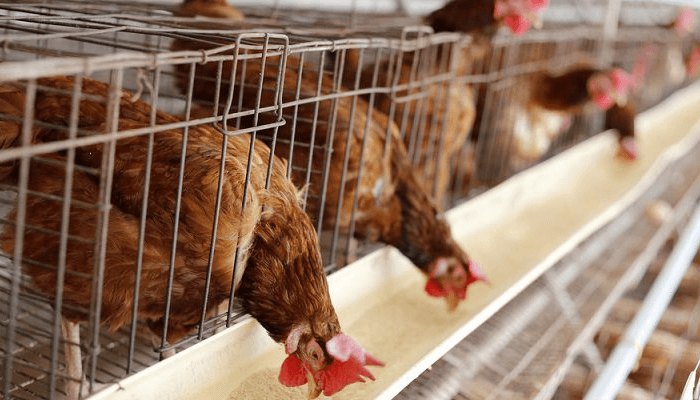
Nigerian poultry are increasingly opting to ditch commercial feed suppliers and switch to homemade blends, thereby cutting costs and boosting margins in a sector that has been battered by high input prices.
- +Nigerian poultry farmers ditch pricey feeds for homemade blends
Despite a 62.5 percent plunge in maize and soybean costs – key inputs in poultry feed formulations – millers slashed prices by only 10 percent.
Despite a 62.5 percent plunge in maize and soybean costs – key inputs in poultry feed formulations – millers slashed prices by only 10 percent. Feeds account for 70 percent of poultry farmers operating expenses, making it the largest single expense for most producers.
“We mill the feeds used on our poultry farm. It is more profitable for us than buying commercial feeds,” said Martha Adegoroye, a poultry farmer in Lambe, Akute, Ogun State.
Adegoroye noted that preparing homemade feed blends is helping her farm save N1,500 per kg compared to the cost of commercial feeds.
Sunday Ezeobiora, president of the Poultry Association of Nigeria, explained that the fight for survival during the constant surge in the prices of commercial feeds forced many poultry farmers to become innovative by formulating their feeds for birds.
“Lots of farmers are switching from commercial feeds to their own feed formulation to reduce costs,” Ezeobiora noted. “You have to be innovative to survive, and that is what the farmers are doing to keep their businesses afloat. They will get it by at least five percent cheaper than a bag of commercial feed,” he added.
He argued that the mitigation strategies adopted by most poultry farmers have stabilized the prices of eggs and poultry meat in the country.
Miller’s inability to reduce feed prices is driven primarily by logistical, energy, and macroeconomic challenges that add significant overhead to their production costs.
Manufacturers spend 40 percent of their total production costs on generating power for their businesses, according to the Manufacturers Association of Nigeria (MAN). The Iran war has further increased this cost for manufacturers as prices of diesel jumped over 70 percent since the crisis.
Feed producers explained that even when major raw material ingredients (maize and soybeans) for poultry feeds are relatively cheaper, several factors directly influence their ability to decrease final prices.
“Yes, maize and soybean prices have crashed by over 50 percent; however, we cannot reduce our prices drastically,” said a manager at a Feed Mill in Oyo state who was not authorized to speak on the issue.
He explained that prices of additives, acidifiers and bagging the feeds are rising, coupled with escalating power and logistics costs.
He noted that despite the crash in maize prices, production of poultry feeds remains expensive because producers require foreign exchange to import other components of the raw materials.
The country’s poultry and aquaculture industries are expanding, which is supposed to translate into higher demand for feeds. However, the momentum is not translating into the feed milling industry.
“Feed millers who consume the largest quantity of corn through bulk purchases now face reduced patronage from poultry farmers,” the United States Department of Agriculture (USDA) said in its March grain report on Nigeria.
“Rather than experiencing increased sales, corn consumption by feed millers is expected to remain flat,” the report said in its projection.
Taiwo Adeoye, former president of the Animal Science Association of Nigeria (ASAN), said from his Ogun State farm, that farmers formulating their feed do so without a proper cost analysis.
He explained that it is not more profitable to formulate one’s own feed over commercial feeds owing to inadequate expertise in the feed formulation processes. “If you look at it on a dipper cost analysis, it is not cheaper,” Adeoye said.
Growth in the country’s livestock sub-sector, in which poultry accounts for a bulk of it, grew 0.08 percent in 2025 from a contraction of 2.14 percent in 2024.