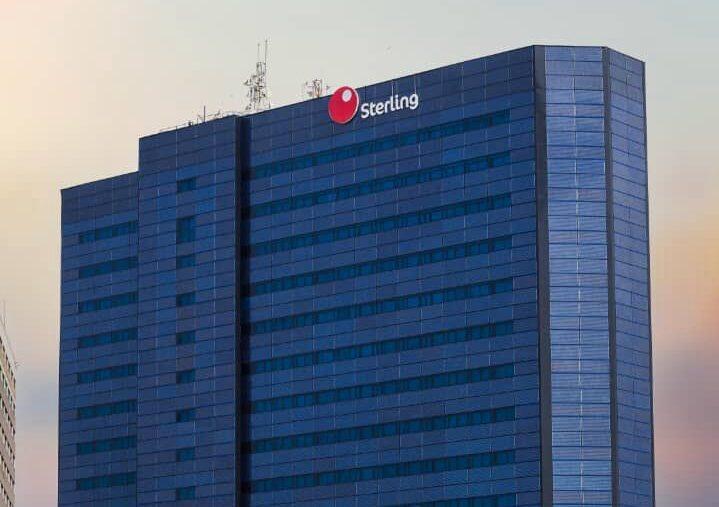
Sterling Financial Holdings Company Plc’s decision to consolidate its shares on a 10-for-1 basis has sparked debate among capital market stakeholders, with analysts and market operators raising concerns about the potential impact on shareholder value, liquidity, and future market performance.
- +Sterling Holdings shareholders question value after 10-for-1 consolidation
The resolution, approved by shareholders at the company’s 3rd Annual General Meeting held on June 9, 2026, will see Sterling reduce its issued shares from 68.5 billion units to 6.85 billion units through a share reconstruction exercise, subject to regulatory approvals and confirmation by the Federal High Court.
The resolution, approved by shareholders at the company’s 3rd Annual General Meeting held on June 9, 2026, will see Sterling reduce its issued shares from 68.5 billion units to 6.85 billion units through a share reconstruction exercise, subject to regulatory approvals and confirmation by the Federal High Court.
While management has not publicly disclosed the strategic rationale behind the move, experts believe the reconstruction represents one of the most significant capital structure adjustments by a Nigerian banking group in recent years.
The development comes at a time when Sterling is simultaneously seeking approval to raise up to $400 million through various debt and equity instruments, prompting questions about the timing and broader implications of the exercise.
The AGM resolutions reveal a major restructuring of Sterling Financial Holdings’ capital structure alongside plans for fresh capital raising:
For existing shareholders, the practical implication is straightforward: every ten shares currently held will be converted into one share after the reconstruction.
Share reconstruction, sometimes referred to as share consolidation, does not alter the total value of an investor’s holdings immediately after implementation.
Analysts note that the success of such exercises depends largely on earnings growth, dividend capacity, and investor confidence rather than the reconstruction itself.
Yet, market participants remain cautious given historical examples where reconstructed stocks eventually declined back toward their pre-reconstruction valuation levels.
One frequently cited example is C & I Leasing, whose 4-for-1 reconstruction initially boosted its share price from around N3 to approximately N12 before the stock later retraced significantly. Today, the company’s shares trade well below the reconstructed level despite years having passed since the exercise.
Capital market stakeholders have expressed mixed reactions to Sterling’s decision, with some questioning the benefits for shareholders while others believe management may have strategic considerations not immediately visible to the market.
According to Chief Blakey Okwudili Ijezie, founder of Okwudili Ijezie & Co. (Chartered Accountants), the reconstruction raises concerns about long-term shareholder value.
Ijezie argued that reducing the number of shares does not automatically create value for investors.
He noted that investors with large holdings would see their share counts reduced substantially while relying on market performance to preserve value.
Dr. David Walker Ogogo, pioneer Registrar of the Institute of Capital Market Registrars (ICMR), offered a more balanced perspective.
According to him, boards typically evaluate numerous strategic considerations before approving such major corporate actions.
He suggested the reconstruction may be tied to broader strategic objectives that are not yet fully disclosed to shareholders.
However, Ogogo acknowledged that the move may not immediately align with shareholder interests.
Nevertheless, he cautioned investors against panic selling, emphasizing that experienced boards generally act with long-term institutional objectives in mind.
Dr. Ebo Ayodeji also observed that previous reconstruction exercises have often been followed by short-term price declines.
He explained that reducing shares outstanding may improve per-share metrics and help stabilize volatility over time.
The debate comes despite Sterling Financial Holdings reporting one of its strongest financial performances in recent years.
The Group posted a pre-tax profit of N86.78 billion for the 2025 financial year, representing an 89.2% increase from N45.86 billion recorded in 2024.
Historical precedents in the Nigerian market suggest that reconstructed share prices often require strong operational performance to sustain elevated valuation levels, which is partly why C & I Leasing shares consolidation is yet to make a positive impact on pricing.
As investors digest the implications of the move, attention is likely to shift from the mechanics of the reconstruction to whether Sterling can sustain its strong earnings momentum and convert improved per-share metrics into lasting shareholder value.