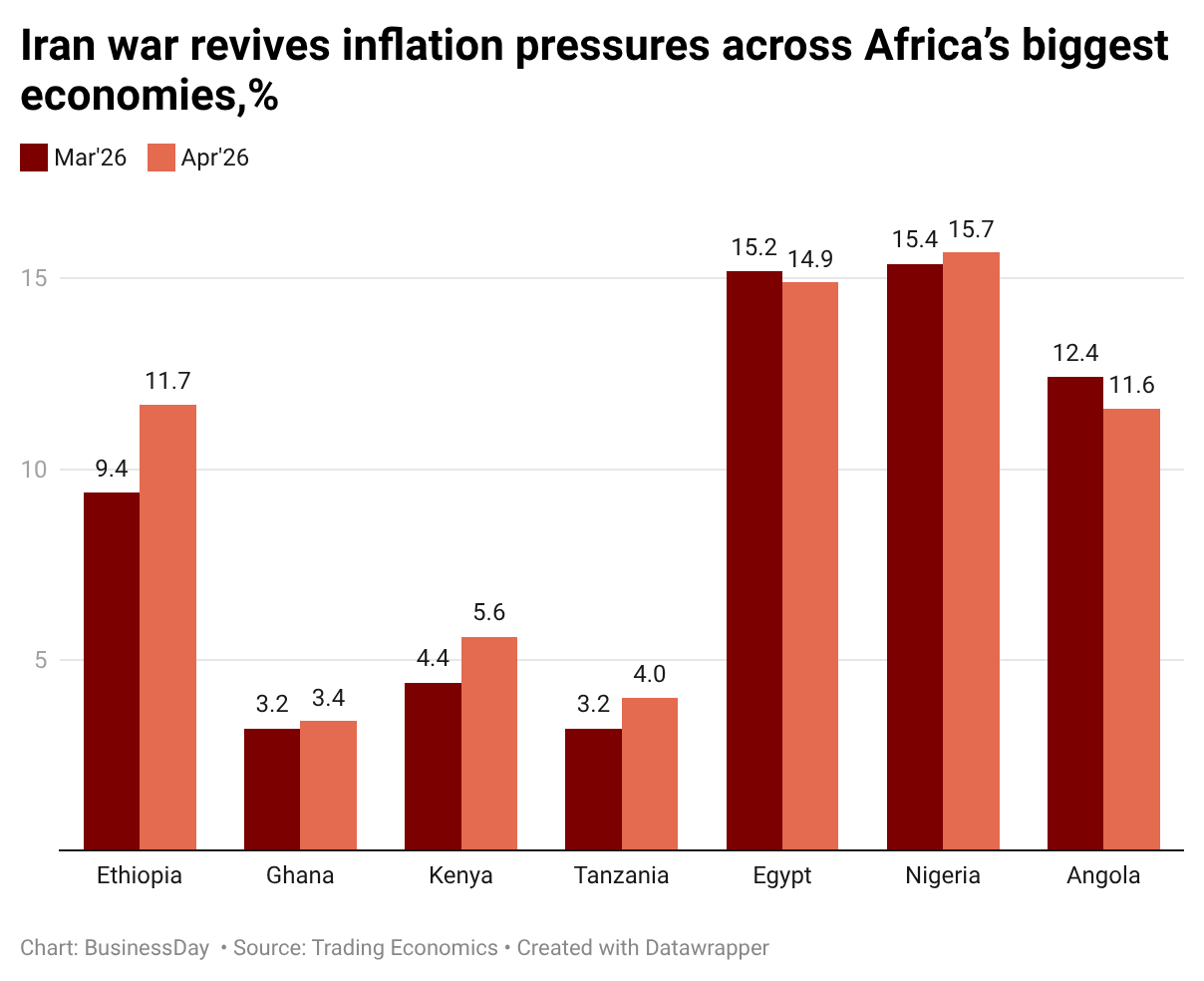
Iran war reignites inflation pressures across Africa’s biggest economies in April
- +Ethiopia’s inflation returns to double digits
- +East Africa feels the pressure
- +West Africa’s disinflation story weakens
- +Southern Africa takes defensive measures
- +Egypt, Angola defies the trend—for now
Inflation pressures resurfaced across some of Africa’s biggest economies in April as the prolonged Iran conflict pushed global oil prices above $100 per barrel, driving up fuel, transport and food costs and threatening to reverse months of easing price pressures across the continent.
Inflation pressures resurfaced across some of Africa’s biggest economies in April as the prolonged Iran conflict pushed global oil prices above $100 per barrel, driving up fuel, transport and food costs and threatening to reverse months of easing price pressures across the continent.
For more than two months, escalating tensions involving the United States, Israel and Iran have rattled commodity markets and heightened concerns over supply disruptions around the Strait of Hormuz, a key artery for global oil shipments. The shock is now feeding directly into African economies through higher fuel, transport, food and production costs.
The reversal marks a significant turning point for policymakers who, until recently, had been benefiting from easing inflation after aggressive monetary tightening over the past two years.
“Prices of Brent crude oil and liquefied natural gas have risen sharply, while fertilizer prices have also increased amid disruption to shipments through the Strait of Hormuz,” the World Bank said in its latest Africa’s Development Update. “These developments threaten both current and future planting seasons, potentially exacerbating food insecurity.”
The multilateral lender warned that rising fuel and food import costs could force central banks—particularly in oil-importing economies—to halt easing cycles or tighten policy again.
Ethiopia’s inflation returns to double digits
Ethiopia has emerged as one of the hardest-hit economies.
Annual inflation accelerated to 11.7 percent last month, returning to double digits after five months in single-digit territory, according to Trading Economics data. The jump was driven largely by food and fuel costs following a 35 percent increase in petrol prices.
Food inflation climbed to 13.5 percent, while non-food inflation rose to 9.1 percent.
The rebound reverses one of the clearest gains from the second most populous nation’s macroeconomic reform programme, which had helped push inflation below 10 percent through tighter monetary policy, fiscal restraint and improved supply conditions.
But the country’s heavy dependence on imported fuel has left it highly exposed to global energy shocks.
Fuel prices were adjusted twice within weeks. On April 1, the government raised diesel prices to 163.09 birr per litre and gasoline to 142.41 birr. Another increase followed in May, with diesel rising to 180.46 birr and gasoline to 167.50 birr.
The speed and scale of the increases illustrate how rapidly external oil shocks are being transmitted into domestic inflation.
East Africa feels the pressure
In Kenya, inflation accelerated to 5.6 percent from 4.4 percent in March—the highest level in two years.
Transport costs surged 10 percent year-on-year, reflecting higher petroleum prices linked to the Middle East conflict. Food inflation also accelerated, while monthly consumer prices rose 1.4 percent, the sharpest increase since April 2022.
The government has attempted to cushion households in the East Africa’s biggest economy by reducing Value Added Tax on petroleum products from 16 percent to 9 percent and deploying the fuel stabilisation fund. About KES 6.2 billion ($40 million) has already been spent to contain pump prices.
Still, Treasury officials expect inflationary pressure to intensify further in the coming months.
Tanzania also saw inflation rise to a near three-year high of 4 percent in April, driven by higher transportation, education and consumer goods prices. Monthly inflation jumped 1.3 percent—the fastest pace since 2019.
West Africa’s disinflation story weakens
In Ghana, inflation edged up to 3.4 percent in April from 3.2 percent in March, interrupting a disinflation trend that had been in place since late 2024 for the continent top gold producer.
Government Statistician Alhassan Iddrisu said the increase was driven mainly by transport, education, restaurants and accommodation costs.
“Inflation remains slow overall but we are beginning to see a slight upward movement,” Iddrisu said.
He noted that global shocks and regional disruptions were beginning to push food and fuel prices higher again, although the impact had not yet spread fully across the inflation basket.
The development complicates the outlook for the Bank of Ghana, which has been cutting rates aggressively this year. The central bank is expected to hold its next Monetary Policy Meeting on May 18th to 20th.
In Nigeria, headline inflation rose for a second straight month to 15.69 percent—the highest level in five months—after March data ended an 11-month disinflation trend.
Food inflation in Africa’s most populated country accelerated to 16.06 percent as fuel price pressures and supply chain disruptions fed through to consumer prices.
Economists expect inflation to rise further in May following another increase in domestic fuel prices, complicating the policy outlook ahead of the Central Bank of Nigeria’s next rate decision this month.
Southern Africa takes defensive measures
South Africa has so far seen only modest inflationary pressure, with annual inflation rising slightly to 3.1 percent in March from 3 percent previously.
However, transport costs are beginning to reflect higher global oil prices, while core inflation has also started edging upward. In response, the government extended temporary fuel tax cuts for May and June, sacrificing about R17.2 billion in revenue to shield consumers from rising energy prices.
The South African Reserve Bank has kept interest rates unchanged at 6.75 percent in March as policymakers assess the impact of global shocks on the economy. April inflation data is expected next week, with analysts projecting a further increase in price pressures.
The central bank’s third MPC meeting of the year is scheduled for May 28, with expectations split between another hold and a possible rate cut.
Egypt, Angola defies the trend—for now
Egypt and Angola bucked the broader continental trend, with inflation easing even as price pressures accelerated across much of Africa.
Data released on Wednesday by the Central Agency for Public Mobilization and Statistics showed annual urban consumer inflation eased to the lowest in three month of 14.9 percent in April from 15.2 percent.
However, the moderation may prove temporary.
Food prices in the continent’s second biggest economy rose at the fastest pace in ten months, while higher fuel and transport costs linked to the Iran conflict continue to pressure the Egyptian pound and broader consumer prices.
Meanwhile, Angola’s annual inflation rate fell to 11.58 percent in April from 12.42 percent in the previous month, marking the lowest level since June 2023 and extending the disinflation trend seen since mid-2024.