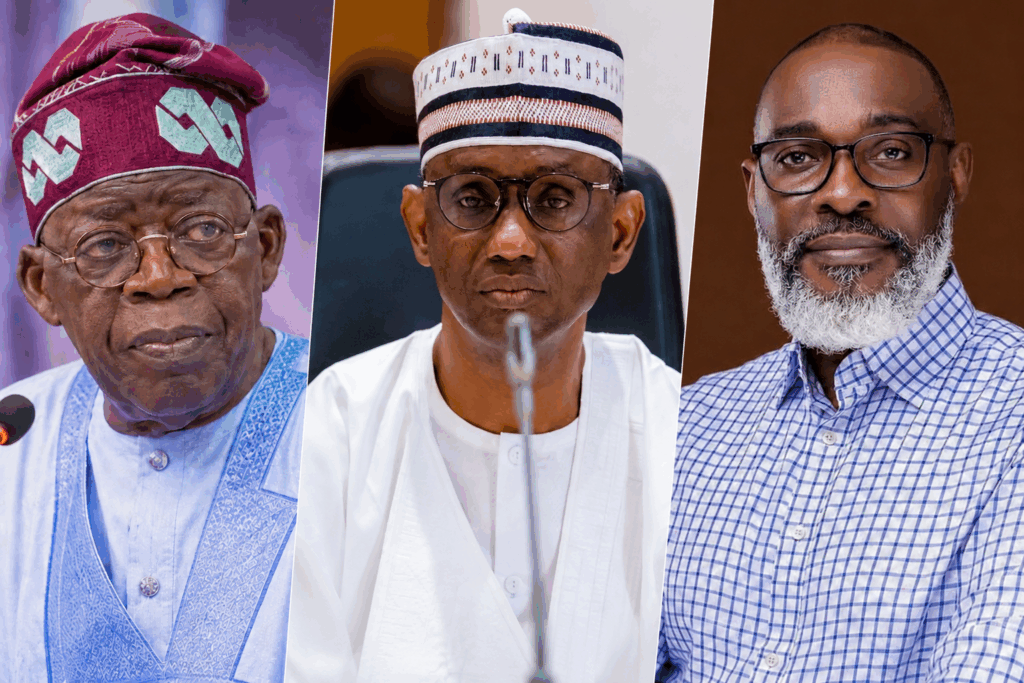
The appointment of Adeyinka Famadewa, a retired major-general as special adviser on Homeland Security, by President Bola Tinubu has triggered fresh debate over the evolving shape of Nigeria’s security architecture, with observers warning that the new office could either strengthen domestic security coordination or deepen institutional rivalry within the nation’s already complex security system.
- +Tinubu’s homeland security adviser appointment raises questions over NSA powers
The appointment, announced on Monday through a circular from the Office of the Secretary to the Government of the Federation comes at a time Nigeria is grappling with worsening insecurity across several regions.
The appointment, announced on Monday through a circular from the Office of the Secretary to the Government of the Federation comes at a time Nigeria is grappling with worsening insecurity across several regions.
“The appointment underscores the commitment of the administration of Bola Ahmed Tinubu to strengthening internal security coordination, enhancing intelligence-driven operations, and deepening inter-agency collaboration in addressing emerging security threats across the country,” the circular reads in part.
But the move has immediately raised questions over possible overlaps with the Office of the National Security Adviser (ONSA), currently being held by Nuhu Ribadu, which traditionally serves as the President’s central coordinating platform for intelligence and national security matters.
For decades, the NSA has functioned as the President’s chief security coordinator, overseeing intelligence fusion, counter-terrorism strategy, cybersecurity coordination and inter-agency security management involving agencies such as the DSS, NIA, DIA and military intelligence units.
The debate comes amid growing pressure on the government over persistent attacks by bandits, insurgents and criminal networks, with soldiers, policemen and other security personnel increasingly becoming casualties of violent attacks across the country.
The country’s security crisis also gained wider international attention after US President Donald Trump redesignated Nigeria as a Country of Particular Concern (CPC) in late 2025 over allegations of Christian persecution.
Ribadu has played a pivotal role in coordinating diplomatic and security engagements between Nigeria and the United States. He has held a series of high-level meetings with senior US officials, including a recent engagement with Vice President JD Vance, where he pushed back against claims of genocide against Christians in Nigeria and defended the government’s position on the country’s security challenges.
The diplomatic development subsequently led to increased security cooperation between Nigeria and the United States, including the controversial Christmas Day US airstrike in Sokoto State targeting extremist elements.
Against this backdrop, observers say the creation of a Homeland Security advisory office appears aimed at tightening the government’s grip on internal threats and domestic security management.
However, some warn that the success or failure of the arrangement will depend heavily on the clarity of its mandate and relationship with existing institutions.
One of the major concerns revolves around intelligence coordination. The presidency stated that the new adviser would help improve intelligence integration and inter-agency collaboration, functions traditionally coordinated by the NSA.
Unless reporting lines are clearly defined, security agencies could face conflicting directives or begin aligning with whichever office enjoys greater presidential access.
Questions are also being raised over who would ultimately convene intelligence coordination meetings, provide final strategic recommendations to the President or exercise superior authority over domestic intelligence operations.
Critics argue that introducing another high-level security advisory office could blur operational boundaries and complicate accountability within the security chain of command.
“With this new office of the homeland security in place, the responsibilities of office of the national security adviser will have to be clearly delineated and defined,” said Opeoluwa, a prominent public affairs analyst.
“There is an inherent risk to this appointment. The risk of overlapping duties.”
Presidential access is also emerging as a critical factor in the unfolding debate. In Nigeria’s presidential system, analysts note that proximity to the President often translates into institutional influence.
“Should the new adviser enjoy direct briefing authority or parallel access to the President independent of the NSA structure, bureaucratic rivalry and intelligence hoarding may intensify within the security establishment,” a security expert said.
Others, however, see the appointment as a strategic recalibration rather than duplication.
Supporters of the move argue that Nigeria’s internal security challenges have become too expansive and complex for a single coordinating office.
According to this line of thinking, the NSA can remain focused on broader strategic and external security concerns while the Homeland Security adviser concentrates specifically on domestic stabilisation and internal threat management.
“My understanding is that homeland security will oversee internal security issues and natural disaster response management,” Opeoluwa, earlier quoted said.
“The office of the homeland security will enable coordination between the following agencies – FRSC, federal police( in the event we have a state police), NEMA, NSCDC, Nigeria immigration service, customs, Nigeria correction service.”
The use of the term “Homeland Security” itself has attracted attention because it mirrors the post-September 11 American model, where homeland security structures focus largely on internal threats, border protection, emergency management and critical infrastructure protection.
But unlike the United States, Nigeria does not currently operate a clearly separated institutional framework between national security and homeland security functions, raising concerns over administrative duplication.
Political observers also believe the appointment may reflect efforts by the presidency to create alternative intelligence channels, balance influence within the security hierarchy or prevent excessive concentration of power in a single security office.
“The term “homeland” is ideological and historically rooted. It makes sense in contexts like the United States, Germany, Israel, or Palestine. In Nigeria, it is largely meaningless,” Bolaji Abdullahi, the publicity secretary of the opposition party, African Democratic Congress, said.
“If the President no longer has confidence in his National Security Adviser, he should simply replace him, not create a new office with a copycat title.”
For now, the presidency has not publicly clarified the exact operational boundaries between the NSA and the newly created Homeland Security advisory structure.