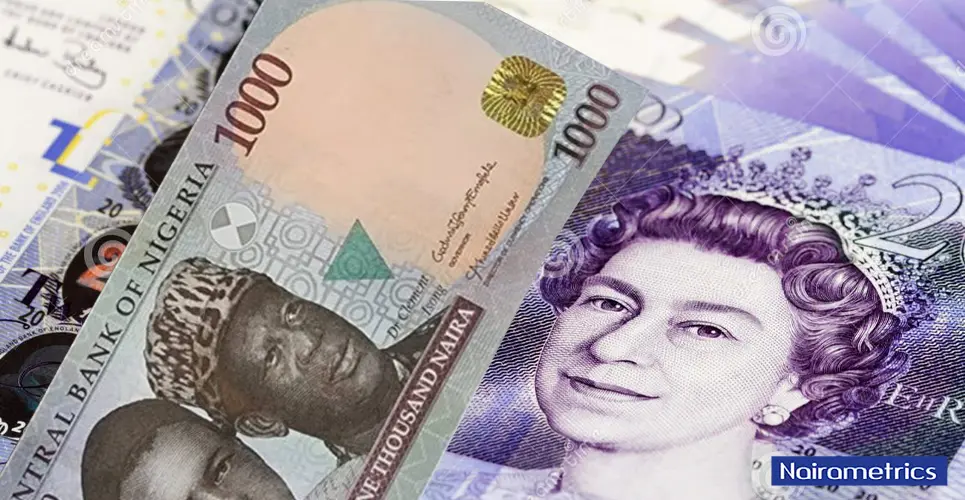
The naira maintained its strength against the British Pound Sterling in the most recent price action on the Nigerian foreign exchange market, despite a rebound in the British pound sterling in the global foreign exchange market.
- +Naira strengthens to N1,833/£1 against resilient British Pound
Latest price action from the CBN showed the naira settled at N1833/£1 at the Nigerian foreign exchange market.
Latest price action from the CBN showed the naira settled at N1833/£1 at the Nigerian foreign exchange market.
The Naira’s best form against the Cable this year was when it reached a spot market peak of roughly N1,814 to the British pound, strengthening to its highest valuation of the year on April 16.
Latest fundamental action highlighted that even when the cable is rising against the greenback in the global foreign exchange market, the local appreciation of the Naira pulls the British Pound down on the domestic board because local market makers price GBP/NGN synthetic crosses primarily through the lens of local US dollar supply rather than perfect real-time synchronization with global spot desks.
The GBP/NGN pair’s environment is influenced by more aggressive policies from the Central Bank of Nigeria (CBN) and energy supply disruptions. The CBN maintained the Monetary Policy Rate (MPR) at 26.5%.
The Nigerian Apex Bank held the Cash Reserve Requirement (CRR) at 45%, absorbing excess liquidity. Nigeria’s nearly $49.3 billion in foreign reserves provides the capacity to defend the Naira and counteract extreme FX market volatility. Current crude oil prices, around $100 per barrel strengthening Nigeria’s foreign exchange reserves.
Structural issues and currency inflation still favor investments with higher returns although the high 26.5% interest rate favors the Naira over carrying trades.
The British pound sterling oscillated around $1.3460 against the greenback, reflecting a recovering British Pound amid a global environment supportive of the American Dollar.
The latest Personal Consumption Expenditures (PCE) report showed inflation metrics below expectations, alleviating some concerns about energy shocks. Headline PCE inflation rates remained above the Federal Reserve’s (Fed) target at 3.8% and 3.3%, respectively, with the Price Index rising 0.4% and core PCE up 0.2% MoM.
This softening data may lead the Fed to adopt a less aggressive “higher-for-longer” interest rate stance, benefiting risk assets. The decline in crude oil prices, fueled by optimism around US-Iran relations, further reduces inflation fears.
Consequently, investors are reassessing the likelihood of future US rate hikes by the Bank of England (BoE). Recent UK economic data indicating a cooling labor market, subdued inflation, and decelerating growth support this shift.
The BoE’s base rate remains at 3.75%, following a recent decision where most voted to hold, with one dissenter proposing a hike.
Geopolitical disruptions have complicated this outlook, although inflation was projected to reach the 2% target. Market expectations for the BoE’s June 18 meeting are divided: some anticipate a 25-basis-point hike to 4.00% due to rising energy prices, while others prefer to hold due to weak domestic growth.