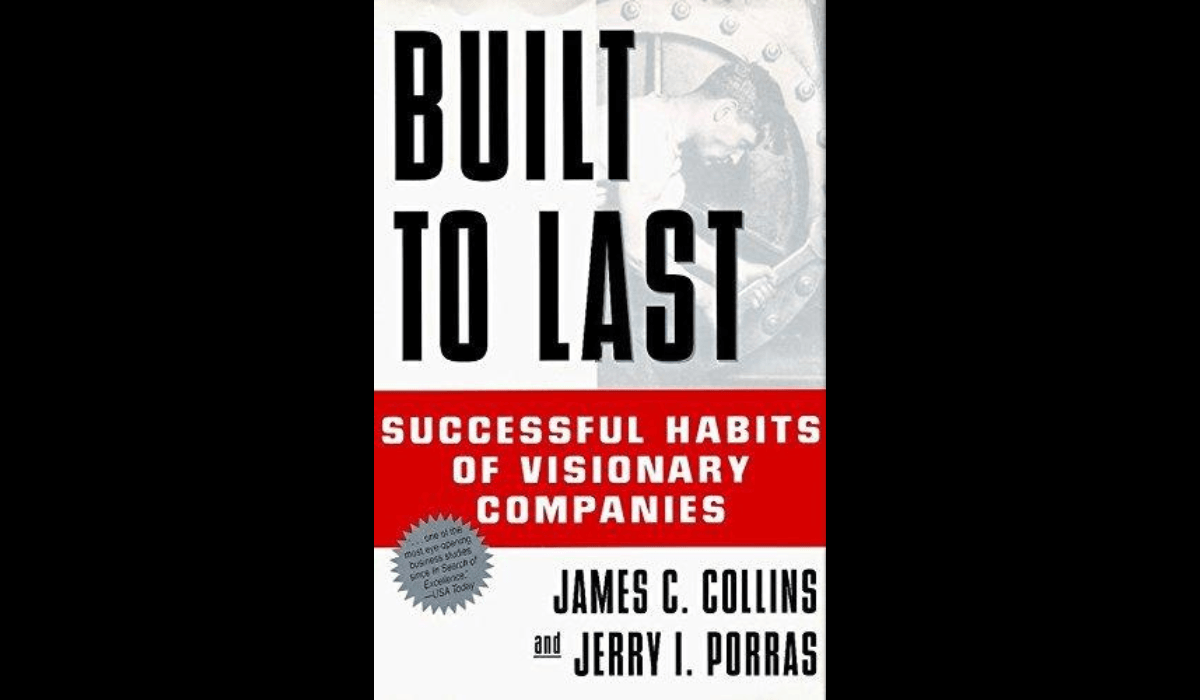
Most businesses do not fail because they lack profits; they fail because they cannot outlive their founders. Across Nigeria and much of Africa, countless enterprises disappear after the exit, retirement or death of their founders, exposing a fundamental weakness in institutional development. It is this challenge that sits at the heart of Built to Last, the influential management classic by Jim Collins and Jerry Porras.
- +Built to Last — The blueprint for building companies that endure
- +Author: Jim Collins and Jerry I. Porras
- +Published: Nov 1,2004 by Harper Business
First published in 1994, the book sought to answer a deceptively simple question: Why do some companies endure for generations while others, despite periods of remarkable success, eventually fade into irrelevance?
Author: Jim Collins and Jerry I. Porras
Published: Nov 1,2004 by Harper Business
First published in 1994, the book sought to answer a deceptively simple question: Why do some companies endure for generations while others, despite periods of remarkable success, eventually fade into irrelevance?
Drawing from a six-year research project conducted at Stanford University, Collins and Porras examined 18 “visionary companies” and compared them with competitors operating in similar industries. Their objective was not to identify firms that merely achieved financial success, but organisations that consistently outperformed rivals over decades while maintaining relevance across changing economic cycles.
Their conclusion challenged several popular assumptions about business leadership. Contrary to the belief that extraordinary companies are built by charismatic founders, the authors found that enduring organisations are more often defined by strong institutional cultures, clearly articulated values and systems that transcend individual personalities.
At the centre of the book is what Collins and Porras describe as the principle of “Preserve the Core, Stimulate Progress.” Visionary companies, they argue, maintain unwavering commitment to their core values while continuously adapting their products, strategies and business models to changing realities.
More than three decades later, this remains one of the book’s most powerful insights.
The business landscape has changed dramatically since Built to Last was published. The internet revolution, artificial intelligence, digital commerce and platform-based business models have transformed entire industries. Yet the tension between preserving organisational identity and embracing change remains as relevant as ever.
The lesson resonates strongly in Africa, where many businesses remain founder-centric. Too often, corporate governance structures are weak, succession plans are absent and decision-making is concentrated in a single individual. The result is that businesses frequently struggle to survive beyond their first generation of leadership.
From family-owned enterprises to fast-growing startups, the challenge is not simply building a successful company but building an institution capable of enduring beyond its founders.
One of the book’s most enduring contributions to management thinking is the concept of the Big Hairy Audacious Goal (BHAG). These are ambitious, long-term objectives designed to inspire employees and push organisations beyond incremental growth.
The idea may sound commonplace today, but it has influenced generations of corporate leaders. Many of the world’s most successful companies have pursued goals that initially appeared unrealistic, using them to drive innovation and organisational focus.
For African businesses operating in increasingly competitive global markets, the concept remains highly relevant. Whether expanding across borders, developing indigenous technology or competing against multinational corporations, transformational growth often requires ambitions larger than annual revenue targets and quarterly performance metrics.
Perhaps the book’s most controversial argument is its assertion that profit is not the primary purpose of great companies. Collins and Porras found that visionary organisations were often motivated by missions larger than shareholder returns. Profit, they argued, was essential but functioned as fuel rather than purpose.
In an era increasingly defined by environmental, social and governance considerations, this argument appears remarkably prescient. Companies that align commercial success with a broader societal mission often enjoy stronger employee engagement, deeper customer loyalty and greater long-term resilience.
Yet Built to Last is not without significant flaws.
The book’s biggest weakness lies in the assumption that corporate excellence can be identified through historical analysis and then distilled into enduring principles. Several companies celebrated in the book later experienced serious difficulties. Some lost market leadership, others struggled to adapt to technological disruption, while a few suffered prolonged periods of decline.
This raises an uncomfortable question: Were these companies truly “built to last,” or were they simply exceptional performers during a particular period in history?
Critics have long argued that Collins and Porras may have fallen victim to what management scholars call the “halo effect” , the tendency to attribute success to specific management practices after a company has already become successful. In other words, some of the characteristics identified as causes of success may merely have been symptoms of success.
The book also reflects the limitations of its era. Published before the rise of digital-native firms, platform economies and artificial intelligence, its research focuses heavily on large American corporations operating in relatively stable competitive environments.
Today’s business environment is far less predictable. Companies can rise to global prominence in a matter of years and lose relevance just as quickly. Speed, innovation and adaptability often matter as much as institutional consistency.
For African entrepreneurs, this presents an important caveat. While the principles of culture, values and institutional discipline remain valuable, blindly applying lessons from twentieth-century American corporations to twenty-first-century African businesses may be misguided. The realities of infrastructure deficits, regulatory uncertainty, foreign exchange volatility and fragmented markets require a level of agility that the book does not fully address.
Nevertheless, dismissing Built to Last because some of its examples aged poorly would be a mistake.
Its lasting value lies not in the individual companies it celebrates but in the broader questions it forces leaders to confront. What does your organisation stand for? Can it survive the leadership transition? Are you building systems or merely managing personalities? Will your business remain relevant when market conditions change?
These questions are particularly important in Nigeria, where institutional fragility remains a recurring challenge across both the private and public sectors.