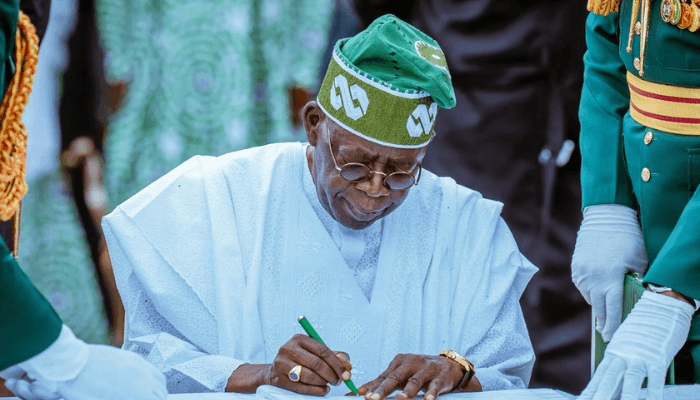
President Bola Ahmed Tinubu has signed into law the 2026 Appropriation Bill, approving a record ₦68.32 trillion national budget aimed at stabilising the economy, driving infrastructure development, and addressing Nigeria’s persistent fiscal challenges.
- +Tinubu Signs ₦68.32tn 2026 Budget
The newly enacted budget, the largest in the country’s history, signals the administration’s aggressive fiscal stance as it seeks to consolidate economic reforms, boost investor confidence, and stimulate growth across key sectors, including energy, transportation, agriculture, and security.
The newly enacted budget, the largest in the country’s history, signals the administration’s aggressive fiscal stance as it seeks to consolidate economic reforms, boost investor confidence, and stimulate growth across key sectors, including energy, transportation, agriculture, and security. The signing, which took place at the Presidential Villa in Abuja, marks a critical milestone in the government’s economic roadmap for the 2026 fiscal year.
The ₦68.32 trillion spending plan reflects a significant increase from previous budgets, underlining rising government expenditure amid inflationary pressures, currency volatility, and expanding social obligations. A substantial portion of the budget is expected to go toward capital projects, with the federal government prioritising infrastructure upgrades such as roads, rail networks, and power generation to unlock productivity and improve ease of doing business.
In addition to capital spending, recurrent expenditure including salaries, overheads, and debt servicing continues to take a large share of the budget. Analysts have raised concerns over Nigeria’s growing debt burden, with debt servicing projected to consume a notable percentage of total government revenue. This trend has intensified calls for improved revenue generation and fiscal discipline to ensure long-term sustainability.
Speaking after signing the bill, Tinubu reiterated his administration’s commitment to economic reform, emphasising that the budget is designed to promote inclusive growth and reduce poverty. He noted that efforts would be intensified to expand the tax base, improve non-oil revenue, and plug leakages in public finance management.
The National Assembly had earlier passed the appropriation bill after weeks of deliberation, during which lawmakers made adjustments to the executive proposal to reflect constituency needs and national priorities. The legislative process highlighted ongoing debates over budget assumptions, including oil price benchmarks, production targets, and exchange rate projections.
Economic experts say the success of the 2026 budget will depend largely on implementation efficiency. Historically, Nigeria has struggled with poor budget execution, with delays in fund releases and project completion undermining intended outcomes. Observers stress that timely disbursement of funds and strict monitoring mechanisms will be crucial in ensuring value for money.
There are also expectations that the government will leverage public-private partnerships to bridge funding gaps, particularly in infrastructure financing. With limited fiscal space, collaboration with the private sector is seen as essential to delivering large-scale projects without further straining public debt.
While the budget offers a framework for economic activity in 2026, its impact will ultimately hinge on macroeconomic stability, including inflation control and exchange rate management. Businesses and investors are watching closely for policy consistency and clarity, especially in sectors affected by ongoing reforms.
As Nigeria navigates a complex economic landscape, the 2026 Appropriation Act represents both an opportunity and a test for the Tinubu administration’s ability to translate ambitious fiscal plans into tangible development outcomes.