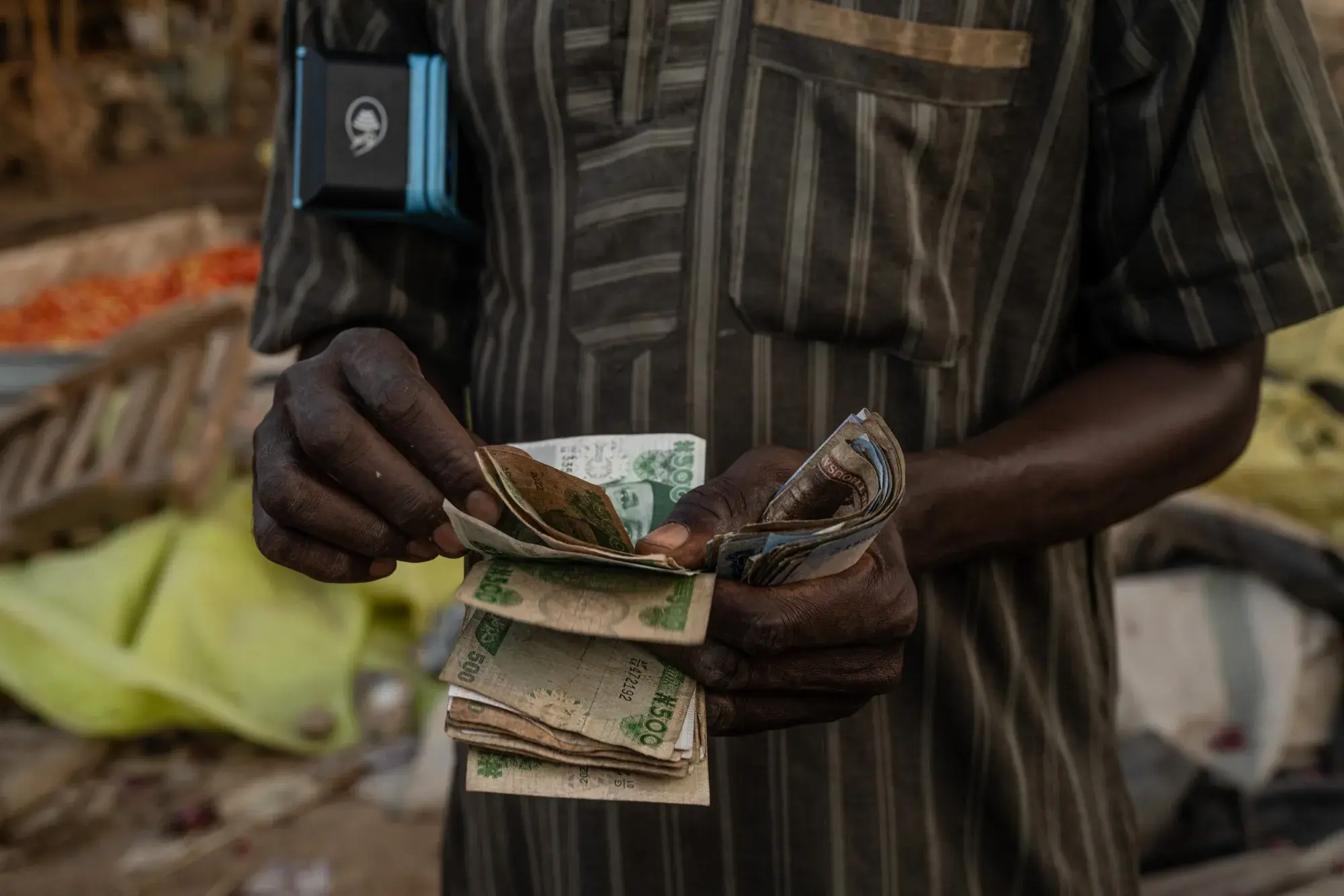
Beyond financial inclusion, Nigeria’s central bank is chasing regional payments leadership
In the first half of 2007, Nigerians processed ₦946.22 million ($695,469) in point-of-sale (PoS) transactions.
In the first half of 2007, Nigerians processed ₦946.22 million ($695,469) in point-of-sale (PoS) transactions. In the first quarter of 2025, that figure grew to ₦10.51 trillion ($7.73 billion).
The growth was the product of a series of policy decisions by the Central Bank of Nigeria (CBN), which has spent nearly two decades trying to reduce the country’s reliance on cash and build a digital payments ecosystem through successive Payment System Vision (PSV) frameworks.
The first of those frameworks, (PSV) 2020, was launched in 2007 and focused on expanding electronic payments and modernising the country’s payment infrastructure. A second iteration, PSV 2025, followed in 2022, with a much stronger emphasis on financial inclusion, agent banking, interoperability, and the rails needed to support a digital economy.
PSV 2025 pushed formal financial inclusion to 64% from 56% in 2020. According to the CBN, agent banking networks expanded to more than two million agents nationwide, and electronic payment value has jumped by 203.51% since 2022 to ₦1.2 quadrillion ($880.51 billion) in 2025. The Bank Verification Number (BVN) system has also become a foundational digital identity layer with over 66 million unique IDs, the CBN noted.
However, approximately 26% of bankable adults remain financially excluded, and many Nigerians lack the know-how and confidence to use digital payment tools safely and effectively, the CBN said in the new PSV document. Despite the growth in electronic transactions, only 52% of adults actively use digital payments.
Those shortcomings partly formed the basis of PSV 2028, launched on June 1. It seeks to push financial inclusion to 95%, and also reveals a regulator increasingly focused on positioning Nigeria as a regional payments infrastructure hub, connecting African markets, supporting cross-border trade, deploying emerging technologies such as stablecoins and artificial intelligence, and strengthening cyber resilience across an increasingly interconnected financial ecosystem.
The strategy rests on five pillars: infrastructure, interconnectivity and interoperability; digital financial inclusion, consumer protection and financial literacy; innovation, digital assets and emerging technologies; cross-border payments and central bank digital currency integration; and regulation, risk management and cybersecurity.
Together, they offer a clear picture of how the CBN sees the future of payments in Nigeria.
Interact with the data to see how the central bank’s new policy targets shape cash, cross-border flows, and tech access.
Sub-Saharan Africa has some of the world’s highest remittance costs, averaging 8.46%. PSV 2028 aims to deploy stablecoins, eNaira corridors, and PAPSS to bring costs down to ≤ 5%.
Currently, 52% of adults actively use digital payments. The CBN wants to push formal financial inclusion to 95% by 2028. Here is how that expands a startup’s Total Addressable Market (TAM).
*Calculations based on an estimated bankable adult population of 130 million.
As open banking and CBDCs expand the attack surface, fraud becomes a systemic risk. The CBN is aiming for a 70% drop in fraud losses by 2028 through an AI-powered National Payment SOC.
Previous payment visions were largely domestic. The priorities were expanding electronic payments, increasing financial inclusion, reducing cash usage, and improving local payment infrastructure.
“CBN reforms (National Financial Inclusion Strategy 2022, eNaira, Open Banking, Regulatory Sandbox, and PSV 2025) have modernised domestic payments and interoperability, while Nigerian Fintech firms have expanded digital solutions across Africa,” the CBN said.
The regulator noted that the regional integration for payments remains limited.
The PSV 2028 repeatedly highlights the Pan-African Payment and Settlement System (PAPSS), the African Continental Free Trade Area (AfCFTA), regional interoperability, cross-border settlements, CBDC corridors, regional liquidity pools, settlement banks, and digital trade infrastructure.
It proposes strengthening Nigeria’s integration with African payment systems while reducing dependence on foreign settlement currencies in regional trade.
“Cross-Border Settlements and PSV 2028 set out to close these gaps by harmonising regulatory standards within ECOWAS/AU, advancing bilateral CBDC corridors, upgrading digital infrastructure for secure real-time settlement, and deepening partnerships,” the CBN said.
“By aligning NIBSS and the eNaira with PAPSS and AfCFTA and leveraging over $20 billion in annual diaspora remittances, Nigeria can emerge as a core regional hub for trade settlement and remittances.”
Nigeria already possesses one of Africa’s most sophisticated payment ecosystems. Nigeria Inter-Bank Settlement System Instant Payments processes billions of transactions annually, fintech adoption is among the highest on the continent, and digital payments have become deeply embedded in everyday commerce.
At the same time, Africa’s cross-border payments market remains fragmented, expensive, and heavily dependent on correspondent banking relationships outside the continent. Businesses trading across African markets often face multiple currency conversions, lengthy settlement times, and high transaction costs.
The CBN intends to leverage stablecoins and CBDCs to navigate the currency hurdles. Because dollar-backed stablecoins such as USDT are pegged to the U.S. dollar, they can serve as a common settlement asset between countries with different currencies.
Instead of routing payments through multiple correspondent banks and foreign exchange conversions, participants can convert local currency into a stablecoin, transfer the value across borders almost instantly, and convert it into the recipient’s local currency.
According to blockchain analytics firm Chainalysis, stablecoins accounted for 43% of all crypto transaction volume in Sub-Saharan Africa in 2024. Many fintech companies, including Grey Business, Paga, and Flutterwave, are positioning stablecoins as practical payment rails for businesses engaged in international trade.
The CBN also wants to champion regional liquidity pools and settlement banks backed by Pan-African banks to support PAPPS and other Pan-African payments.
To take this further, the bank said it is focusing on launching potential bilateral CBDC corridors with Ghana, South Africa, or Egypt.
“Move eNaira and regulated stablecoins from conceptual tools to live cross-border corridors for trade flows and remittances,” it said.
To support that vision, the regulator is proposing deeper integration with PAPSS, regional settlement infrastructure, and a shared Nigeria Settlement Cloud that would connect domestic payment schemes, PAPSS, eNaira, SWIFT, remittance providers, and trade digitisation platforms through a common infrastructure layer.