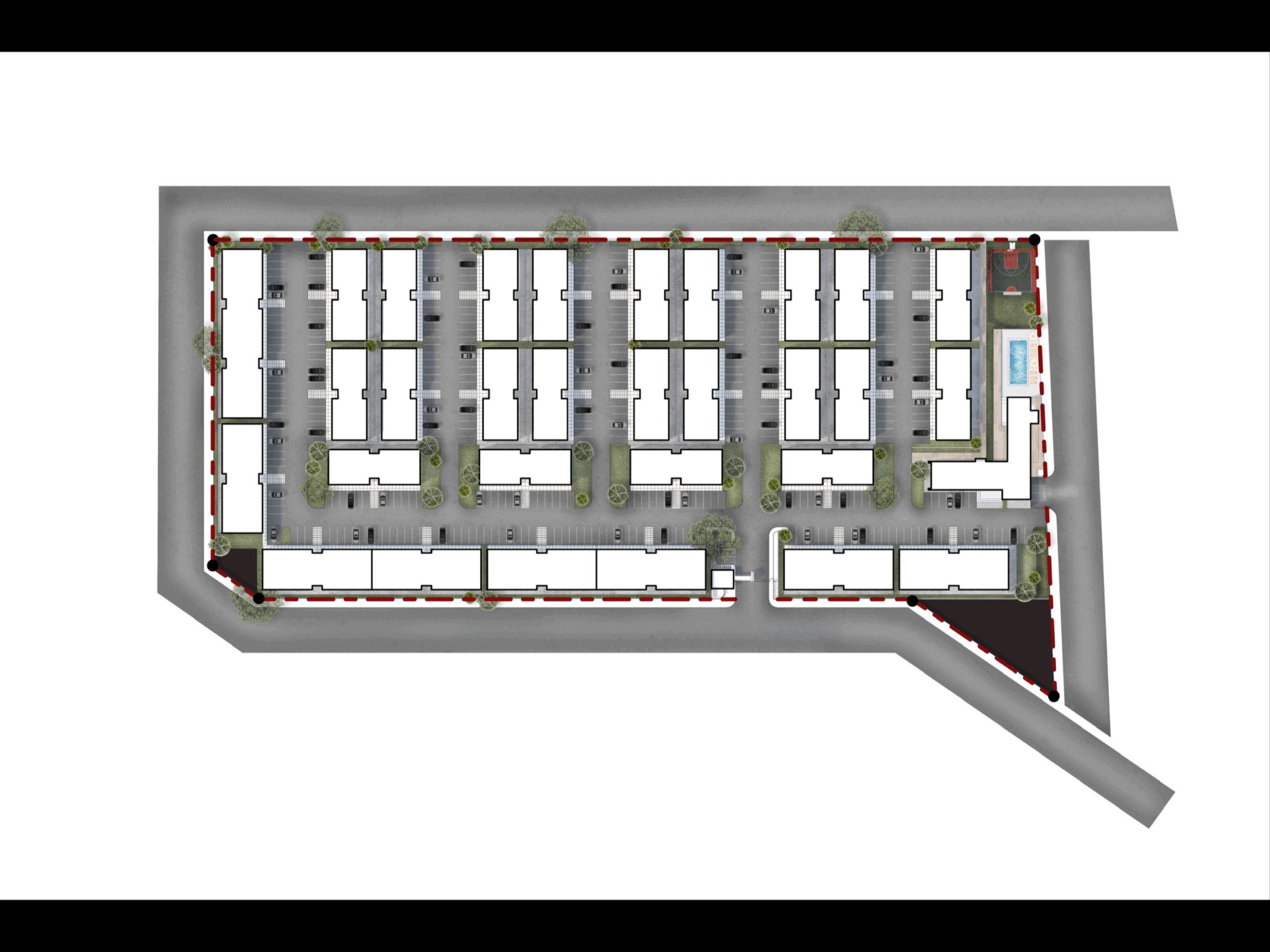
Dantata Hostels: Institutional-Grade Student Housing Emerges in Abuja’s Fixed Academic Belt
Nigeria’s student housing market has historically operated within a fragmented and largely informal structure.
Nigeria’s student housing market has historically operated within a fragmented and largely informal structure. Supply has typically responded to short-term demand signals rather than long-term infrastructure planning.
Dantata Hostels represents a deliberate effort to formalise that segment within one of Abuja’s most institutionally concentrated districts.
Located on a 3.39-hectare parcel known as Plot 747 in the Institutional and Research District–Jabi, the development sits adjacent to Nile University and within walking distance of Baze University. The corridor has evolved into a dense academic and institutional cluster, housing the Institute of Human Virology, the National Open University main campus, Baze University Teaching Hospital, WHO staff housing, the ECOWAS headquarters, the National Assembly Library, the Wupa Metro Station, and several federal security formations. The forthcoming FCTA bridge linking Nile and Baze further strengthens the district’s integration.
In property markets, clustering typically precedes repricing.
More than 20,000 students compete annually for fewer than 4,000 formal dormitory spaces across Nile and Baze Universities. The resulting accommodation deficit has created commuting patterns from Gwarinpa, Katampe, Jahi, Idu, Asokoro and other peripheral districts, introducing transport costs, time inefficiencies, and operational unpredictability into student living arrangements.
According to Mr. Oluwatosin Bolaji, Director and Chief Executive of One Square meter By Dantata (1SQM), the real estate firm behind Dantata Hostels, the imbalance between stabilised enrollment demand and constrained proximate supply creates structural pricing pressure.
“Where land supply is fixed and enrollment demand is stable, proximity transitions from convenience to economic necessity,” Bolaji says.
Dantata Hostels comprises 337 fully furnished terrace duplexes and penthouse apartments delivering approximately 1,200 bedspaces, structured with a maximum of two occupants per room. Shared study areas, kitchens, and communal facilities are calibrated for controlled density and long-term asset durability rather than short-term occupancy maximisation.
Globally, university-adjacent student housing has matured into a recognised institutional asset class. In cities such as Boston and London, proximity to major academic institutions has demonstrated resilience across economic cycles, supported by enrollment stability and constrained land supply. Nigeria’s student housing market has yet to undergo comparable institutionalisation.
The operational framework underpinning Dantata Hostels is designed to address performance risks typically associated with the segment. Each unit operates on an individually metered solar-hybrid energy system supported by modular grid backup under a no-generator estate policy. The 1.2-megawatt distributed energy system is structured to reduce diesel dependency, stabilise operating costs, and minimise noise pollution, factors that frequently erode occupancy satisfaction and margin durability in the Nigerian context.
“Operating volatility directly impacts asset performance,” says Arc. Moruf Olabisi, MNIA, General Manager, Project Development at 1SQM. “The infrastructure was engineered to reduce that volatility at source.”
The development also integrates a 2,000 square meters Tech Innovation Hub designed to embed structured digital certification pathways into the residential environment. Under the guidance of Certified Microsoft Innovative Educator Expert, Mr. Ibukun Atoro, the hub supports Azure, AI, and Power Platform certification tracks.
“When certification is integrated into daily residency, participation improves and employability outcomes become measurable,” Atoro explains.
The model allows up to 1,200 resident students annually to access structured digital training within the estate, reinforcing both occupancy stability and long-term value positioning.
From a demand perspective, student accommodation behaves differently from short-term rental markets. Between 2020 and 2023, Abuja experienced rapid expansion in short-stay and Airbnb-style inventory. Subsequent oversupply compressed yields and increased occupancy volatility. University demand, by contrast, resets annually and demonstrates lower discretionary sensitivity.
In 2023, 1SQM delivered a 60-room female hostel approximately 50 meters from the current development site. Despite limited amenities relative to Dantata Hostels, the property has maintained full occupancy since delivery.
“Absorption was driven by proximity rather than marketing intensity,” notes JohnPaul Malherbe, General Manager, Business Operations.
At present, ninety-nine units within Dantata Hostels have been fully subscribed at advanced construction stage. Phase One delivery is scheduled before the end of Q2 2026, with full estate completion targeted for December 2027. Phased subscription allows demand validation prior to full stabilisation.
The remaining units are being offered for direct ownership, with studios beginning at ₦50 million and four-bedroom configurations extending to ₦300 million. Projected rental yields are estimated at 12–15 percent annually with projected capital appreciation at 30%+ per annum, subject to stabilised occupancy.
Beyond yield, capital preservation forms a central component of the investment thesis.
The Institutional and Research District–Jabi has recorded consistent appreciation in recent years, driven by infrastructure consolidation, diplomatic clustering, and the progressive exhaustion of titled land supply within walking proximity of the university belt. Plot 747 is widely regarded as the last titled bulk residential site within immediate reach of both Nile and Baze.
Engr. Nasiru Dantata, Director at 1SQM, describes the project as an infrastructure-grade residential asset rather than a conventional dormitory development.
“When bulk land supply is constrained inside a fixed academic corridor, long-term pricing tends to reflect structural scarcity rather than cyclical sentiment,” he says.
From a lifecycle perspective, institutional student housing markets typically move through formation, stabilisation, and consolidation phases. During formation, pricing reflects projected demand. During stabilisation, valuation anchors to demonstrated occupancy and operating history. During consolidation, entry benchmarks against established comparables. Dantata Hostels is transitioning from formation toward stabilisation.
Upon Phase One delivery and verified occupancy performance in 2026, valuation metrics will increasingly anchor to audited operating data rather than projected yield assumptions. In capital markets, that transition materially alters risk perception.