The federal government of Nigeria is seeking to unlock private capital to expand Compressed Natural Gas (CNG) refuelling stations, Electric Vehicle (EV) charging infrastructure, and local vehicle manufacturing to accelerate the country’s transition to clean mobility.
- +FG seeks private capital to accelerate Nigeria’s clean mobility drive
Speaking at the 3rd Nigeria Auto Industry Summit (NAISU) themed, ‘Nigeria’s Clean Mobility Future: The EV And CNG Journey Under The President Bola Tinubu Administration,’ Joseph Osanipin, director-general of The National Automotive Design and Development Council (NADDC), identified investment as critical to scaling the country’s emerging clean and sustainable transport ecosystem.
Speaking at the 3rd Nigeria Auto Industry Summit (NAISU) themed, ‘Nigeria’s Clean Mobility Future: The EV And CNG Journey Under The President Bola Tinubu Administration,’ Joseph Osanipin, director-general of The National Automotive Design and Development Council (NADDC), identified investment as critical to scaling the country’s emerging clean and sustainable transport ecosystem.
Osanipin, who was represented by Susan Taiwo, director of public relations, NADDC, said the council has spent over two decades laying the foundation for the country’s automotive transformation, with a strong focus on electric vehicles and alternative energy solutions.
“Previously, many people doubted that EVs could succeed in Nigeria because of inadequate power supply. Today, the world has embraced clean energy, EVs are becoming increasingly common, and Nigeria cannot afford to be left behind.
“Our goal is to ensure Nigeria keeps pace with global developments in clean mobility while creating a healthier environment for present and future generations,” Osanipin said.
According to him, despite certifying 345 CNG conversion centres across Nigeria, ensuring that all facilities meet the required safety and operational standards, the number of CNG refuelling stations remains limited.
“We want a situation where motorists can simply drive into a CNG station, refill their tanks and continue their journeys without delays. The council alone cannot achieve this. We need private sector investment,” Osanipin noted.
Ismaeel Ahmed, executive Chairman and chief executive officer of the Presidential Initiative on Compressed Natural Gas and Electric Vehicles (Pi-CNG & EV), represented by Zayyanu Yabo, the initiative’s chief compliance officer, said the Initiative was established not simply to promote alternative fuels but to build a complete ecosystem capable of supporting infrastructure, investment, vehicle conversion, local manufacturing, technical capacity development and consumer confidence.
Ahmed identified infrastructure expansion, consumer financing, local manufacturing capacity, technical training, research, innovation and standardisation as areas requiring greater attention, noting that Nigeria’s clean transportation future would also depend on multiple technologies.
He further stressed that overcoming these challenges would require stronger collaboration among government agencies, investors, manufacturers, transport operators, financial institutions, development partners and the media.
The summit organised by the Nigeria Auto Journalists Association (NAJA) brought together policymakers, regulators, automotive manufacturers, financiers, transport operators and development partners who agreed that collaboration, robust standards, road safety and sustained investment remain critical to achieving Nigeria’s clean mobility ambitions.
Ifeanyi Okeke, director-general of the Standards Organisation of Nigeria (SON), represented by Olalekan Omoniyi, said Nigeria’s clean mobility ambitions would only succeed if backed by internationally recognised standards, certification and strict regulatory compliance.
Okeke said standards remain the foundation upon which a safe, reliable, and globally competitive EV and CNG ecosystem must be built, noting that SON has already developed more than 80 Nigerian Industrial Standards for CNG vehicles and equipment, along with 87 additional standards and the National Nigeria Guideline (NNG 1214:2024) governing CNG vehicle conversions.
He added that the agency is also developing standards covering electric vehicles, charging infrastructure, batteries, charging connectors and battery-swapping systems.
Okeke warned against the growing proliferation of uncertified CNG conversion centres and substandard equipment, noting that poor installations have contributed to explosions and fire incidents.
He urged the government to make certification compulsory for imported and locally assembled EVs, CNG vehicles, conversion kits and charging equipment while expanding testing facilities and public awareness campaigns.
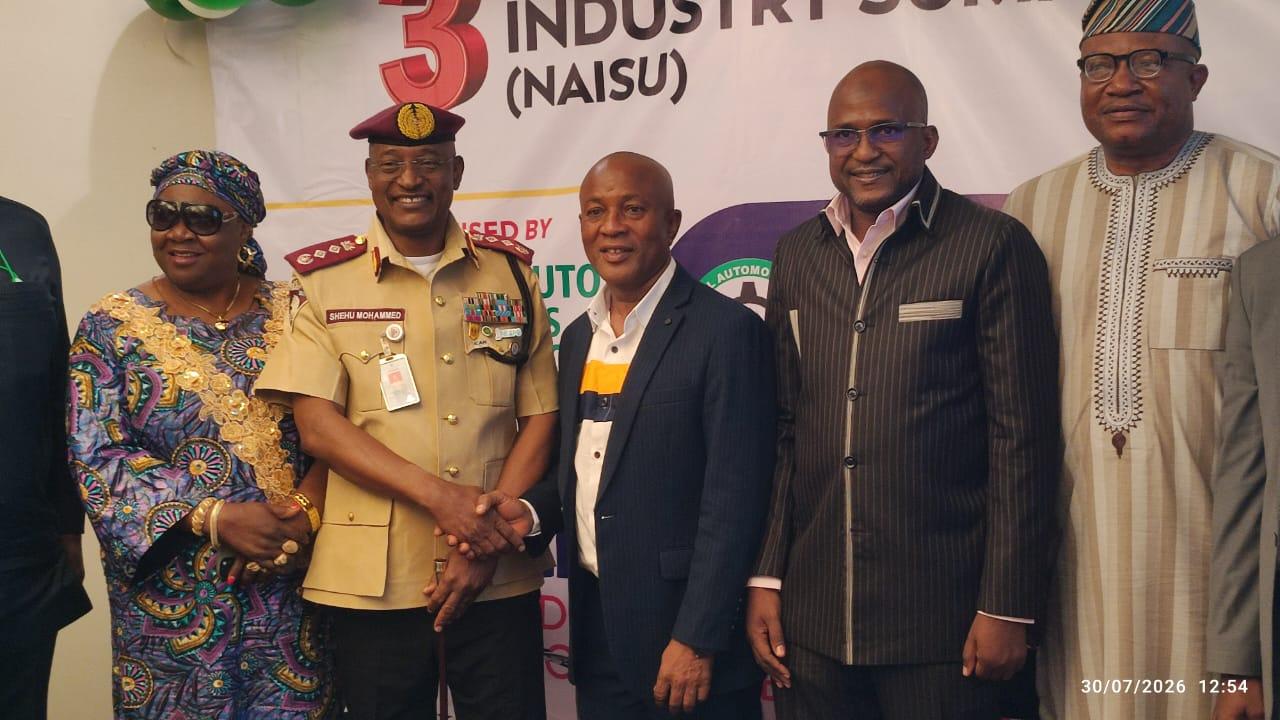
Shehu Mohammed, corps marshal of the Federal Road Safety Corps (FRSC), said Nigeria’s clean mobility journey must be anchored on road safety if it is to deliver its intended benefits.
He explained that as alternative fuel vehicles become increasingly common, regulatory institutions must adapt through specialised training, stronger enforcement and updated operational guidelines.
Mohammed emphasised that cleaner mobility should improve not only environmental sustainability but also road safety, vehicle standards and public confidence.
Theodore Opara, chairman of NAJA, described the summit as more than an industry conference, saying it was a strategic platform to shape the future of Nigeria’s automotive industry.
Opara said that the success of reforms around CNG, electric vehicles, local automotive manufacturing and sustainable transportation would depend on stronger collaboration among industry stakeholders.
He also called on journalists covering the automotive industry to see themselves as partners in national development through accurate and constructive reporting that supports informed policymaking and investor confidence.