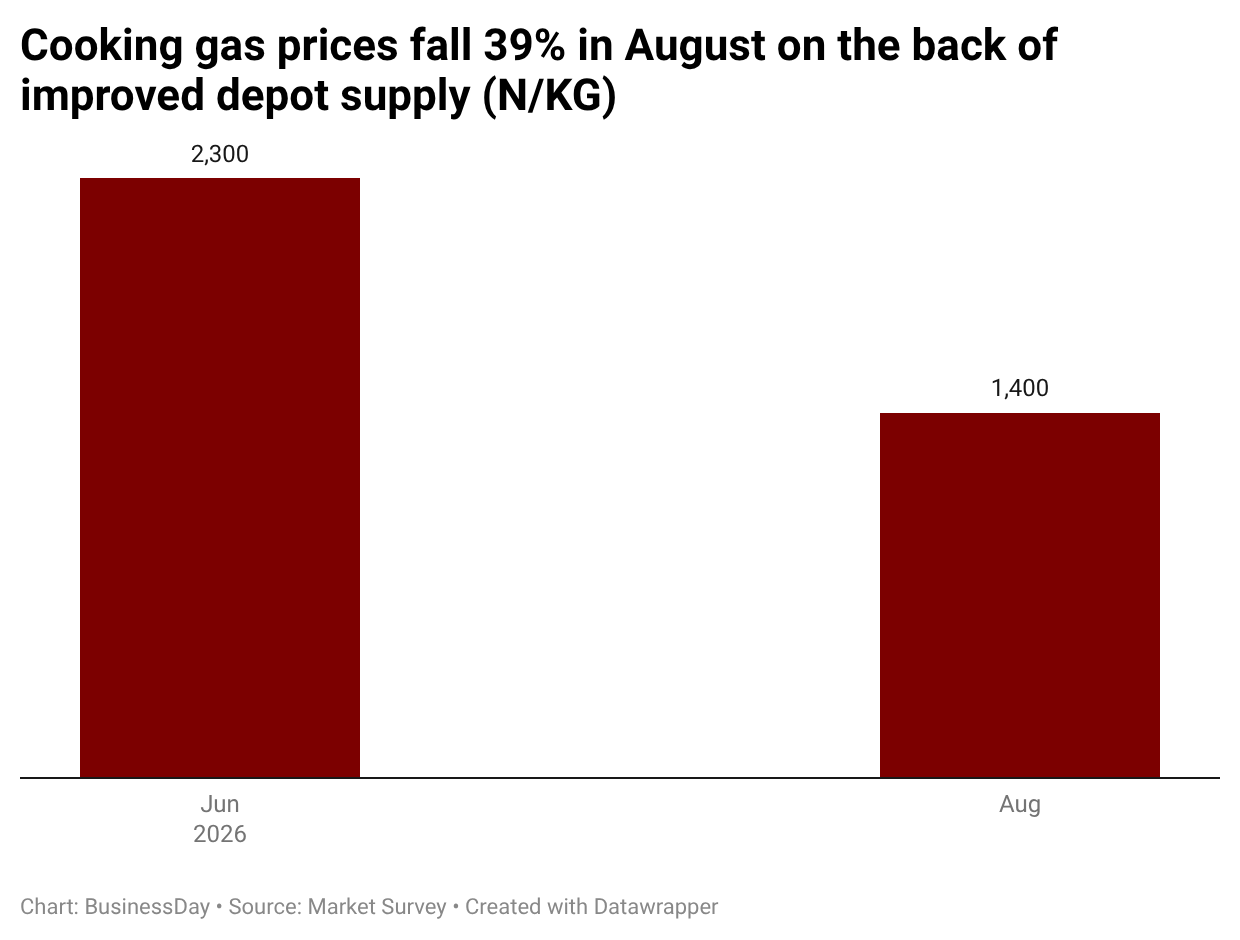
The price of Liquefied Petroleum Gas (LPG), popularly known as cooking gas, has fallen by roughly 39 percent from the record highs reported in June as increased depot supply and lower wholesale prices begin to filter through to retailers across Nigeria.
- +Cooking gas prices fall 39% as depot supply improves
In June, a kilogramme of cooking gas was selling for more than N2,000, even hitting a high of N2,300 in some states.
In June, a kilogramme of cooking gas was selling for more than N2,000, even hitting a high of N2,300 in some states. However, latest findings by BusinessDay show that retail prices now hover around N1,400 per kilogramme in Lagos, Enugu, and other states, reflecting a 39 percent drop within two months.
When Juliet Onyinyechi carried her 6kg gas cylinder to a retail filling station in Ojo Local Government Area of Lagos on Sunday, inside her purse was a budget of N14,000, enough for her N13,800 monthly fill and a N200 motorcycle ride back to her home. But after the attendant filled the cylinder, he asked her to pay only N8,400.
“At first, I was confused. When I came to the same filling station last month, it cost N13,800 for the usual 6kg I often buy because a kilogramme was N2,300,” she told BusinessDay. “So I didn’t expect to pay less. But he told me a kilogramme now costs N1,400, hence why my bill dropped to N8,400. I was happy.”
According to depot dealers, there has been increased supply in July supported by a considerable drop in loading prices, which is easing pressure on consumers. Currently, 11 Plc is selling at a depot price of N1,025 per kilogramme, Ardova at N1,020, Navgas at N1,005, NIPCO at N1,025, PPMC at N1,005, and Rain Oil at N1,030 per kilogramme.
Mama D, a Lagos-based mother of five, told BusinessDay that the drop in cooking gas has brought relief for her cash-strapped family, making life “a little more comfortable for them.”
“When the guy I buy gas from told me about the price drop, I was happy. In fact, happiness does not capture how I felt. At the peak of the surge last month, my family suffered so much,” she said. “At one point, we had to turn to coal pot. It wasn’t convenient, but at least it enabled us to eat cooked food.”
Nigeria currently has a food inflation of 17.52 percent in June as structural supply-side constraints like insecurity and high logistics costs continued to outpace the easing headline inflation rate of 15.91 percent. Since cooking gas is a household necessity, lower prices could provide modest relief to families already grappling with elevated food costs.
In Enugu, Nigeria’s coal city, findings also show that prices of cooking gas range around N1,400, down from N1,900 in June. However, it depends on location and retail centres.
Obiora Ani, a gas dealer who operates in Uwani, a community inside Enugu, said the reduction reflects a nationwide trend driven by stronger supply.
“When you go to other parts of the country, the price of cooking gas has dropped as well, not only in Enugu. The drop is encouraging more people to fill their cylinders,” he said.
Nigeria has one of the largest gas reserves in Africa with 215 trillion cubic feet. But data has shown that a large chunk of that gas is exported, leaving the domestic market vulnerable to supply shortages during periods of weak local production or rising demand.
According to reports from the Nigerian Upstream Petroleum Regulatory Commission, more than 2.1 billion cubic metres of gas was exported in December alone.
Energy executives have said that while exports are a part of any growing economy, a defined portion of gas production must be reserved for domestic use, noting that expanding domestic gas supply remains critical to keeping LPG affordable.
Adegbite Falade, managing director of Aradel Holdings, stated at the BusinessDay CEO Forum recently that Nigeria needs to tap into its comparative advantage in gas, where the country holds dominance.
While Nigeria also possesses an abundance of fertilisers, urea, and methanol, its biggest “resource is still gas,” he said, “so, in terms of the knock-on domino effect, gas is the game changer for us.”
Data sourced from an industry report titled Nigeria LPG Production & Supply Matrix (2023–2026) estimated national consumption of cooking gas rose by 20 percent to 1.8 million metric tonnes in 2026, up from 1.5 million metric tonnes in 2023.
However, estimated national supply, by contrast, averaged only 1.6 million metric tonnes over the same period, a gap of at least 150,000 metric tonnes that the market consistently absorbs through price rather than volume.
The shortfall means Nigeria still relies on imports to bridge demand, leaving prices exposed to exchange-rate movements and international market swings.
But analysts have said that sustaining lower prices will depend on consistent domestic supply, stable exchange rates and increased investment in Nigeria’s gas infrastructure. Any disruption to supply could quickly reverse the recent gains enjoyed by consumers, they say.