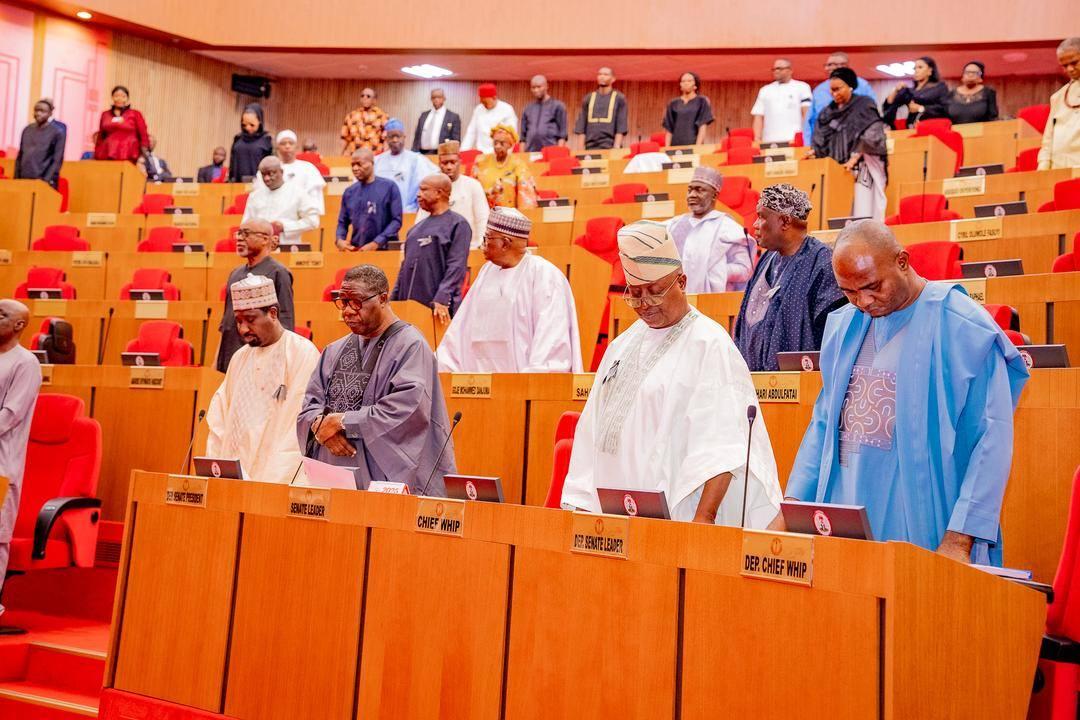
Despite repeated assurances by the Tinubu administration that Nigeria would cease operating overlapping budgets, the Senate on Thursday extended the implementation of the capital component of the 2025 federal budget until 30 September 2026.
- +Again, Senate extends the 2025 federal budget
The Senate President, Godswill Akpabio, announced the extension during plenary after the proposal received the support of a majority of senators by voice vote.
The Senate President, Godswill Akpabio, announced the extension during plenary after the proposal received the support of a majority of senators by voice vote.
Abkpabio’s action on Thursday indicates that President Bola Tinubu may have gone back on his pledge to stop the practice of extending budget implementation beyond the fiscal year.
Although there was no correspondence from President Tinubu requesting the extension of the budget’s lifespan, it is believed that the senators could not have initiated the legislative measure without the Presidency’s knowledge.
This is the third time the legislators have extended the capital component of the 2025 budget.
The budget was first extended in December 2025, from its original expiration date of 31 March 2026, to 31 March 2026 to allow the federal government to complete ongoing projects captured in the appropriation.
When that extension expired on 31 March, lawmakers again extended the implementation period to 30 June 2026 for the same reason.
Meanwhile, on 9 October 2025, the then Minister of Finance and Coordinating Minister of the Economy, Wale Edun, while appearing before the Senate Committee on Finance to discuss the performance of the 2025 budget, pledged that the government would end the practice of extending budget implementation beyond the fiscal year.
Similarly, in December 2025, President Tinubu, while presenting the 2026 budget before a joint session of the National Assembly, promised to end the practice of operating overlapping budgets. He assured Nigerians that all outstanding capital liabilities would be fully funded and settled by 31 March 2026.
“We’re terminating the habit of running three budgets in one flow. By March 31, 2026, all capital liabilities from previous years will be fully funded and closed. From April, Nigeria will operate on a single budget,” the president promised.
The bill seeking the extension was sponsored by the Senate Chief Whip, Tahir Monguno, during plenary.
Mr Monguno, who represents Borno North Senatorial District, said the extension was necessary to ensure adequate funding for the implementation of government programmes, projects, and activities.
“Despite substantial releases made by the federal government to ministries, departments, and agencies for the execution of approved projects and programmes, a significant proportion of the first release remains unutilised due to procurement timelines, project implementation challenges, and other administrative processes,” he said.
He added that several projects across the country remain unfinished and require additional funding and time for completion.
“Several strategic capital projects across critical sectors of the economy are at an advanced stage of completion and require additional time for execution, certification, and fermentation. Failure to extend the implementation period of the 2024 Appropriation Act may result in the abandonment of critical projects, wastage of already committed public resources, and disruption of ongoing government interventions,” Mr Monguno stated.
The Chairman of the Senate Committee on Appropriations, Adeola Olamilekan, said the extension was necessary to complete ongoing projects.
Mr Akpabio, however, told senators that there was little need for extensive debate on the proposal since they all understood the reasons behind it.
The senators agreed and approved the extension.