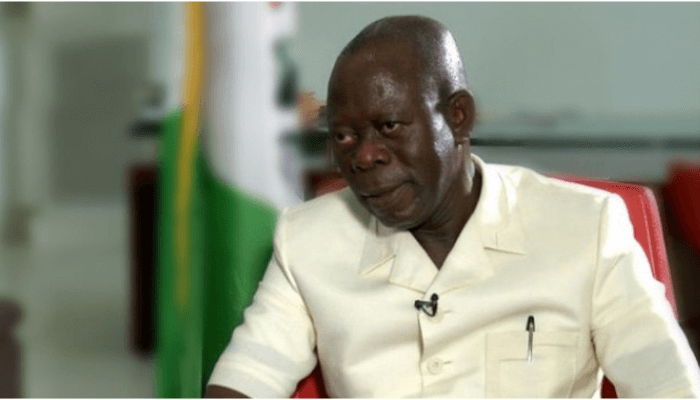
Senator Adams Oshiomhole, has described June 12 as a symbol of courage, resilience and democratic conviction anchored on the legacy of the late Moshood Kashimawo Olawale Abiola, whom he called the conscience of the Nigerian nation.
- +June 12: Oshiomhole hails Abiola as symbol of democratic resistance
Oshiomhole, who spoke on Friday in Akure during the 2026 June 12 Democracy Day celebration; themed “June 12 and Beyond; Reflecting on the progress of democracy and security concerns,” organised by the Ondo State Government said the Abiola’s refusal to abandon his mandate under military pressure from General Ibrahim Babangida and later General Sani Abacha made him a global symbol of democratic struggle and sacrifice.
Oshiomhole, who spoke on Friday in Akure during the 2026 June 12 Democracy Day celebration; themed “June 12 and Beyond; Reflecting on the progress of democracy and security concerns,” organised by the Ondo State Government said the Abiola’s refusal to abandon his mandate under military pressure from General Ibrahim Babangida and later General Sani Abacha made him a global symbol of democratic struggle and sacrifice.
Oshiomhole recalled his role as Deputy President of the Nigeria Labour Congress (NLC) during negotiations with the military regime, acknowledging Oba Olu Falae’s role in labour-government engagements.
He recounted Abiola’s detention and insisted that he had been duly elected President and would not renounce his mandate.
He said: “If he did not possess those qualities, Abiola would have disappeared and become just another Nigerian recalling how his mandate was stolen. He stood firm for democracy and Nigeria.”
According to him, the 1993 election demonstrated rare national unity, with Nigerians voting across ethnic and religious lines.
He said: “In celebrating Abiola, we are celebrating courage, consistency, doggedness, commitment to nation and fearlessness. He stood firm for democracy and he stood firm for Nigeria.”
Oshiomhole also recalled labour negotiations with the military government of General Ibrahim Babangida, praising Oba Falae’s role in dialogue.
“We went into that room angry and determined to do what labour people do best, but we almost forgot what brought us there,” he said. “Through his skill of persuasion and negotiation, we were able to have what you might call a compromise.”
He criticised rising religious influence in politics, saying: “Religion has become an issue in a way that distorts political understanding.”
He added: “Talking about June 12 is to remind ourselves that we had Nigerians who commanded respect across the North, South, East and West.”
On Abiola’s resistance, he quoted: “When you find yourself already inside the river, why do you have to bother about the fact that you are wet?”
He added: “Freedom, even in poverty, is to be celebrated because you can lose both. Democracy does not promise a perfect society. What it promises is freedom to talk.”
Oshiomhole also said Nigeria has made democratic progress since 1999, citing reforms such as BVAS and provisions allowing suspension of elections where technology fails.Nigeria economic analysis
On the Nigerian National Petroleum Company Limited (NNPCL), he defended National Assembly scrutiny following audit reports alleging about ₦210 trillion in unaccounted funds, insisting it was an oversight duty.
He backed President Tinubu’s economic reforms, including subsidy removal and exchange rate unification, describing subsidy as a source of corruption and distortion.
He also criticised the abolition of History as a school subject, describing it as misplaced and arguing that young Nigerians must know their origins. He said he would present the matter to the President, expressing confidence it would be favourably considered.
Governor Lucky Aiyedatiwa, also described June 12 as a defining moment in Nigeria’s democratic history and a continuing benchmark for credible elections anchored on accountability, rule of law and public trust.
He stressed that democracy is not a finished project but an evolving process requiring constant strengthening of institutions.Ondo government updates
He noted that the 1993 presidential election, widely regarded as the freest and fairest in Nigeria’s history, remained the clearest expression of the people’s will and should serve as a reference point for electoral integrity and democratic conduct.
According to him, the anniversary offered an opportunity for sober reflection on Nigeria’s democratic trajectory, particularly as the country moves towards another election cycle in 2027 amid persistent security challenges.
Aiyedatiwa warned that insecurity remains a direct threat to democratic consolidation, stating that violence, fear and instability weaken civic participation and erode public confidence in governance.
He maintained that democracy cannot thrive where citizens are intimidated or unsafe.
He said the theme of the lecture was timely, linking democratic progress with national security, stressing that peace remains the foundation of sustainable governance and development.
Olu Falae, the Olu-Abo of Ilu-Abo and former Secretary to the Government of the Federation, who chaired the occasion recounted sacrifices made during the June 12 struggle, describing it as a watershed in Nigeria’s political evolution.
He said Nigerians overwhelmingly voted for Abiola in a credible election that was annulled, triggering national outrage and resistance.
He noted that the annulment led to organised resistance, including the formation of NADECO and sustained opposition to military rule.
Falae, who recounted his detention and refusal to renounce his role, insisted that the struggle was against military dictatorship. He stressed that organised labour shut down economic activities in defence of democracy.
Falae warned that military rule must never return to Nigeria, noting that the struggle involved detention, exile and loss of lives but paved the way for the present democratic order.
BusinessDay reports that the event, held at the International Centre for Culture and Events (The Dome), Igbatoro Road, Akure, attracted political leaders, traditional rulers, government officials, youths, students, civil society organisations and security agencies in a broad-based commemoration of Nigeria’s democratic struggle.