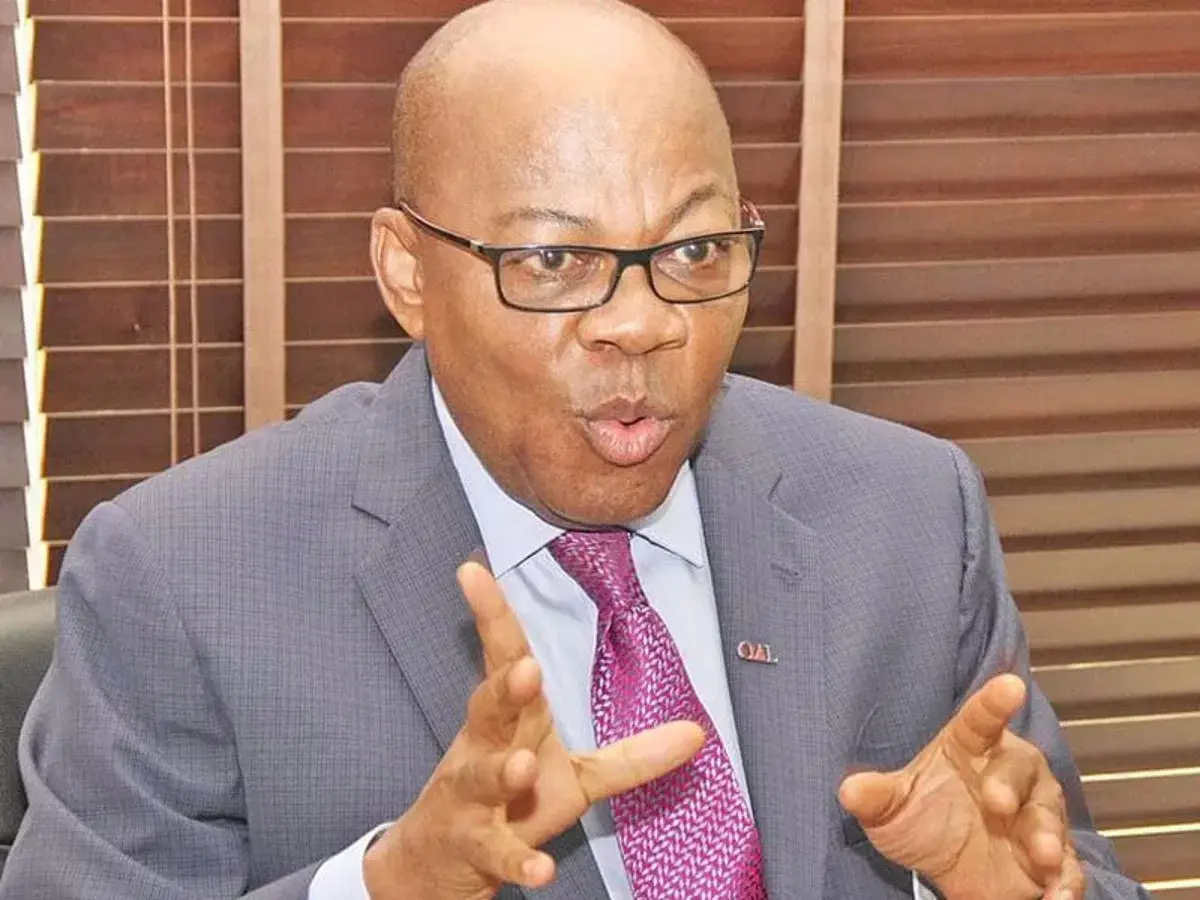
Olisa Agbakoba, a former president of the Nigerian Bar Association (NBA), has said that there is an urgent need for fiscal policy reform with the applixation of Section 162(1) of the Nigerian Constitution, to address continued fiscal leakages and unnecessary borrowing by the Federal Government.
- +Agbakoba seeks constitutional application to tackle revenue leakages
- +…Explains why TSA could not work
Agbakoba made the call on Wednesday at a media briefing entitled: ‘The Federation Account of Nigeria and Infinite Possibilities.
…Explains why TSA could not work
Agbakoba made the call on Wednesday at a media briefing entitled: ‘The Federation Account of Nigeria and Infinite Possibilities. When the Framework is put Right,’ held in Lagos.
In a 40-page paper focusing on fiscal policy reform, Agbakoba, who also is a Maritime lawyer, explained that the objective of the amendment was to make sure that Section 162 (1), of the Constitution of Nigeria works.
He explained that Section 162(1) of the Constitution provides that: “The Federation shall maintain a special account to be called the Federation Account into which shall be paid all revenues collected by the Government of the Federation…”
He noted however, that the law was not being followed.
He recalled that Ngozi Okonjo-Iweala, as Finance minister, created the Treasury Single Account (TSA) to consolidate government revenues.
“It was a well-intentioned reform. But the Treasury Single Account is not Section 162. It was introduced by executive directive, not by law, and it does not have the constitutional force that Section 162 carries. Leakages have continued. By current estimates, Nigeria is losing up to twenty trillion naira every year in revenues that should be entering the Federation Account but never arrive,” he said.
He said that the solution was to fully implement Section 162 by amending the Constitution to make its obligations clear, binding, and enforceable.
Agbakoba therefore, proposed that: “All revenues accruing to the Federation shall be paid into the Federation Account in gross, and no deductions, costs, charges, or offsets of any nature shall be made prior to such payment.
“All costs and expenditures relating to the generation of such revenues shall be appropriated by the National Assembly and disbursed only after remittance into the Federation Account. No executive instrument, administrative direction, or government policy shall establish or maintain any account as a substitute for or equivalent to the Federation Account established by this section.”
Listing key findings on Nigeria’s revenues, Agbakoba noted that the Federation revenues rose from N16.8 trillion in 2023 to N31.9 trillion in 2024 and have continued to grow.
According to him, “In 2025, over 39 percent of gross federation revenues (N14.94 trillion) were absorbed by deductions before reaching the Federation Account Allocation Committee (FAAC).
“Nigerian National Petroleum Company Limited (NNPCL) remitted only N600 billion of N1.1 trillion due in 2024, withholding N500 billion reportedly for legacy arrears.
“An ongoing FAAC investigation covers allegations of $42.37 billion in under-remittances between 2011 and 2017.
“Debt service consumed 78% of federal revenue in 2023 and 69% in 2024, far above the 30- 40 per cent IMF/World Bank benchmark.
“Nigeria’s infrastructure deficit is estimated at $2.3 trillion between 2020 and 2024.
“The constitution does not specify a custodian for the Federation Account, a critical gap unaddressed for 25 years.
“The TSA is constitutionally invalid and structurally incompatible with the Federation Account and should be abolished and replaced by the Federation Account Administration Act architecture proposed in this paper.”
Agbakoba further proposed a four-prong approach as solution: “First, the Federation Account suffers from a constitutional gap: it is established but inadequately operationalised.
“Second, the revenue remittance architecture is broken, with multiple agencies operating as collection points without uniform accountability.
“Third, the TSA introduced by executive directive without legislative or constitutional authority unconstitutionally usurps the Federation Account and must be abolished.
“Fourth, the President has both the authority and the obligation to remedy all of this through a comprehensive Executive Order, supported by dedicated legislation and, in due course, a constitutional amendment.”