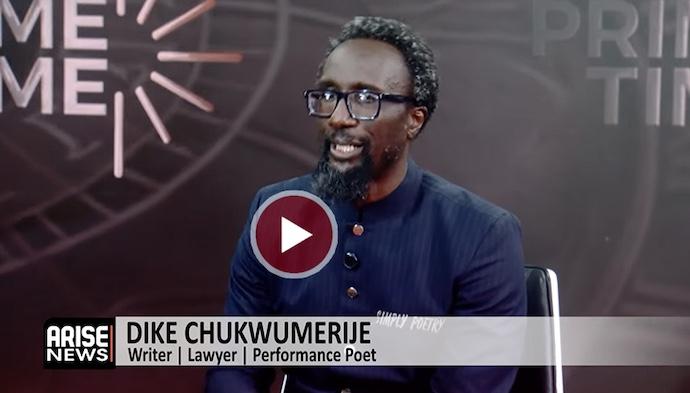
Dike Chukwumerije: Nigeria I A Country In Conflict; There Are Too Many Headwinds
Dike Chukwumerije bemoans the state of Nigeria, describing it as “a country in conflict” held back from its full potential.
Dike Chukwumerije bemoans the state of Nigeria, describing it as “a country in conflict” held back from its full potential.
Writer, lawyer, and performance poet, Dike Chukwumerije has expressed concern over the current state of Nigeria, describing the country as one burdened by internal struggles and obstacles that continue to hinder its growth.
Speaking in an interview with ARISE NEWS on Friday, the writer Nigeria is “a country in conflict” that is trying to rise but is being weighed down by “too many headwinds.”
“In truth, today Nigeria feels to me like a country in conflict. It feels to me like a country that is being held back from its full potential—a country that is working, but it’s like somebody carrying heavy weights around their ankles This is a country that’s trying to stand up, but there are so many headwinds,” he lamented.
Speaking on the 2023 general elections, Chukwumerije said his disappointment after the 2023 presidential election was not about who won or lost, but about the conduct of political institutions and actors.
“It was disappointment with institutions, not the outcome itself. We’re playing with fire. So, it was disappointment with the institutions and the behavior of politicians, not with the country, and not with the outcome,” he said.
He added that his concerns about Nigerian democracy have only grown stronger with time, arguing that politicians often exploit ethnic and religious divisions because many citizens remain vulnerable to such rhetoric.
“Time has only reinforced my conviction [04:19]. I feel like many things I said at the time have sort of panned out. When you come to power using certain methods, it’s impossible to deliver the dividends—it’s just impossible where the culture is rooted on patronage. So, time has only deepened my conviction that there’s a lot of work to do in terms of dealing with mindsets.”
Addressing the growing disillusionment among young Nigerians, Chukwumerije said many youths are now grappling with deep cynicism, fatigue, and political withdrawal after years of economic hardship and disappointment with democratic institutions.
“There is a deep cynicism, which is very uncharacteristic for young people. The very nature of youth is to be hopeful and idealistic. We have a generation of young Nigerians who are exhibiting the cynicism of much older people because of what they are seeing and what they are experiencing—from the shock of End SARS, for instance, to that beautiful welling of youthful hope that was so brutally crushed. There’s the fatigue, there’s withdrawal,” he noted.
Chukwumerije said Nigeria’s democratic space is narrowing, with institutions increasingly compromised and a growing gap between government rhetoric and citizens’ realities.
“I see the democratic space narrowing, a systematic compromise of institutions, and a huge gap appearing between the rhetoric of the government and the reality of the people.”
Despite this, he noted that the political consciousness that emerged in 2023 has strengthened a willingness among Nigerians to explore alternative forms of political engagement outside the mainstream.
“I think that something entered the ecosystem in 2023—a consciousness, like you mentioned, an awareness of a possibility, things that we never thought possible. It demonstrated that it is possible to have a real grassroots movement metastasize into a political force. Everybody knows that it is possible, and that itself has created a willingness to play alternative politics, to stay out of the mainstream, and challenge it from the margins, which is important. So, under the current administration, I think the democratic space is being deliberately narrowed, but I don’t think that is going to stop what’s coming,” he stressed.
Rejecting the current administration’s claim that Nigerians oppose necessary reforms because of the associated hardship, Chukwumerije said the issue is not pain itself, but what he described as an unfair distribution of that burden.
“I don’t think Nigerians have a problem with accepting pain; it is the democratization of that pain. For now, that pain is being assigned to just one party in this contract: the people. This is a series of reforms that have transferred wealth from the pockets of ordinary people to the coffers of government [12:02]. With these expanded resources, we are not seeing a lot of footprint in people’s everyday lives. So, telling people to tighten their belts while you’re loosening your belt is the problem. It is not the pain. If we’re all suffering together, we will suffer together. But when you can clearly see that you are bearing the brunt while somebody else’s lifestyle is not changed at all, that becomes an issue,” he said.
Citing the enduring influence of art and storytelling, the performance poet said poetry and literature remain powerful tools for shaping political consciousness by first reshaping social values and mindsets.
“Our role is to challenge the imagination of young people to see a different possibility,” he highlighted.
Adding, he said: ” Yes, it can, and that’s part of the work that we do very intentionally. In the end, political consciousness sits on social consciousness; it is a superstructure that sits on a foundation of mindsets and values. There is still nothing more powerful for changing mindsets than art, music, poetry, and literature. These things are very subtle and very powerful tools for introducing narratives into society.”
Responding to questions on Nigerian identity, Chukwumerije said the country exists within both division and shared experience, noting that while ethnic and religious differences are strongly expressed, a quieter sense of unity continues to grow.
“We are living in different ethnic and religious realities, but there is also a shared narrative that exists organically and is building organically. The problem is that it is not well-articulated. The realities of division are well-articulated, and there is an organized messaging behind them, but the reality of organic unity is not as articulated.”
Sharing his main concern ahead of the 2027 elections, Chukwumerije said what worries him most is not who wins, but how victory is achieved. He warned that the use of ethnic and religious division during campaigns creates lasting damage to national unity and weakens trust after elections.
“How they win is what worries me. Who wins doesn’t really worry me, but how you win bothers me. It bothers me how willing politicians are to knock ethnic and religious heads together just to get that victory, and the damage that does,” he said.