Some opportunities transcend transaction and become legacy.
- +The Reinvention of Student Housing in Nigeria
- +“When learning is co-located with living, participation rises.”
Once in a generation, a development emerges that quietly redraws the structural boundaries of an entire market.
Once in a generation, a development emerges that quietly redraws the structural boundaries of an entire market.
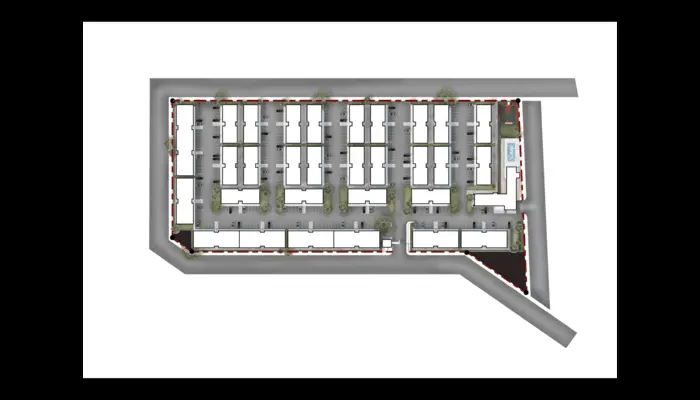
On a 3.39-hectare parcel known as Plot 747 in Abuja’s Institutional and Research District, Jabi, a new category of Student Housing is taking form. Adjacent to Nile University’s main gate and within walking distance of Baze University, Dantata Hostels occupies what urban analysts describe as the last titled bulk residential land within Nigeria’s most concentrated premium university corridor.
In a capital defined by zoning discipline and institutional clustering, that fact is not cosmetic. It is structural.
The forthcoming FCTA bridge and road linking Nile and Baze Universities through the Body of Benchers complex have accelerated the district’s consolidation into a rare academic and institutional micro-belt. Within immediate radius sit the Institute of Human Virology, the National Open University main campus, Rubicon Polo Field, Baze University Teaching Hospital, WHO staff housing, Noble Hall Leadership Academy, Federal Medical Staff Housing, the ECOWAS headquarters, the National Assembly Library, Wupa Metro Station, and the Army Intelligence and Cyber Warfare Commands.
“Where land supply is fixed and student housing or commercial demand is rising, proximity becomes functionally necessary,”says Oluwatosin Bolaji, Director and Chief Executive of One Square Meter by Dantata (1SQM).“Once density stabilizes, the market reprices access”
That imbalance is measurable. More than 20,000 students compete annually for fewer than 4,000 functional dormitory spaces across Nile and Baze Universities. The shortfall has defined Abuja’s off-campus accommodation market for years. Students commute daily from Gwarinpa, Katampe, Idu, Jahi, and beyond, distances that convert mobility into structural inefficiency.
Daniel, a 300-level student at Baze University, frames it in simple arithmetic.
“I spent two years commuting from Life Camp,” he says. “That’s almost two hours a day for two years.”
Dantata Hostels, a One Square Meter by Dantata (1SQM) project, is structured around that arithmetic. The development comprises 337 fully furnished terrace duplexes and penthouse apartments delivering approximately 1,200 bedspaces, capped at two students per room. Shared study areas, kitchens, dining spaces, and lounges are calibrated for operational balance, independence without density distortion.
Globally, student housing anchored to elite academic clusters has evolved into a recognized institutional asset class. In Boston, residential assets surrounding Harvard and MIT have demonstrated resilience across cycles due to constrained land supply and enrollment stability. In London, university-adjacent corridors trade at sustained premiums driven by structural scarcity and international demand. In those markets, proximity is not convenience. It is pricing power.
Nigeria’s student housing sector has historically been fragmented, diesel-dependent, and improvisational. Plot 747 signals a structural pivot. Dantata Hostels sits exclusively within immediate walking proximity of these premium universities. That positioning is not rhetorical; it is cadastral.
“You are either fortunate to secure from limited campus dormitories,” says Mrs. Amina Yusuf, a Nile University parent, “or you send your child far from campus and manage transport, power, and security risks.”
Reliability defines the difference.
“We are not constructing dormitories,” says Engr. Nasiru Dantata, Director at 1SQM. “We are building infrastructure-grade residential assets. Foundations, MEP coordination, lifecycle planning, these are institutional decisions.”
Each unit operates on an individually metered solar-hybrid energy system supported by modular grid backup under a strict no-generator estate policy. The 1.2-megawatt distributed system reduces diesel exposure, stabilizes operating costs, and eliminates generator noise, variables that often erode margins in Nigeria’s student housing structures.
“Operating volatility undermines long-term performance,” notes Arc. Moruf Olabisi, MNIA, General Manager, Project Development. “We engineered certainty into the infrastructure.”
Embedded within the estate is also a 2,000-square meters Tech Innovation Hub structured to integrate globally recognized digital certification pathways into a purpose-built residential ecosystem. The Hub optimizes Microsoft Learn pathways, Azure cloud environments, AI-900 tracks, and Power Platform certification flows under the guidance of Certified Microsoft Trainer and Microsoft Innovative Educator Expert, Ibukun Atoro.
“Our objective is structured certification and applied competence,” Atoro explains. “When digital learning is embedded within residency, completion rates increase and employability becomes measurable.”
Up to 1,200 resident students annually can access structured digital training within the estate. An academic administrator within the corridor describes the model succinctly:
“When learning is co-located with living, participation rises.”
Certainty, in Nigeria’s property market, is a very rare currency. Short-stay and Airbnb conversions once promised attractive yields across Abuja. Oversupply has since compressed margins and increased occupancy volatility.
“We studied the short-stay curve carefully,”says JohnPaul Malherbe, General Manager, Business Operations.“Supply expanded rapidly. Price competition intensified. Discretionary demand softened.”
In 2023, 1SQM delivered a 60-room female hostel 50 meters from the current site. Without premium amenities, the facility has maintained full occupancy to date. Proximity, not branding, drove absorption. Ninety-nine terrace duplexes and apartments within Dantata Hostels are already at advanced construction stage and fully subscribed, with delivery scheduled before the end of Q2 2026. Full estate completion is targeted for December 2027.
“We validate demand through phased delivery,” Malherbe notes. “The first tranche reached full subscription prior to completion.”
The remaining units are now being released for direct ownership. Studios begin at ₦50 million. Four-bedroom configurations extend to ₦300 million. Projected rental yields average 12-15 percent annually , subject to guaranteed occupancy rates. Post-completion valuation for the project is estimated at over ₦45 billion. Yet yield represents only one dimension. In constrained institutional districts, capital preservation is the primary strategy, protecting downside risk while positioning for upside, followed by accelerated appreciation, conservatively underwritten at 30%+ per annum during the early stabilization and growth phase.
The Institutional and Research District has recorded consistent appreciation driven by infrastructure consolidation, diplomatic clustering, and the exhaustion of titled land supply.