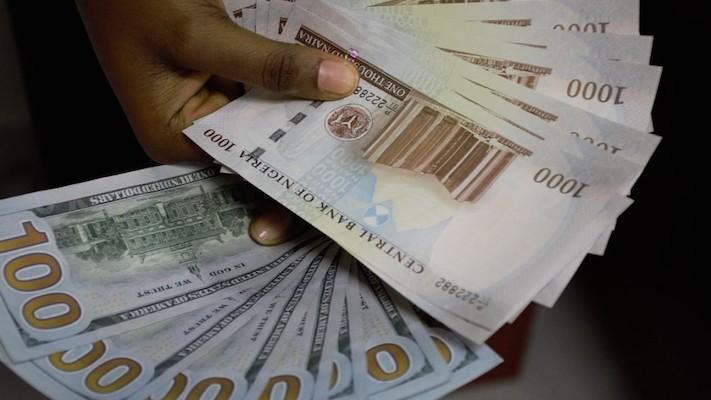
The naira strengthened in the official foreign exchange (FX) market on Wednesday following a record surge in turnover at the Nigerian Foreign Exchange Market (NFEM) and renewed growth in the country’s external reserves.
- +Naira strengthens as NFEM turnover hits record $1.89bn in single-day trade
Data published by the Central Bank of Nigeria (CBN) showed that the naira appreciated by N5.06 as the dollar was quoted at N1,370.56 on Wednesday, representing a 0.4 percent gain compared to N1,375.62 quoted on Tuesday at the NFEM window.
Data published by the Central Bank of Nigeria (CBN) showed that the naira appreciated by N5.06 as the dollar was quoted at N1,370.56 on Wednesday, representing a 0.4 percent gain compared to N1,375.62 quoted on Tuesday at the NFEM window.
The FX market recorded a sharp increase in liquidity, with NFEM turnover rising to a record $1.89 billion in single-day trading on Tuesday. This represented an increase of about 783 percent compared to the $206.46 million recorded on Monday.
The number of deals executed at the NFEM window also increased by 33.18 percent to 281 transactions on Tuesday from 211 deals recorded on Monday.
At the interbank segment, the volume of transactions rose by 25 percent to 130 deals on Wednesday from 104 deals recorded on Tuesday. Interbank turnover also climbed significantly by 75.31 percent to $130.55 million on Wednesday compared to $74.47 million recorded the previous day.
Nigeria’s external reserves, which provide the CBN with buffers to support the naira and meet external obligations, also recorded a fresh increase. Data published on the apex bank’s website showed that reserves rose by about $150 million or 0.2 percent to $48.48 billion as of May 12, 2026, from $48.33 billion recorded on May 5, 2026.
At the parallel market, also known as the black market, the local currency closed at N1,398 per dollar, representing a marginal gain of N2 compared to N1,400 quoted on the previous day.
The exchange rate gap between the official and parallel market rates widened slightly to N28 on Wednesday from N27 recorded earlier in the week.
Members of the Monetary Policy Committee (MPC) have continued to express confidence in the stability of the FX market and the outlook for the naira, citing stronger reserves, improved investor confidence and better liquidity conditions.
In his personal statement at the last MPC meeting, Aloysius Uche Ordu said gross external reserves increased to about $50 billion as of February 2026, equivalent to roughly 10 months of import cover, supported by stronger oil receipts and renewed investor confidence.
He also highlighted the CBN’s efforts to diversify reserve holdings through increased locally sourced gold refined to international standards, noting that the implementation of Executive Order 9 and sustained FX market stability were expected to further strengthen reserves.
According to him, the naira appreciated by 3.43 percent to N1,386.55 per dollar from N1,435.76 at the end of December, reinforcing confidence in the domestic currency. He added that the naira commenced 2026 on a stronger footing, trading around N1,347 per dollar in February compared to N1,688 per dollar in November 2024, when the currency experienced heightened volatility.
He said improved FX liquidity had significantly reduced arbitrage opportunities between the official and parallel market rates, reflecting renewed confidence in the naira as a store of value.
Also commenting on FX market conditions, Muhammad Sani Abdullahi said exchange rate pressures remained moderated while relative stability in the FX market reflected improved liquidity and reduced speculative activity.
He noted that gross external reserves increased to $50.45 billion as of February 16, 2026, from $42.77 billion at the end of December 2025, adding that the reserve position could support more than nine months of imports of goods and services.
Similarly, Murtala Sabo Sagagi said reserves of $50.45 billion provide substantial capacity to absorb external shocks, defend the naira when necessary and sustain investor confidence even as interest rate differentials with advanced economies narrow.
He added that the strong reserve position significantly reduces the risk that monetary easing could trigger destabilising capital outflows or renewed FX volatility.
In his contribution, Mustapha Akinkunmi said one of the major achievements of recent reforms has been improved stability in the foreign exchange market.
According to him, Nigeria’s transparent and more market-driven exchange rate framework has created a more predictable and balanced FX market, with the naira officially trading at N1,363.4 per dollar as of March 2, 2026, representing an appreciation of more than N80 compared to the November 2025 average.