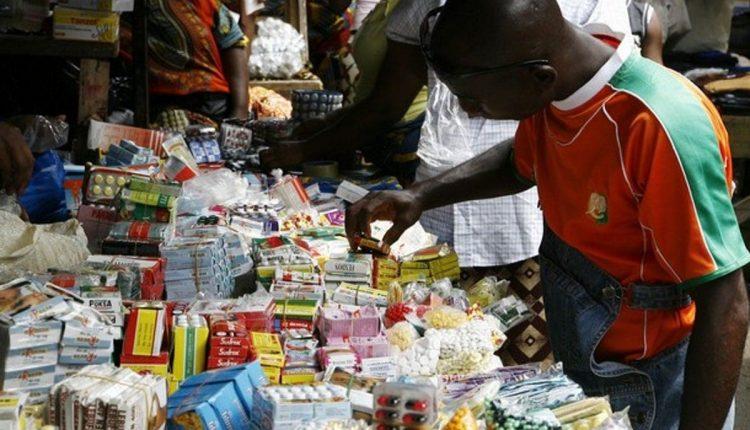
Nigeria has continued to remain a major distribution hub for counterfeit, falsified and substandard medicines despite years of enforcement operations, repeated raids and seizures worth more than N1.1 trillion.
- +Nigeria’s fake drug markets thrive despite N1.1trn seizures
- +Deadly cost of the thriving illegal trade
BusinessDay’s analysis of National Agency for Food and Drug Administration and Control (NAFDAC) enforcement records between 2023 and 2025 shows that the agency has repeatedly returned to the same pharmaceutical distribution hubs despite years of arrests and product seizures.
BusinessDay’s analysis of National Agency for Food and Drug Administration and Control (NAFDAC) enforcement records between 2023 and 2025 shows that the agency has repeatedly returned to the same pharmaceutical distribution hubs despite years of arrests and product seizures.
Among the most prominent markets are Bridge Head Market in Onitsha, Eziukwu (Cemetery) Market in Aba, Idumota Open Drug Market and the Trade Fair Complex in Lagos.
These markets are not ordinary retail centres. They serve as some of Nigeria’s largest pharmaceutical distribution hubs, supplying medicines to pharmacies, patent medicine vendors and informal drug sellers across the country.
Between 2023 and 2025, Eziukwu (Cemetery) Market in Aba remained one of the country’s biggest hotspots for counterfeit-drug enforcement.
In December 2023, NAFDAC uncovered more than 40 illegal factories producing counterfeit beverages and destroyed fake products valued at about N750 million.
The following year, the agency launched “Operation Clean Up Aba,” uncovering widespread falsification of expiry dates on baby formula and other consumer products. More than 150 shops were sealed while fake and expired products worth about N5 billion were confiscated.
Rather than ending the illegal trade, enforcement intensified in 2025 as Aba again featured prominently in NAFDAC’s nationwide crackdown on counterfeit medicines, contributing to seizures valued at more than N1 trillion.
A similar enforcement pattern emerged in Lagos.
In 2023, intelligence-led raids at Idumota Open Drug Market targeted traders suspected of distributing controlled and unregistered medicines. Drug shops and warehouses were sealed after regulators said they discovered medicines that should never have been circulating through open markets.
Attention shifted to the Trade Fair Complex in 2024, where investigations uncovered counterfeit and unregistered consumer products and other regulated goods.
By 2025, both markets had once again become major enforcement targets.
NAFDAC identified Idumota as part of a distribution network responsible for supplying more than 80 per cent of medicines across Nigeria.
During the February operation, the agency screened and sealed 3,027 shops, warehouses and packing stores, uncovering counterfeit, expired, unregistered and improperly stored medicines, including banned Analgin injections, diverted antiretroviral drugs and vaccines stored under unsanitary conditions.
The operation also led to the evacuation of 27 truckloads of suspected illicit pharmaceuticals from Idumota, making Lagos one of the largest seizure points during the nationwide crackdown.
At the Trade Fair Complex, regulators seized more than 10,000 cartons of unregistered tomato paste, cosmetics, soaps, body sprays, air fresheners and other regulated products during a five-day enforcement operation, highlighting the market’s expanding role in the distribution of counterfeit and unsafe goods.
BusinessDay found that the repeated appearance of the same markets in successive enforcement operations points to a deeper structural problem.
While counterfeit products are routinely seized and destroyed, the commercial networks responsible for importing, financing and distributing them appear to remain largely intact.
Interviews with traders, pharmaceutical distributors and industry stakeholders indicate that medicines entering these markets typically pass through multiple layers of wholesalers before reaching retailers, making their origins increasingly difficult to trace once they enter the supply chain.
“It is not a system where everyone knows where every product comes from. A carton can change hands several times before it reaches the final seller. By then, tracking the source becomes extremely difficult,” said Folake Adewunmi, a pharmaceutical distributor familiar with operations in one of the major markets.
Another trader involved in medicine distribution at Trade Fair Market said enforcement operations often focus on products recovered during raids rather than those financing and coordinating the wider distribution network.
“When regulators close shops, many traders lose their stock. But the bigger challenge is finding those behind the supply chain. If the suppliers are not disrupted, products eventually find their way back into the market,” she said. For public health experts, that recurring pattern helps explain why the same markets continue to feature in enforcement operations despite years of increasingly large seizures.
Deadly cost of the thriving illegal trade
The persistence of Nigeria’s counterfeit drug trade carries consequences far beyond regulatory violations.
According to the World Health Organisation (WHO), substandard and falsified medicines contribute to an estimated 116,000 additional malaria deaths annually across sub-Saharan Africa, while poor-quality antibiotics are linked to between 72,000 and 169,000 childhood pneumonia deaths each year.
The problem extends beyond Nigeria’s borders and is compounded by the sophisticated trafficking networks that move illicit pharmaceuticals across West Africa.
A 2023 report by the United Nations Office on Drugs and Crime (UNODC) found that more than 605 tonnes of medical products were seized in West Africa between 2017 and 2021, with most shipments arriving through legitimate international trade channels, particularly by sea.
The report noted that many of the products originated from major exporting countries, including China, India, Belgium and France, before being diverted into illegal supply chains in the region.
According to the UNODC, counterfeit and substandard medicines are moved across West Africa through established trade and transport routes, exploiting porous borders and weak regulatory oversight.
The UN warned that the region has become a major redistribution hub for illicit goods, allowing falsified medicines to spread from ports and commercial centres into local markets and across the Sahel.
Researchers described fake and substandard medicines as one of the most serious threats to public health in low- and middle-income countries. Nigeria bears a significant share of that burden.
BusinessDay’s review of NAFDAC annual reports, enforcement disclosures and regulatory statements shows that the agency has intensified anti-counterfeit operations in recent years, destroying increasingly large volumes of falsified, substandard and expired products.