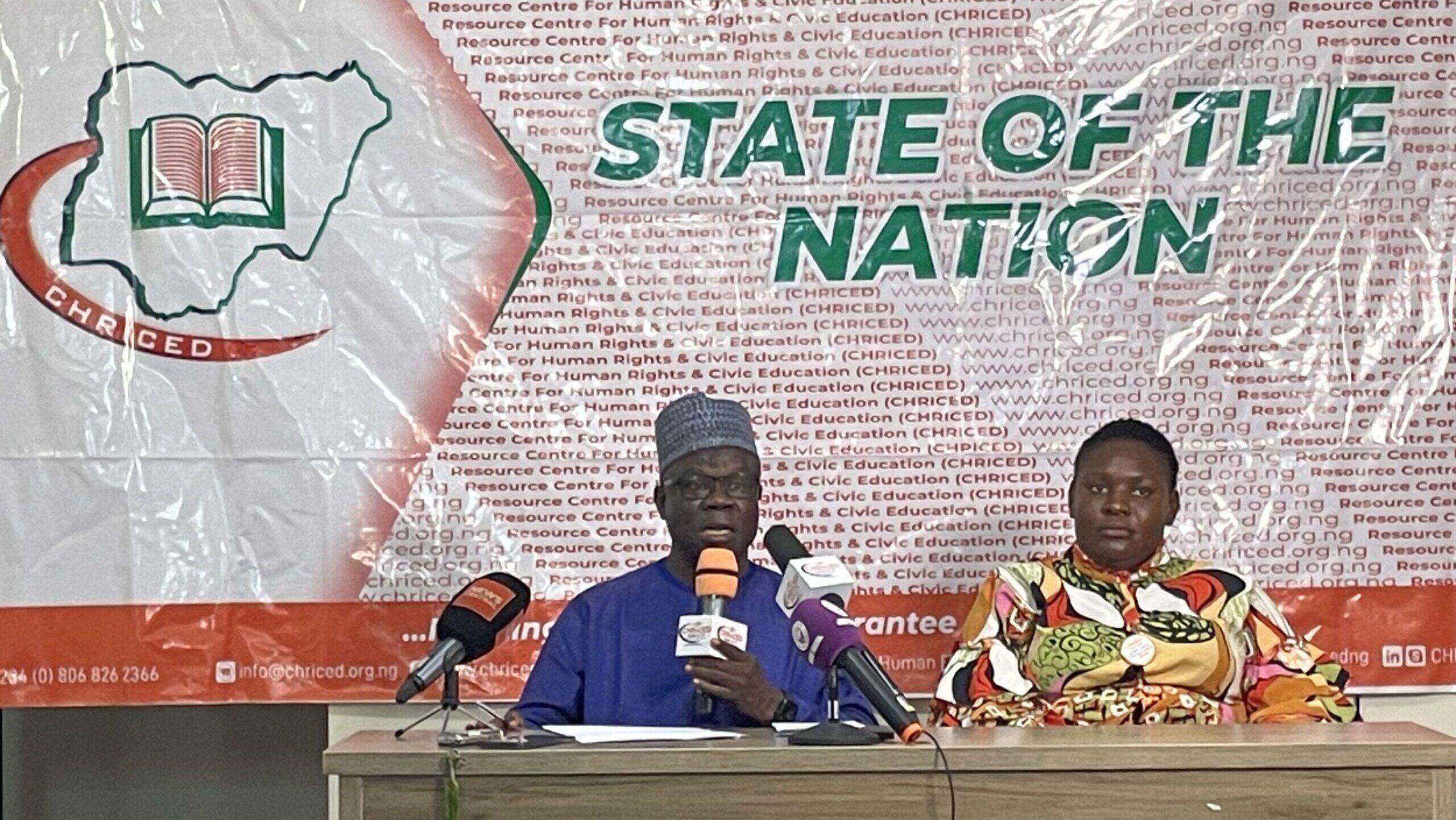
A group, Resource Centre for Human Rights and Civic Education (CHRICED), has warned that Nigeria is sliding into a full-scale national emergency marked by deepening insecurity, economic hardship, and what it described as a dangerous erosion of democratic value.
- +Group warns of national emergency as insecurity, hardship deepen in Nigeria
At a press conference in Abuja on Tuesday, the organisation’s Executive Director, Ibrahim Zikirullahi, painted a grim picture of a nation under severe strain, where citizens face fear, hunger, and disillusionment amid what he called a breakdown of the social contract between the government and the people.
At a press conference in Abuja on Tuesday, the organisation’s Executive Director, Ibrahim Zikirullahi, painted a grim picture of a nation under severe strain, where citizens face fear, hunger, and disillusionment amid what he called a breakdown of the social contract between the government and the people.
Anchoring his remarks on the enduring warning of Chinua Achebe that democracy requires both moral leadership and an engaged citizenry, Mr Zikirullahi said the current moment demands urgent clarity and accountability.
He argued that across Nigeria, insecurity has reached alarming proportions, with armed groups operating freely in many regions and leaving communities vulnerable to attacks, abductions and killings.
“The signs of strain are everywhere: in the insecurity that stalks communities, in the collapsing economy, in the shrinking civic space, and in the despair etched on the faces of ordinary Nigerians,” he said.
According to him, more than 1,100 people have been abducted since January 2026, while coordinated assaults by insurgent groups such as Boko Haram and the Islamic State West Africa Province continue to devastate communities in the North-east.
He added that banditry in the North-west and North-central has evolved into a sophisticated criminal network, while insecurity is also spreading across southern Nigeria, leaving no part of the country untouched.
The group said recent incidents underscore the depth of the crisis, including the 29 March attack in Plateau State that left dozens dead and a reported Nigerian Air Force airstrike in Borno that mistakenly hit civilians.
It also cited the killing of Oseni Braimah, a brigadier general, during a coordinated terrorist assault at a military base in Benisheikh, Borno State, as evidence of a “symbolic rupture” in Nigeria’s defence architecture.
Mr Zikirullahi said the death of a senior military officer in what should have been a fortified command environment raises troubling questions about intelligence, planning and operational capacity, warning that if top commanders are no longer safe, ordinary citizens face even greater peril.
“When a senior military officer, operating within what should be a fortified command environment, is overrun and killed by insurgents, it sends a chilling message about the state of national security. The question therefore, if a brigadier can be ambushed and killed, what hope remains for ordinary citizens?” he said.
He described the incident as a national alarm bell that exposes systemic failures within the country’s security framework.
Beyond the battlefield, CHRICED criticised what it termed the government’s inadequate response to the crisis, arguing that official visits to affected communities often appear disconnected from the suffering of victims. The organisation said symbolic gestures cannot substitute for meaningful policy action or empathy, warning that such actions risk deepening public frustration.
The group also raised concerns about what it described as increasing harassment of opposition figures and shrinking civic space, warning that Nigeria risks repeating patterns that undermined earlier democratic experiments.
It noted that journalists and civil society actors now operate under growing pressure, which weakens accountability and limits citizens’ access to information.
Quoting George Orwell, an English novelist, Mr Zikirullahi warned that societies that drift away from truth often become hostile to those who speak it, stressing that freedom of expression remains essential to democratic survival.
On governance, he expressed alarm over what it called the normalisation of corruption, alleging that individuals facing serious allegations are increasingly rewarded with high public office, including diplomatic appointments. He warned that such practices erode public trust, damage Nigeria’s international reputation, and send a troubling message that integrity is optional.
Mr Zikirullahi said the country’s economic situation has compounded the crisis, with rising inflation, unemployment and poverty pushing millions into hardship.
It noted that petrol prices have surged to between ₦1,350 and ₦1,500, while the cost of basic goods has tripled in some cases, forcing families to make painful choices about food, education and healthcare.
“Petrol now sells between ₦1,350 and ₦1,500, while diesel goes for over ₦2,000 depending on the location. A bag of cement, which cost ₦3,600–₦4,000 in 2023, now sells for slightly above ₦12,000,” he said.