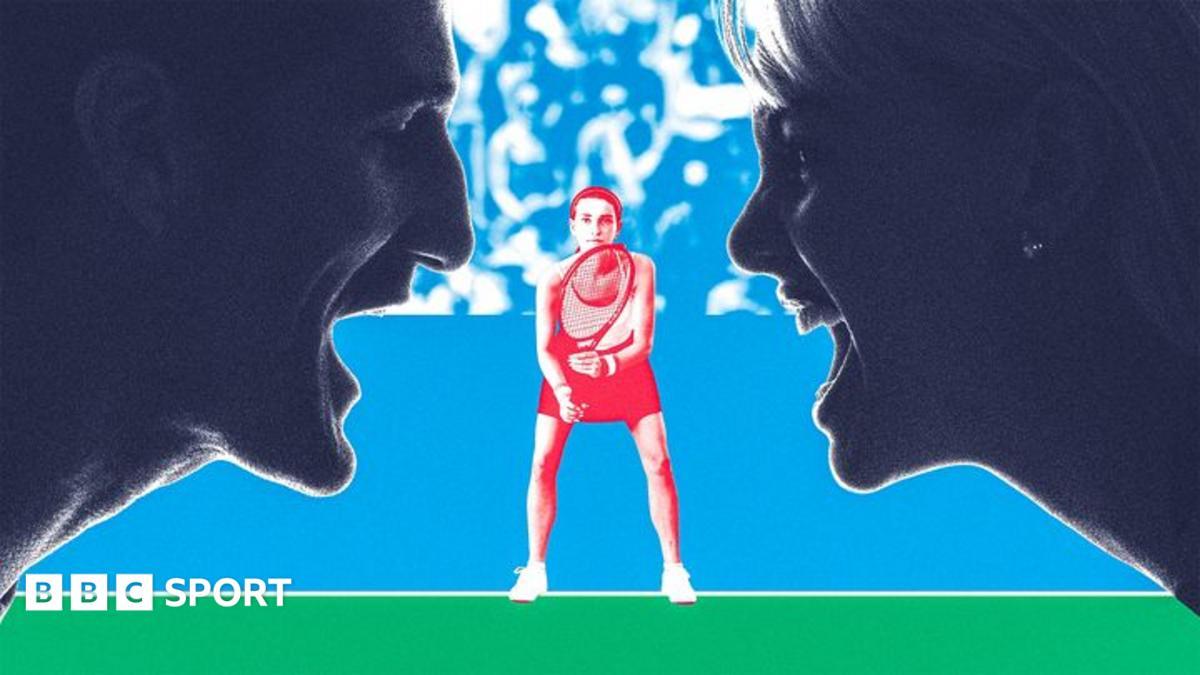
The former top-ranked junior player would go on to compete alongside some of the top names in British tennis including Katie Boulter, Emma Raducanu and Harriet Dart before stopping playing at 19 because she was burned out and not enjoying it any more.
- +Wimbledon 2026: How not to be a tennis parent
- +So, why is that and what needs to change?
- +So when does it start to get serious?
- +Ellie-Rose Griffiths is a former British junior number one
- +Todd Ley was the top 12-year-old tennis player in the world but quit at 17
When the 27-year-old looks back now, it is not just the tennis she remembers.
When the 27-year-old looks back now, it is not just the tennis she remembers. It is the pressure around it, and in particular one group of people she believes could deal with it better.
Pushy parents are nothing new in a sport offering the potential of millions of pounds in prize money at the very top - at elite level there are well-documented incidents involving the dads of Jelena Dokic, Mary Pierce and Bernard Tomic to name a few.
It all starts at junior level.
"You see parents shouting at children all the time in tennis," Griffiths tells BBC Sport. "There's a lack of understanding on how they should behave... on how they could help their child to blossom into the athlete that they should become."
"We've had situations here before where unfortunately we've had to call the police because the parents' behaviour is getting that far out of control," says Chris Johnson, head coach at Sutton Coldfield Tennis Club, where he has worked for 36 years.
"They won't listen, they think they can get away with anything, they don't respect the referees, it can get a bit ugly."
Both are clear that behaviour like that does not happen in isolation and that it is the environment tennis creates that makes parents behave this way.
So, why is that and what needs to change?
Tennis can be intense for parents.
There is transport to arrange, coaching to fund, and a complicated player pathway to navigate. In some cases there's even private tutoring to arrange if their child has left mainstream school to focus on the sport.
"You do get on a bit of a hamster wheel", says John from Derbyshire, whose 11-year-old son Harrison is a promising player. "It's 12 months of the year, indoor courts and outdoor courts."
Children can start a form of tennis from the age of four on a modified court. The Lawn Tennis Association's (LTA) performance pathway for the most promising juniors supports players from the age of seven on their journey to potentially becoming a Grand Slam champion.
Competitions are grouped according to age and start aged eight and under.
And the ratings and rankings you get from doing them are one way to get noticed.
So when does it start to get serious?
"The minute they start playing their first competition," according to Johnson.
"A lot of adults can't cope with the pressures of playing an individual sport and then they're expecting young children to be able to do so."
Steve Whelan, a coach working in St Albans with nearly three decades of experience, agrees that the system places too much emphasis on winning at a young age.
"It just creates this race to the bottom because parents are chasing ratings and rankings," he says.
He tells parents: "These are not tennis players. They are kids who play tennis and there's a big difference."
The LTA says it undertook a "comprehensive review" of its rating and ranking system in 2018 "specifically to address the issue of putting too much pressure on children at too young an age."
Now players can't be ranked nationally against their peers until they reach the under-11 age group, with younger children from eight and up organised into competition based on recent form - a rating.
When it comes to parental behaviour the LTA says like any sport "there are occasions when a small minority of parents do not uphold the standards of behaviour expected". The governing body will soon be launching a new initiative called Fair Play, to promote positive parent behaviour and support coaches.
Ellie-Rose Griffiths is a former British junior number one
For parents, the pressure is not only emotional. It can also be financial.
"It just gets more and more: lessons, travel, flights, tournament fees..." one parent explains.
"If you want to play four hours a day with a coach... that's £1,000 a week... £4,000 a month... that's more than people's salaries," she says.
The LTA says it "supports talented junior players through access to world-class coaching and facilities across our network of Regional Performance Development Centres".
The governing body also offers grants to young players on its performance pathway who are facing financial barriers to training, travel or competition, through its foundation.
But Griffiths says parents investing to bring their children to the next level can alter behaviour.
"The financial support comes from the winning and the losing," she says.
"If my child wins, I might get some more funding; if my child loses, we might not - so we don't want them to lose."
"They are almost expecting a return on their investment, and it shouldn't be like that."
"A 10-year-old isn't expected to do a job, but it does become that," Griffiths says.
It is a view echoed by Australian Todd Ley, who was once touted as the best junior player in the world and at 12 became the youngest athlete ever signed by global sports agency IMG before quitting the sport at 17.
He trained at the Nick Bollettieri academy in Florida, where the Williams sisters, Andre Agassi and Maria Sharapova were among the famous names associated with the programme.
Andy Murray and Juan Martin Del Potro were some of the junior players he measured himself against.
Tennis quickly became all-consuming, says Ley, and "tennis went from enjoyment to employment". He ended up "hating" tennis and still does.
His dad Max was his coach and manager. From Ley's perspective, tennis came first for his dad, and his son came second.
"Realistically, it was tennis from, you know, breakfast to bedtime," says Ley, who has written about his experiences in Smashed: Tennis Prodigies, Parents and Parasites.
"Very quickly, the child isn't looked at as a person. They are a commodity and a stock."
Ley believes early success in tennis can create incentives that push families, coaches and systems towards doing more, earlier.
"If you have very good results early then you're going to get a better ride and you're going to get better management companies, sponsors," he says.
"Very early it becomes a contest about who can do more.
"People forget completely that they're dealing with children."
Todd Ley was the top 12-year-old tennis player in the world but quit at 17
Not everyone minds having pushy parents - or at least not in hindsight. Emma Raducanu has previously described hers as "so pushy" when she was younger.
In an interview with the Times in 2024 she said: "I've seen some great people who I was playing with in the juniors who had way more lenient parents, who were like, 'It's OK if you lost', and those players don't play tennis any more, so I don't blame my parents for it."