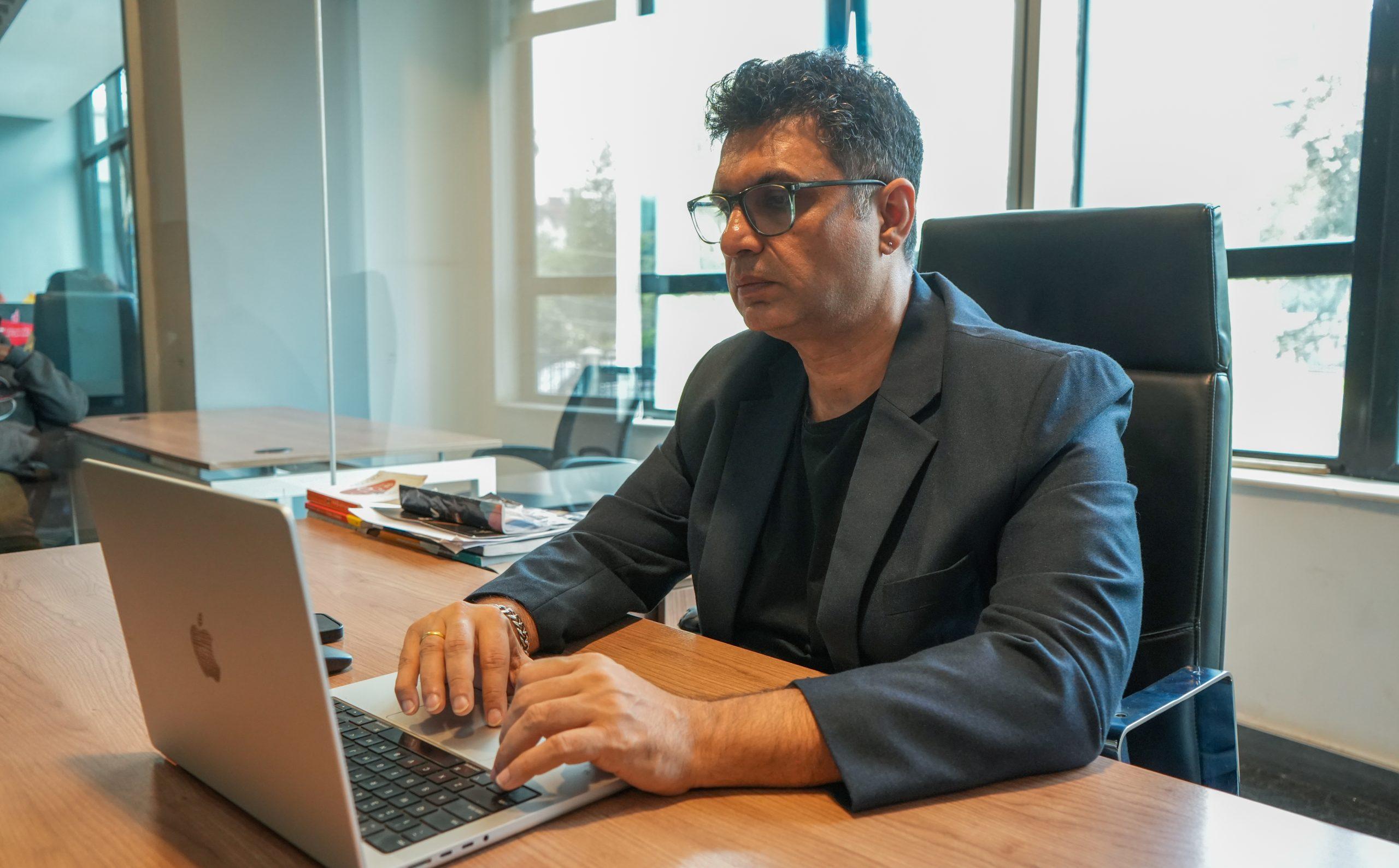
The offices of Craydel, a Pan-Africa edtech connecting African students to global universities, occupy a glass-partitioned floor at The Pavilion on Lower Kabete Road, away from Nairobi’s perpetual traffic and construction noise. Through the transparent walls, almost nothing is hidden. Student counsellors are fielding anxious calls from parents and students, while product managers huddle over laptops.
- +Craydel co-founder Manish Sardana quit a high-flying job to start from zero
Manish Sardana’s office sits in the middle of it all, deliberately so.
Manish Sardana’s office sits in the middle of it all, deliberately so. On one side is the operations team; on the other, the engineers building the artificial intelligence (AI) engine that powers Craydel’s study abroad matchmaking tool. There is no imposing corner office separating the co-founder and CEO from the very people helping him build the company.
He asks whether I would like tea. He orders coffee for himself.
Sardana has the calm confidence of someone comfortable with uncertainty. He says he has spent his life restless, suspicious of comfort, and constantly searching for purpose. Raised in a modest household in India, he abandoned a place at the prestigious Delhi School of Economics before, over a decade later, walking away from a high-flying career at WPP Scangroup, a marketing and communications company, to build Craydel from scratch.
Five years on, he says he has no regrets.
He imagines himself still building, still searching for the next problem to solve, until his deathbed. That restlessness has not come cheaply. His family, he acknowledges, has carried part of that burden.
“I’ve been married for 18 years now,” he says with a laugh. “So I must have done something right.”
When pressed on what success ultimately looks like, he says it is whether his children, his parents, and the people closest to him feel proud of the life he chose to build.
This interview has been edited for length and clarity.
You grew up in India, built businesses across continents, and eventually chose Africa. What part of yourself were you looking for that you couldn’t find elsewhere?
A few things. First, all three co-founders were based in Kenya, so that anchored us here. But personally, I had the option to go back to India and start something there. I chose not to because this continent has been incredibly generous to me. I had sold my company in India and was at a loose end when I got the opportunity to come to Kenya. I built a successful career here, gained a lot, and felt I needed to give back.
That was important to me because I see so many expats come, work a few years, make money, and leave. Very few actually stay and contribute to building something lasting. For me, that commitment was real—I invested almost everything I earned and saved here into my venture in Kenya. That was critical.
Second, I’m genuinely happy here. Kenyans are warm, and the continent has massive human potential. Yet the number of people solving problems here is very small. In India, there are so many entrepreneurs building so many things—they didn’t need another Manish to start something there. But here, especially in higher education and study abroad, not much was happening.
Nobody was disrupting the market; everyone was maintaining the status quo. So we saw an opportunity to do something interesting. I also built startups during my time with ScanGroup on the continent, and I’d turned those ventures into successes. That gave me the confidence to build something here and succeed.
Looking back at your twenties, what kind of man were you when nobody was watching? And what parts of that younger man are still alive today?
I’m the same person whether someone is watching or not. That doesn’t change how I behave. I’m known for being authentic—for better or worse. In my twenties, I displayed traits like incredible risk-taking. I quit a top college I’d gotten into, in a fiercely competitive environment, and walked away from economics. I had a massive risk appetite then, and I still have it today.
I love a challenge. I push myself into corners where I’m really tested. When I’m comfortable, it irritates me; I get bored and seek out new challenges. So, risk-taking, seeking challenges, always looking to build something that creates value—those were the traits I displayed in my twenties, and there’s plenty of evidence of them. I still have them today.
When people introduce you, they list your achievements. What do the people who know you best say about you?
The people who know me best would say a few things. First, Manish is never easily satisfied—no matter what he’s achieved or received, he wants more; he doesn’t stop. Second, they’d say I have a lot of grit and courage; I’m unshakable. No matter what life throws at me, I stay resilient. Third, they’d say I’m not someone seeking a “chill life.” That’s not me. I don’t seek a life of just joy and ease. And finally, they’d always tell you that Manish needs a very strong purpose to feel satisfied. Without purpose, I feel shallow.
Most founders tell a story of opportunity. Yours often sounds like a story of conviction. What is the most expensive belief you’ve ever held onto?
The belief that “good is not good enough.” That’s cost me a lot. You achieve something, you feel good, but I never feel it’s enough. So I keep pushing harder, and sometimes it comes at a personal cost; my family has to bear with me. For context, when I quit my job at Scan Group to start Craydel, I was at the peak of my career. I had a great reputation, I was making good money, in a strong position, growing fast. I’d worked incredibly hard to get there. Then I gave it all up to start from zero again. That’s an example of a belief that costs me a lot of money, hardships, and relationships. It just never feels enough.
No, not at all. But I’ve become better at being more empathetic and supportive of the people around me who’ve borne that cost. As I pursue my purpose, I make sure those who depend on me, emotionally and financially, are cared for. I don’t become so obsessed with my own drive that I ignore anyone around me. One good testament: I’ve been married for 18 years now, so I must have done something right.
Craydel was founded to simplify access to higher education. Looking back, what problem did you underestimate the most?
Manish: We started with the conviction that digitising the entire process—searching, finding, applying to universities—is more optimal, more learner-centric, and creates better outcomes. We assumed that because our conviction was so strong, people would buy into it. I underestimated how much resistance to change there is in human behaviour. Even if you believe this is a better way, changing people from old habits to new ones is incredibly difficult. That resistance to adopting technology was bigger than I anticipated.
Craydel sits between students and universities. Which side has been harder to convince?