On a humid Friday evening in Lekki, a young professional stands in the aisle of a neighbourhood store, scanning labels with unusual care. She picks up a jar of peanut butter. Puts it back. Reaches for another – this one locally made, with a simpler label, a slightly lower price. Into the basket it goes.
- +How Nigeria’s new retail class Is turning local production into market power
- +Distribution remains the defining constraint
- +Digital platforms are also entering the equation
- +“You can sell online,” a founder notes. “But you still have to deliver.”
- +Stronger distribution networks
- +More organised retail expansion
- +Better alignment between producers and retailers
Two years ago, that decision would have been harder.
Two years ago, that decision would have been harder. Imported brands dominated perception – cleaner packaging, stronger trust, more visibility. Today, the shelf looks different.
More Nigerian names. More familiar ingredients. More choices that feel, at once, closer and competitive. Behind that quiet shift is a larger story – one that begins not in the store, but far earlier in the chain.
For years, Nigeria’s Go Local conversation has focused on production. Grow more. Make more. Substitute imports.
And progress is visible. Local manufacturers are producing more processed foods, household goods and consumer staples than at any point in the past decade. In categories from snacks to personal care, Nigerian brands are no longer fringe players.
But production, as many founders are discovering, is only half the battle. “The real fight is not in the factory,” says a Lagos-based retail strategist. “It’s on the shelf.”
Across Nigeria’s retail landscape, a new class of indigenous brands is emerging – companies like Bokku Mart, Justrite Superstore, Market Square, Spar Nigeria, and Shoprite Nigeria (now largely localised in operations). Alongside them, smaller neighbourhood formats and digital-first platforms are reshaping how goods reach consumers. Their shelves are becoming a battleground for something deeper than brand preference.
They are where Nigeria’s production economy either translates into value – or stalls. The numbers tell part of the story.
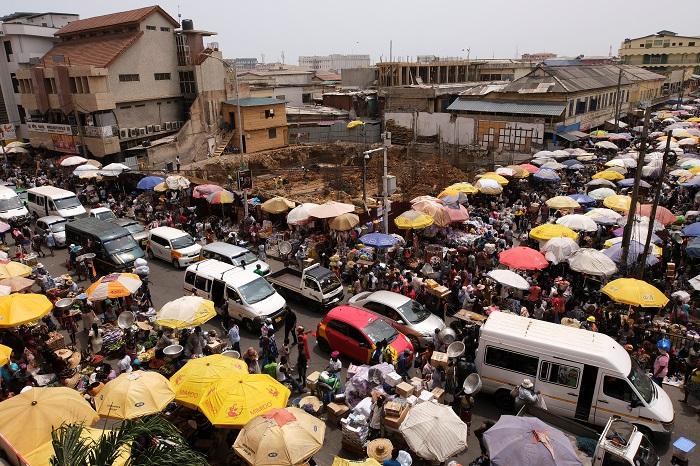
Nigeria’s retail market is estimated at over $100 billion annually, yet modern retail – supermarkets, organised chains – accounts for less than 10 per cent of total trade. The remaining 90 per cent flows through informal markets, kiosks and open stalls (PwC, McKinsey retail analyses).
This fragmentation has consequences. For producers, it means:
For consumers, it means inconsistency – in price, quality and availability. And for the economy, it means value leaks.
What is changing now is not just what Nigeria produces, but how it is sold.
At Justrite Superstore, shelf space increasingly reflects a deliberate shift toward local sourcing. Executives within the chain have indicated that a growing share – often 60–70 per cent in key categories like packaged foods and household goods – is now sourced locally, driven by both supply availability and currency pressures.
At Market Square, owned by Sundry Foods, the strategy is similar: prioritise Nigerian manufacturers where quality meets price expectations. The logic is commercial, not patriotic.
Local products, when efficiently supplied, reduce exposure to foreign exchange volatility.
For retailers, that is margin protection. But getting onto the shelf – and staying there – is not simple.
Distribution remains the defining constraint
A producer in Ogun State may manufacture competitively priced goods, but moving those goods efficiently to stores in Abuja or Port Harcourt can erode margins. Logistics costs in Nigeria can account for 30–40 per cent of final product prices, compared to under 10 per cent in developed markets (World Bank estimates).
This is where the system either holds – or breaks.
Consider Bokku Mart, one of a new generation of curated retail formats. Its model is not just about selling products, but about curating local supply – working closely with producers to ensure consistency, packaging standards and delivery schedules.
This is retail as infrastructure. It is not enough to stock local goods. Retailers must often help shape them – advising on packaging, pricing and even production timelines.
“You cannot just open your doors and expect the system to work,” says one operator. “You have to build parts of the system yourself.”
Digital platforms are also entering the equation
Jumia, along with newer B2B platforms, is helping connect producers directly with retailers and consumers. While e-commerce penetration remains relatively low – estimated at under 5 per cent of total retail – its influence is growing, particularly in urban centres.
For small producers, digital channels offer something traditional retail often cannot: access without gatekeeping. But even here, the physical constraint remains.
“You can sell online,” a founder notes. “But you still have to deliver.”
What emerges is a layered system: Production creates supply. Processing creates value. Distribution determines reach. Retail captures margin. Miss one layer, and the chain weakens.
Back in Lekki, the young shopper reaches the checkout.
Her basket tells a story she may not fully articulate: locally made snacks, Nigerian spices, a skincare product from a homegrown brand. It is not ideological. It is practical.
The products are available. They are affordable. They meet expectation. That is how markets shift – not through slogans, but through shelves.
For Nigeria, the implications are significant. If local production is to translate into economic strength – into jobs, into currency stability, into export readiness – it must be anchored in functioning market systems.
Stronger distribution networks
More organised retail expansion
Better alignment between producers and retailers
Countries that industrialised successfully did not stop at factories. They built systems that connected factories to markets – efficiently, predictably, at scale. Nigeria is now at that stage.
Modern retail is expected to grow steadily as urbanisation increases and consumer preferences evolve. Even a shift from 10 per cent to 20 per cent formal retail penetration would represent tens of billions of dollars moving into more structured systems.
For investors, this is not just a retail story. It is a market infrastructure story.
As the shopper steps out into the Lagos evening, her choices ripple backward through the system. To the retailer, who decides what to stock. To the distributor, who decides what to move. To the producer, who decides what to make.
This is how economies organise themselves. Not in policy documents alone, but in everyday transactions.
The next phase of Go Local will not be defined by how much Nigeria produces. It will be defined by how well it sells what it produces. Because in the end, value is not created in isolation.
It is created when products move – from factory to shelf, from shelf to basket, from basket into the rhythms of daily life. And increasingly, those products are local.