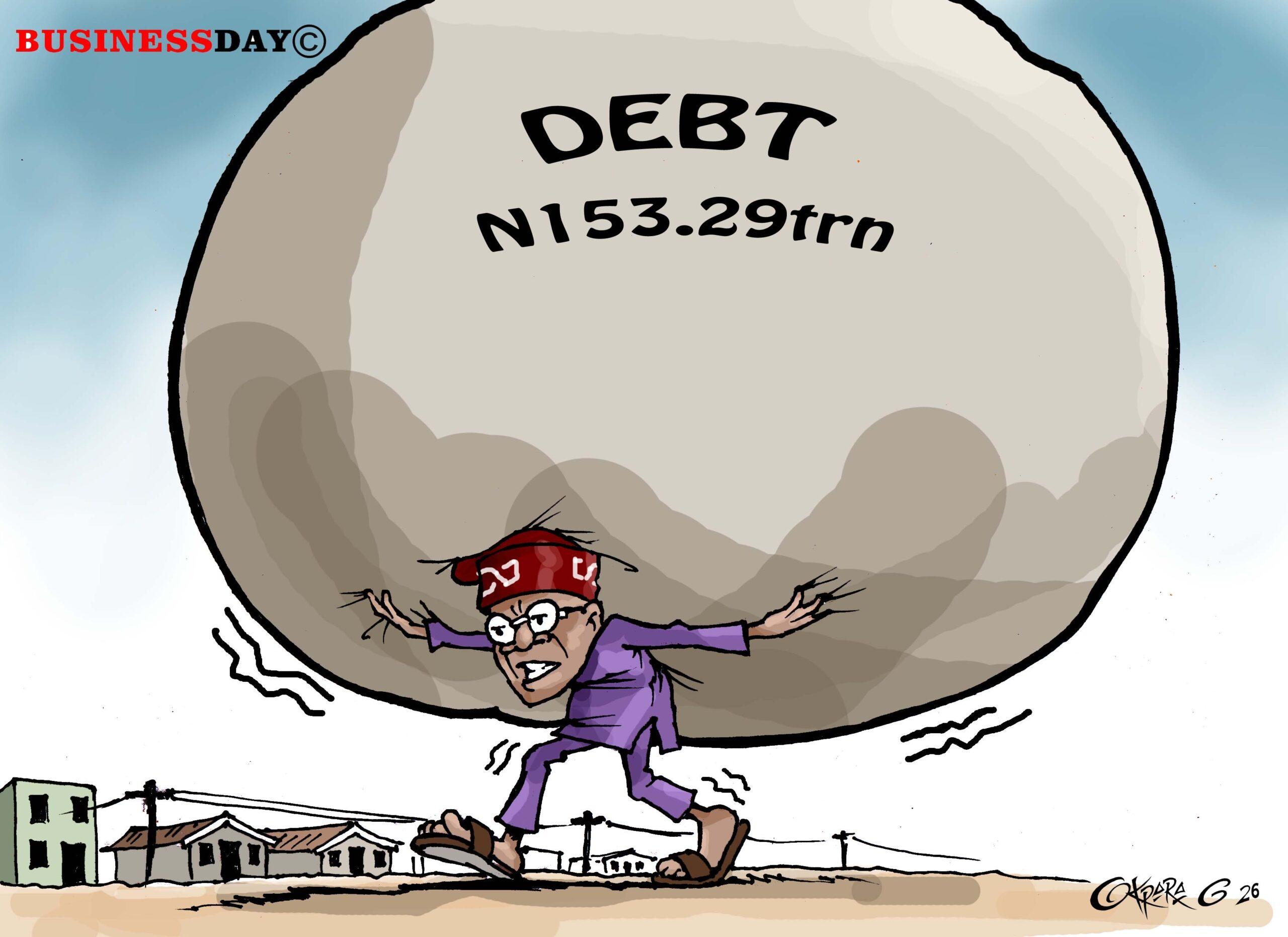
Nigeria’s worsening debt profile is forcing renewed calls for stricter fiscal discipline and alternative financing strategies, as rising debt servicing costs continue to consume a significant share of government revenue and limit spending on critical development needs.
- +Nigeria’s debt burden sparks calls for fiscal discipline
- +…As rising debt service weighs on revenue
With debt servicing projected at N15.81 trillion in the 2026 budget, analysts say the federal government must urgently rethink its spending patterns, prioritise essential expenditures and explore innovative funding models, including public-private partnerships (PPPs), to ease mounting fiscal pressure.
…As rising debt service weighs on revenue
With debt servicing projected at N15.81 trillion in the 2026 budget, analysts say the federal government must urgently rethink its spending patterns, prioritise essential expenditures and explore innovative funding models, including public-private partnerships (PPPs), to ease mounting fiscal pressure.
A report by BudgIT, a civic organisation, obtained by BusinessDay, warned that “Nigeria faces a severe fiscal inflection point driven by explosive debt accumulation, weak revenue mobilisation, currency depreciation and heavy reliance on high-cost borrowing.”
According to the report, “Between 2021 and Q2 2025, total public debt rose from N33.13tn to about N149.29tn, a more than threefold increase concentrated in 2023–2025. Domestic debt now represents a slight majority of the total debt stock (roughly 52 percent –53 percent), reflecting a shift toward domestic financing that, while reducing exchange rate risk, has raised domestic interest rates and crowded out private sector credit.”
The report further noted that “debt service obligations have risen sharply alongside the stock. Annual debt service moved from roughly N3.0tn in 2021 to N12.36tn in 2024, with approved and proposed figures of N13.43tn for 2025 and N15.81 tn for 2026, respectively.”
More concerning, according to BudgIT, is the country’s debt service-to-revenue ratio, which “has reached unsustainable levels, peaking at 83.62 percent in Q2 2025.” It added that “international benchmarks (that suggest ratios above 20 percent for low-income countries) indicate elevated risk; Nigeria’s ratio far exceeds this, signalling an immediate fiscal emergency in which most government revenue is channelled to creditors rather than development.”
To ease near-term pressures, the report recommended “targeted short-term financing such as concessional lines or multilateral support contingent on credible structural reforms, to bridge immediate gaps without resorting to high-cost domestic borrowing.” It added that “this combined approach is seen easing near-term pressures while locking in policy changes that improve medium-term sustainability.”
Muda Yusuf, chief executive officer of the Centre for the Promotion of Private Enterprise (CPPE), described the rising debt servicing burden as a structural challenge that leaves government finances severely constrained. “The consequence is that you have to go out and borrow again. It’s a major structural issue,” Yusuf told BusinessDay.
He explained that once debt servicing is deducted from government revenue, little is left for other obligations, reinforcing a cycle of borrowing to fund recurrent and capital expenditure.
Yusuf raised concerns over the high cost of borrowing, noting that interest rates on both domestic bonds and eurobonds remain prohibitive. “If the government is borrowing at 17, 18, or 20 percent, that is extremely high,” he said. “There has to be a more deliberate way of managing these costs. We cannot continue to finance the budget at such prohibitive rates.”
He stressed the need for the government to align its expenditure with realistic revenue expectations, warning that persistent budget deficits financed through borrowing are crowding out private sector access to credit.
“The federal government often overloads itself with too many responsibilities,” he said. “There are projects currently in the budget that the private sector is well-positioned to take over. By leveraging PPPs, we can reduce the fiscal load that necessitates all this borrowing.”
He also suggested a redistribution of responsibilities across tiers of government. “Now that states have more money, some federal projects and responsibilities can be transferred to the state level. If the central burden is lighter, the appetite for borrowing will naturally decrease,” he added.
“The bottom line is that expenditure must be tailored to meet our revenue. If you want to reduce the deficit, you have to cut your cloth according to your size. We don’t have to keep borrowing to fund every initiative. By curbing excess spending and optimising our funding sources, we can begin to resolve this debt crisis,” Yusuf said.
Kabir Isah, an Abuja-based public affairs analyst, echoed similar concerns, warning that continuous government borrowing is shrinking fiscal space and undermining economic growth. “The government just keeps borrowing, and this is leading to higher debt servicing. So when we keep borrowing, we are making it impossible for revenue to be used judiciously for the good of the people, and this must be checked urgently,” he said.
He added that government borrowing is also crowding out the private sector. “Also, when the government borrows, it makes it difficult for the private sector to get financing for their businesses. And this in turn affects the general public because when businesses do not have access to finance, it affects their operations and they can even lay off staff,” Isah said.
However, Ken Ife, chief economic strategist at ECOWAS, offered a more optimistic outlook, noting that the debt servicing burden, at about 50 percent of revenue, is gradually declining compared to previous years.
He said that while debt service previously consumed nearly all government revenue, recent efforts to boost revenue could ease fiscal pressures. According to him, the administration of President Bola Tinubu is focusing on improving revenue generation to better meet expenditure and debt obligations.
He also pointed to gains from global oil market dynamics, noting that crude prices are currently above the budget benchmark of $64.85 per barrel. “Proposals are currently under review to channel these gains not into recurrent expenditure, but into the Nigerian Sovereign Investment Fund and foreign reserves,” Ife said. “By doing so, the government aims to create a sustainable cycle of investment, where infrastructure projects generate interest rather than merely consuming capital.”